We Analyzed 8,520 ChatGPT Shopping Queries. Here's How to Get Recommended
We analyzed 8,520 ChatGPT shopping queries. Only ~60% triggered a product carousel. Intent stages vary by 90 points. Here's what drives AI recommendations.

Ecommerce is undergoing a fundamental shift. Shoppers are no longer just typing keywords into Google — they are asking AI assistants like ChatGPT, Perplexity, Claude, and Gemini to recommend products, compare options, and make purchase decisions on their behalf. The question is no longer whether AI will reshape product discovery. It already has. The question is whether your products are showing up when it matters.
We analyzed 8,520 real shopping intent queries sent to ChatGPT to understand exactly how AI decides which products to recommend — and which to ignore. The findings challenge several assumptions ecommerce merchants hold about visibility, content strategy, and what drives conversions in AI-powered shopping.
The stakes for getting this right keep rising: an estimated 80 million US consumers are expected to use generative AI platforms for shopping in 2026, and AI-referred traffic to US retail sites grew 693% year-over-year over the 2025 holiday season (eMarketer, 2026; Adobe Analytics via Digital Commerce 360, 2026).
Key Takeaways
- Only 59.5% of shopping queries triggered a product carousel — meaning 40.5% of the time, ChatGPT gave an informational answer instead of showing products (AEOsome Research, 2026).
- The gap between the best- and worst-performing query types is 90 percentage points — intent stage is the single strongest predictor of whether AI shows products at all, ranging from 93.0% at Purchase Execution to 2.8% at Post Purchase.
- Naming a specific brand in a query reduces product diversity by 61% — the AI locks onto that brand and shows almost nothing else (7.18 average unique brands without a brand name vs. 2.81 with one).
- Deal-seeking language ("best deal," "cheapest") increases the likelihood of product recommendations by 35 percentage points.
- Retail websites account for 89-99% of all citations across every intent stage — brand-owned websites barely register. This tracks with independent research: 80% of the sources ChatGPT, Gemini, and Copilot cite in answers don't rank anywhere in Google's top 10 for the matching prompt (Ahrefs, 2025).
These are not opinions. They are measured outcomes from structured research. What follows is a breakdown of what drives AI product recommendations and a practical framework for ecommerce merchants who want to appear in them.
How AI Shopping Actually Works (It Is Not What You Think)
Answer Engine Optimization (AEO) is the discipline of optimizing content and product data so that AI answer engines recommend your products in response to natural language queries. It is the AI equivalent of SEO — but the signals, structures, and strategies are fundamentally different.
In traditional search, you optimize for keywords and backlinks. In AI search, the system evaluates structured product data, feed compliance, attribute completeness, and how well your content matches the intent behind a natural language question.
Here is the critical difference: AI does not rank pages. It selects answers. When ChatGPT decides to show a product carousel, it is making an editorial judgment about which products best serve the user's stated need. Your product either makes the cut or it does not.
| Dimension | Traditional SEO | AI Search (AEO) |
|---|---|---|
| What you optimize | Keywords, backlinks, page authority | Product feeds, structured data, attribute completeness |
| What the user sees | Ten blue links | Product carousels, direct answers, comparison tables |
| How ranking works | Algorithmic scoring of page signals | AI selects the best answer to a specific question |
| Conversion path | Click → site → purchase | Sometimes direct purchase with no site visit |
| Key signals | Domain authority, on-page content | Feed compliance, entity consistency, schema markup |
The 9 Stages of Shopping Intent — And Why They Determine Everything
Not all shopping queries are equal. Our research uses a 9-stage behavioral intent framework that maps how customers move from first awareness to post-purchase support. Each stage triggers dramatically different AI behavior.
Shopping intent stages are the sequential phases a consumer passes through when making a purchase decision, from recognizing a problem to seeking post-purchase support. Each stage produces distinct query patterns that AI systems interpret differently.
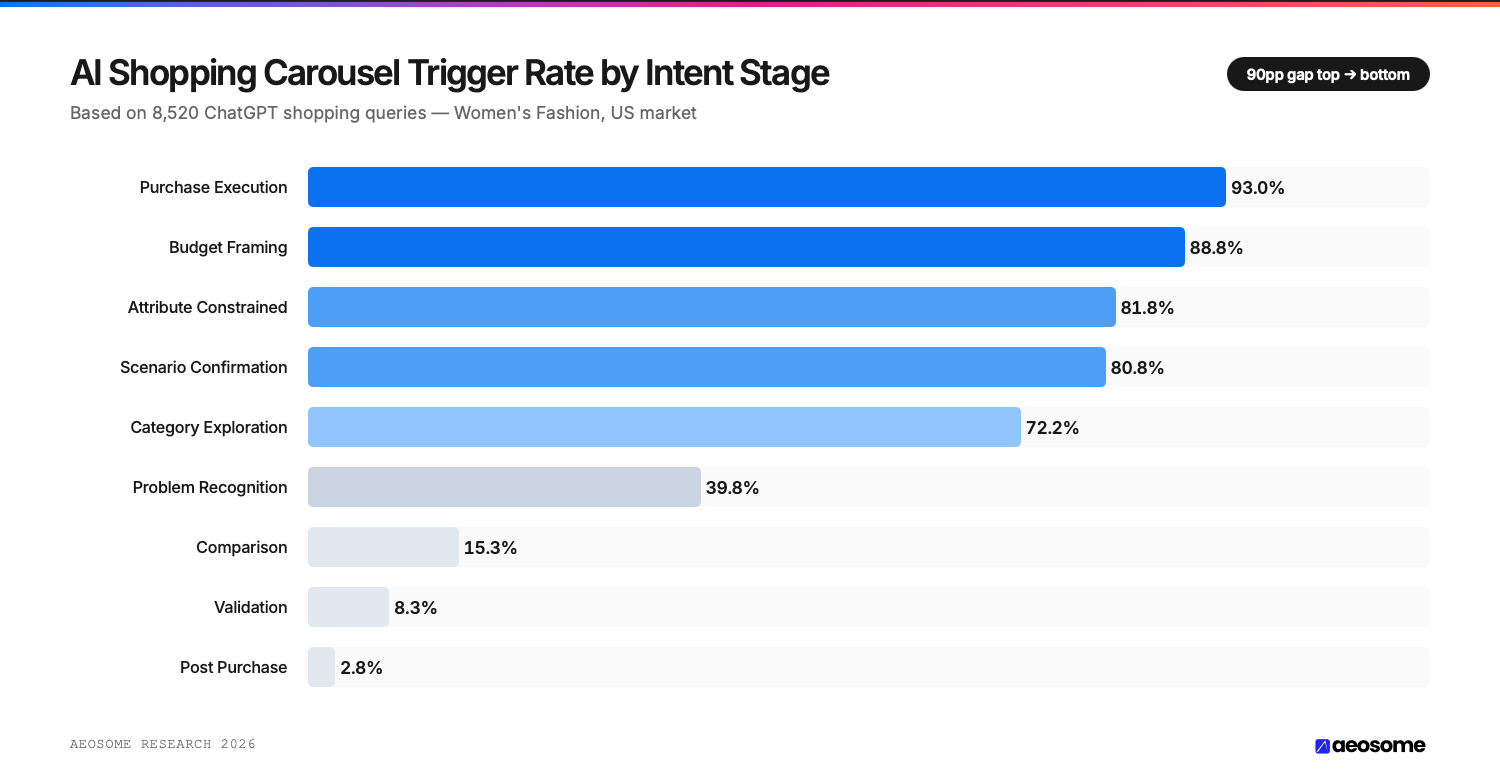
| Intent Stage | Trigger Rate | What AI Does | Example Query |
|---|---|---|---|
| Purchase Execution | 93.0% | Shows products immediately, optimized for conversion | "Where can I buy a midi dress under $100?" |
| Budget Framing | 88.8% | Surfaces price-filtered product sets | "Best dress under $150?" |
| Attribute Constrained | 81.8% | Matches specific product attributes | "I need a floral, knee-length dress" |
| Scenario Confirmation | 80.8% | Recommends products for a specific use case | "Best dress for a beach wedding?" |
| Category Exploration | 72.2% | Shows broad product selection | "What are some reliable dress options?" |
| Problem Recognition | 39.8% | Gives informational answer, occasionally shows products | "I need something to wear to an event next week" |
| Comparison | 15.3% | Provides editorial comparison, rarely shows carousel | "ASOS vs Reformation for summer dresses?" |
| Validation | 8.3% | Answers trust questions informationally | "Is Reformation worth it?" |
| Post Purchase | 2.8% | Almost never shows products | "How do I style a wrap dress?" |
The gap between Purchase Execution (93.0%) and Post Purchase (2.8%) is 90 percentage points. This is the single most important finding in the dataset. The intent behind a query determines whether AI shows products at all — before any other factor comes into play.
What this means for your content strategy
If your content targets Comparison or Validation queries ("Brand X vs Brand Y," "Is Brand X worth it?"), AI will almost never show a product carousel alongside it. These queries are answered editorially. Your content may be cited — but products will not be displayed.
If your content targets Budget Framing, Attribute Constrained, or Purchase Execution queries, AI shows products 81-93% of the time. This is where product visibility is won or lost.
The 5 Signals That Make AI Show Your Products
Our analysis identified specific commercial signals in shopping queries that dramatically affect whether AI displays product recommendations. These are the triggers ecommerce merchants need to understand and optimize for.
Signals that increase product recommendations
| Signal | Effect on Carousel Trigger Rate | Example |
|---|---|---|
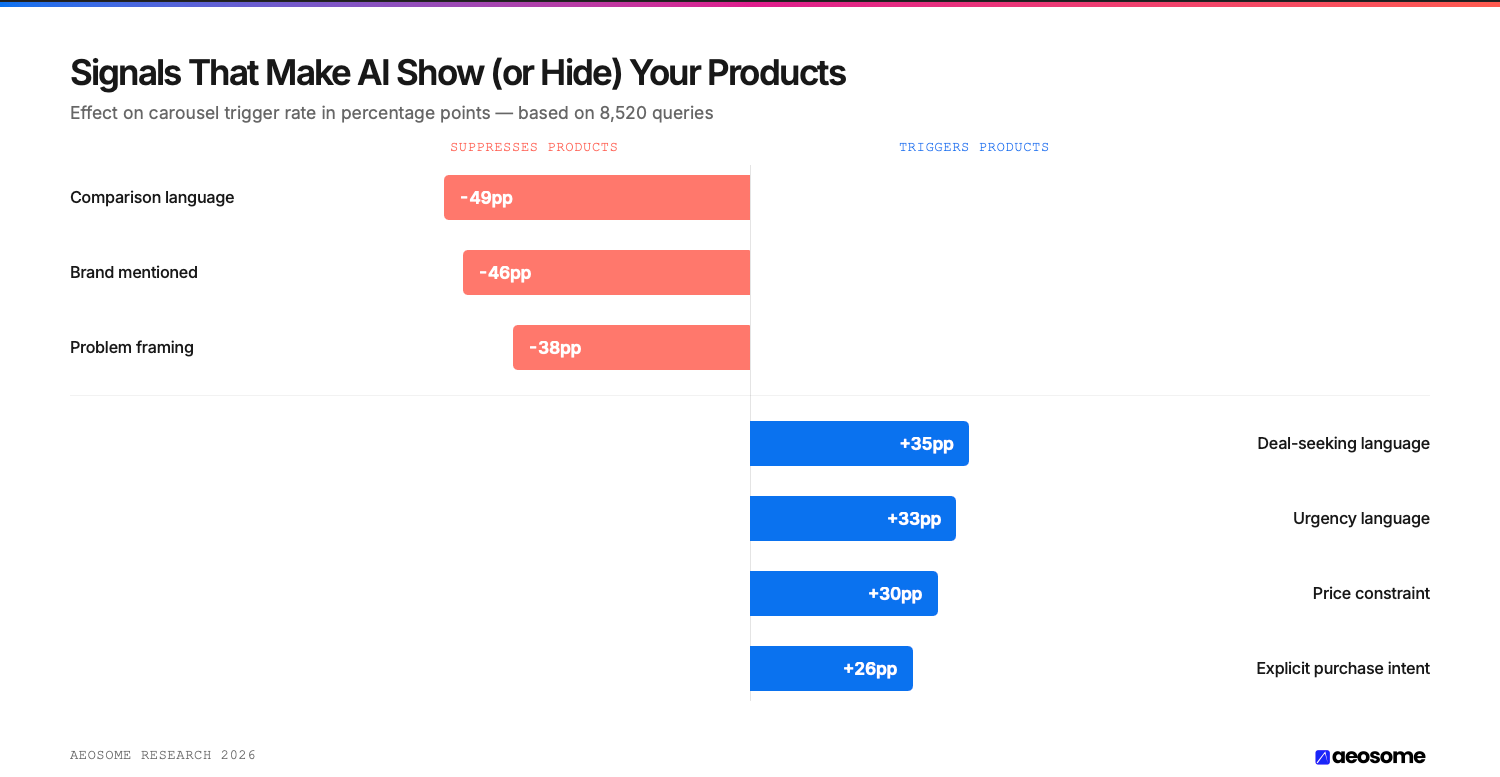
| Deal-seeking language | +35 percentage points | "best deal on summer dresses," "cheapest option" |
| Urgency language | +33 percentage points | "need a dress today," "fast delivery" |
| Price constraint | +30 percentage points | "dresses under $100," "budget-friendly" |
| Explicit purchase intent | +26 percentage points | "where to buy," "purchase online" |
| Multiple product attributes | +29 percentage points (at 5 attributes) | "floral, knee-length, cotton, under $150, machine washable" |
Signals that suppress product recommendations
| Signal | Effect on Carousel Trigger Rate | Why |
|---|---|---|
| Naming a specific brand | -46 percentage points | AI switches to informational mode about that brand |
| Comparison language | -49 percentage points | AI provides editorial comparison instead of product carousel |
| Problem framing | -38 percentage points | AI tries to solve the problem before recommending products |
In our analysis of 8,520 queries, deal-seeking and urgency signals each independently pushed carousel trigger rates above 90%. Combined, they did not add further — each alone was sufficient to signal purchase readiness to the AI.
The brand paradox
This finding is counter-intuitive and critical: when a shopper names a specific brand in their query, AI shows fewer products and concentrates results on that single brand.
- Without a brand name: AI shows an average of 7.18 unique brands per carousel
- With a brand name: AI shows an average of 2.81 unique brands, with the named brand occupying 68% of all product slots
If your competitor's brand is the one shoppers are naming, ChatGPT is showing their products almost exclusively. Brand share of voice in queries directly drives product carousel share of voice.
What Content Structure Gets Cited by AI
AI systems cite content from specific domains in predictable patterns. Understanding these patterns reveals where your optimization efforts will have the most impact.
Retail websites dominate AI citations across every intent stage, accounting for 89-99% of all source citations. Brand-owned websites appear as citations only during Comparison (6.1%), Validation (4.4%), and Purchase Execution (3.7%) queries — the stages where trust and authority matter most. This lines up with a broader pattern independent researchers have found in AI search generally: across the wider web, 80% of the sources ChatGPT, Gemini, and Copilot cite in answers don't rank anywhere in Google's top 10 for the same prompt (Ahrefs, 2025) — citation and classic organic ranking are measuring different things.
Pattern 1: Structured comparison pages
Why it works: AI systems extract structured comparisons more easily than narrative reviews. When a user asks "best X for Y," AI looks for content that directly maps products to criteria.
How to execute: Build pages with comparison tables, clear pros/cons per product, and explicit recommendations per use case. Wirecutter and CNET rank consistently in AI citations because their content is structured for extraction, not just reading.
Pattern 2: Attribute-rich product pages
Why it works: Our data shows a near-linear relationship between attribute count and carousel trigger rate. Queries with 5 product attributes trigger carousels 87.3% of the time versus 58.1% for queries with zero attributes. AI needs attributes to match products to queries.
How to execute: Ensure every product page includes complete specifications — material, dimensions, use cases, care instructions, compatibility, and variant details. The more structured attributes available, the more query types your product can match.
Pattern 3: Price-anchored content
Why it works: Budget Framing queries trigger carousels 88.8% of the time — the second-highest rate of any intent stage. Price is one of the strongest purchase intent signals AI recognizes.
How to execute: Create content organized by price tier: "Best [category] under $50 / $100 / $200." Include actual prices, not just vague value claims. AI extracts specific price points to match against budget-constrained queries.
Pattern 4: Scenario-specific guides
Why it works: Scenario Confirmation ("best dress for a beach wedding") triggers carousels 80.8% of the time. These queries combine use case with purchase intent — exactly the type of content AI loves to match products against.
How to execute: Build guides around specific occasions, use cases, or buyer profiles. "Best running shoes for flat feet," "Office dresses for summer," "Gift ideas for photographers under $200." Each guide should target one scenario with clear product recommendations.
Content Formats That Win in AI Search
Based on the research data, four content formats consistently align with the query types that trigger product recommendations.
Format 1: "Best [Product] for [Scenario]" Pages
- When to use: Targeting Scenario Confirmation and Attribute Constrained queries (combined 82% trigger rate)
- Structure: Introduction with key criteria, comparison table (product, price, best for, key feature), individual product sections with pros/cons, clear verdict per use case
- Example heading: "Best Summer Dresses for Beach Weddings: 12 Options by Budget and Style"
Format 2: Price-Tier Buying Guides
- When to use: Targeting Budget Framing queries (88.8% trigger rate)
- Structure: Price tier sections ($0-50, $50-100, $100-200, $200+), 3-5 products per tier with specifications, comparison table per tier, "best value" callout per section
- Example heading: "The Best Midi Dresses at Every Price Point (2026 Guide)"
Format 3: Product Attribute Matrices
- When to use: Targeting Attribute Constrained queries (81.8% trigger rate)
- Structure: Filter table with columns for every major attribute (material, size range, price, rating, use case), sortable format, each row links to full review
- Example heading: "Women's Dresses Compared: Material, Fit, Price, and Occasion Guide"
Format 4: Category Decision Guides
- When to use: Targeting Category Exploration queries (72.2% trigger rate)
- Structure: "What to look for" section, decision tree or flowchart, top picks by buyer profile (beginners, budget-conscious, quality-focused), FAQ section
- Example heading: "How to Choose the Right Dress: A Complete Decision Guide"
Mapping Content to the Customer Journey
The 9-stage intent framework maps directly to a content strategy across the full buying funnel. Each stage requires a different content approach.
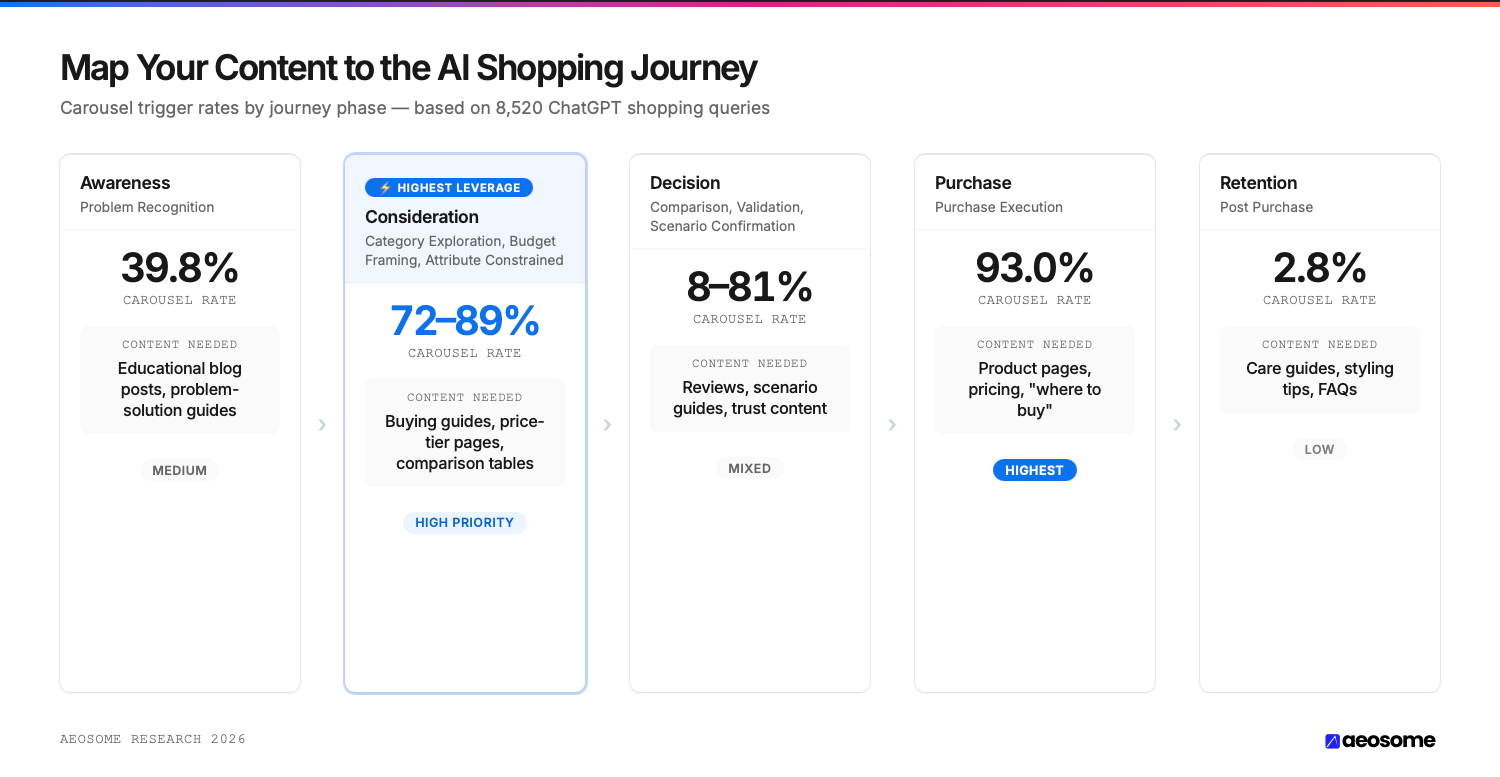
| Phase | Intent Stages | Carousel Rate | Content Strategy | Priority |
|---|---|---|---|---|
| Awareness | Problem Recognition | 39.8% | Educational blog posts, problem-solution content | Medium — builds authority for later-stage citations |
| Consideration | Category Exploration, Budget Framing, Attribute Constrained | 72-89% | Buying guides, comparison tables, price-tier pages | High — this is where product visibility peaks |
| Decision | Comparison, Validation, Scenario Confirmation | 8-81% | Reviews, brand comparisons, scenario-specific guides | Mixed — Scenario Confirmation is high-value; Comparison/Validation are editorial |
| Purchase | Purchase Execution | 93.0% | Product pages, "where to buy" content, pricing pages | Highest — 93% carousel rate, direct conversion |
| Retention | Post Purchase | 2.8% | Care guides, styling tips, FAQs | Low for product visibility; high for customer retention |
The Consideration phase (Category Exploration through Attribute Constrained) is the highest-leverage content opportunity for most ecommerce merchants. These stages combine high carousel trigger rates (72-89%) with broad reach — they capture shoppers who have not yet decided on a specific brand.
How to Get Your Products Recommended by AI: An Actionable Checklist
- Audit your product feed for completeness — ensure every SKU has a GTIN, full attribute set, accurate pricing, high-quality images, and structured schema markup (JSON-LD product schema at minimum)
- Add comparison tables to your top category pages — AI extracts tables more efficiently than paragraphs; include price, rating, key features, and "best for" columns
- Create price-tier buying guides — Budget Framing queries trigger carousels 88.8% of the time; organize content by price bracket with specific product recommendations
- Build scenario-specific product pages — target "best X for Y" queries with structured content mapping products to use cases, occasions, and buyer profiles
- Include pros and cons for every product recommendation — AI systems favor balanced evaluations over promotional content; cover multiple products, not just your own
- Maximize product attributes — each additional attribute increases carousel trigger probability; aim for 3+ structured attributes per product (material, size, use case, price tier, care instructions)
- Implement FAQ sections with natural language questions — phrase questions exactly as a shopper would ask an AI assistant; keep answers to 2-4 direct sentences
- Add structured data markup — implement Product, FAQ, and HowTo schema where applicable; these are machine-readable signals that AI systems use during answer construction
- Monitor your AI visibility by intent stage — track which query types surface your products and which do not; prioritize Budget Framing, Attribute Constrained, and Purchase Execution stages
- Update content quarterly with current pricing and availability — AI systems prioritize fresh, accurate data; stale prices or out-of-stock products reduce recommendation likelihood
Methodology
This analysis is based on 8,520 shopping intent queries executed against ChatGPT (gpt-5-mini), covering all 9 intent stages and 5 query styles across the Women's Fashion category in the US market. Data was collected in February 2026. The study measured carousel trigger rates, product diversity, brand concentration, citation patterns, and response behavior across all query types.
Query styles varied phrasing (direct question, conversational, comparative, constraint-first, and scenario-first) within each intent stage to avoid overfitting the findings to one way of asking. Carousel trigger rate is the share of queries in a given stage or condition for which ChatGPT rendered a product carousel rather than a text-only answer; brand diversity is the average count of distinct brands appearing across triggered carousels for a given condition. The 9-stage intent framework itself is AEOsome's own classification, built from how the 8,520 queries clustered by underlying intent; the stage definitions generalize across ecommerce categories, but the specific percentages reported above reflect this dataset (Women's Fashion, US, ChatGPT) and should be read as evidence from this study rather than a category-independent constant.
Frequently Asked Questions
How does ChatGPT choose which products to recommend?
ChatGPT evaluates product feed data, structured attributes, pricing, ratings, and content relevance to determine which products match a user's query. In our analysis of 8,520 shopping queries, the single strongest predictor was the intent stage of the query — Purchase Execution queries triggered product carousels 93% of the time, while Post Purchase queries triggered them less than 3% of the time. Products with complete attributes, accurate pricing, and proper schema markup are significantly more likely to appear.
What is Answer Engine Optimization (AEO)?
Answer Engine Optimization is the discipline of optimizing content and product data so that AI answer engines — ChatGPT, Perplexity, Claude, Gemini — recommend your products in response to natural language queries. Unlike traditional SEO, which focuses on keyword rankings and backlinks, AEO focuses on feed compliance, structured data, attribute completeness, and entity consistency. It is the AI-era equivalent of search engine optimization for product discovery.
How can ecommerce stores optimize for AI search?
Start with product feed completeness: GTINs, full attribute sets, accurate pricing, and JSON-LD product schema. Then build content that matches high-carousel-trigger intent stages — buying guides organized by price tier, scenario-specific product pages, and comparison tables with structured pros and cons. In our research, queries with 5 product attributes triggered product carousels 87.3% of the time versus 58.1% for queries with zero attributes.
What is the difference between SEO and AEO for ecommerce?
SEO optimizes for search engine rankings — keyword targeting, backlink building, and page authority. AEO optimizes for AI recommendations — product feed compliance, structured data, and content that AI can extract and cite. The key difference is output: SEO produces ranked links, while AEO produces product carousels, direct answers, and in some cases, autonomous purchases. Both matter, but AEO captures a growing share of high-intent shopping traffic as more consumers use AI assistants for product discovery.
What content format gets cited most by AI for shopping queries?
Structured comparison content — tables with clear columns for price, features, pros/cons, and "best for" designations — is the most extractable format for AI systems. In our data, retail websites account for 89-99% of all AI citations across every intent stage. Brand-owned websites only appear as citations during Comparison (6.1%), Validation (4.4%), and Purchase Execution (3.7%) queries. Content structured for extraction outperforms narrative-style reviews.
Does naming a brand in an AI shopping query help or hurt product visibility?
Naming a brand significantly narrows the AI's response. In our dataset, queries that included a brand name had a 21.1% carousel trigger rate versus 66.6% for unbranded queries — a 46 percentage point drop. When a carousel did appear, brand diversity collapsed from 7.18 average unique brands to 2.81, with the named brand occupying 68% of product slots. For merchants, this means unbranded category queries are where the widest competitive opportunity exists.
Summary
- Primary finding: Intent stage is the single strongest predictor of AI product recommendations — a 90 percentage point gap between the best- and worst-performing stages
- Best content type: Structured comparison pages with price tiers, product attribute tables, and scenario-specific recommendations
- Key triggers: "best deal," "under $X," "buy," "today," "best [product] for [scenario]"
- Required structure: Comparison table + pros/cons + FAQ section + structured schema markup
- Quick win: Add comparison tables with price, rating, and "best for" columns to your top 10 category pages — these are the most extractable content format for AI systems
About the author. Vijaya Kumar Channalli is a serial SaaS founder and the founder of AEOsome (Tartu, Estonia), which helps eCommerce brands get their products recommended when shoppers ask AI what to buy. He designed the 8,520-query ChatGPT shopping-intent research methodology and the nine-stage intent framework behind this study, and writes about AI shopping visibility, product feeds, and how Answer Engine Optimization differs from SEO. More at vijay.cc.
Sources: AEOsome Research, 2026 (8,520-query ChatGPT shopping-intent study, Women's Fashion category, US, gpt-5-mini, February 2026); eMarketer, The State of AI Shopping Assistants (June 2026); Digital Commerce 360 / Adobe Analytics, generative AI holiday shopping traffic (January 2026); Ahrefs, AI search overlap study (2025); Search Engine Land, ChatGPT shopping carousel source analysis (March 2026).