What Is the AI Shopping Customer Journey?
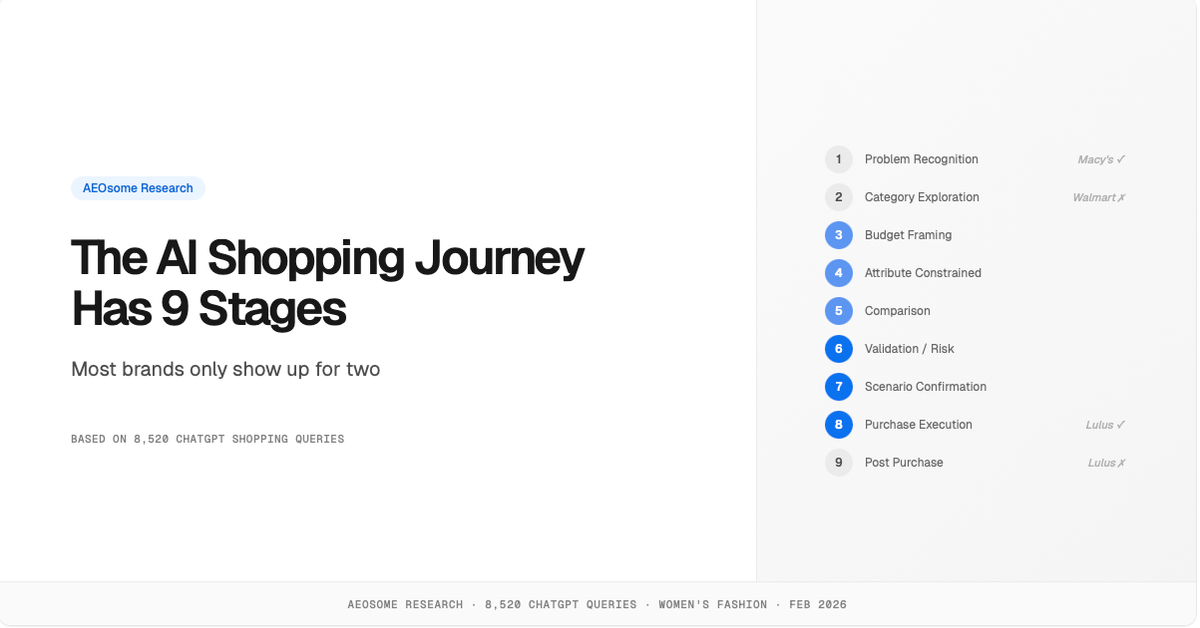
AI search has 9 intent stages. Each drives different carousel rates and brand outcomes. Most brands show up for just two. Here's what it takes to appear across all 9.

A merchant on r/ecommerce put it plainly: "Page 1 for every product category. ChatGPT recommends our competitors in every single one."
That post got a lot of upvotes — because it describes something a lot of ecommerce brands are quietly experiencing. Strong SEO. Solid rankings on Google. Products people actually buy. And yet, when a customer asks ChatGPT, Perplexity, or Google AI Mode to recommend a dress, a skincare product, or a pair of running shoes, a competitor appears and they don't.
The instinct is to blame product data or schema markup. Sometimes that's the culprit. But there's a deeper structural problem most brands haven't considered: they're only trying to appear at one or two stages of a nine-stage customer journey.
AI search doesn't work like a keyword match. It responds to intent, and ecommerce shopping intent breaks into nine distinct stages, from Problem Recognition to Post Purchase. Each stage triggers a different AI response and a different carousel rate. Most brands are built to win one or two of the nine — usually Budget Framing and Purchase Execution — and are structurally invisible for the rest.
Key Takeaways
- Across 8,520 real ChatGPT shopping queries (Women's Fashion > Dresses, US, February 2026), carousel trigger rates ranged from 2.8% at Post Purchase to 93.0% at Purchase Execution (AEOsome Research, 2026).
- Comparison queries almost never trigger a product carousel (15.3%) and instead get a prose answer naming an average of just 3.28 brands — a narrower shortlist than any other stage (AEOsome Research, 2026).
- Walmart shows up in 32.3% of Budget Framing carousels but only 5.2% of Category Exploration carousels — a 6.2x gap the post calls the "Budget Trap" (AEOsome Research, 2026).
- Independent research corroborates that AI surfaces show products selectively, not universally: Google AI Mode displays products on just 23% of shopping queries (versus 88% for standard Google search), with only 0.8% overlap in which products appear across the two (Productrise, 2026).
- 80% of the sources ChatGPT, Gemini, and Copilot cite in answers don't rank anywhere in Google's top 10 for the same prompt (Ahrefs, 2025) — a large part of why page-one Google rankings don't automatically carry over to AI visibility.
- About 80 million US consumers are expected to use generative AI platforms for shopping in 2026, and AI-referred traffic to US retail sites rose 693% year-over-year over the 2025 holiday season (eMarketer, 2026; Adobe Analytics via Digital Commerce 360, 2026).
What is the ecommerce customer journey in AI search?
In traditional SEO, the customer journey was loosely mapped to query types: informational, navigational, transactional. You created content for each and hoped to intercept the right searcher at the right moment.
In AI search, the journey is more granular and more consequential. When a customer asks ChatGPT a question, the AI isn't just returning results — it's synthesizing an answer based on what it knows about the query's intent. A customer asking "what should I look for in a dress that doesn't wrinkle?" gets a completely different type of response than a customer asking "best midi dress under $100." Different format, different brands mentioned, different commercial signals triggered.
The implication: your brand's AI visibility isn't a single number. It's nine different numbers — one for each intent stage — and most brands have never measured them.
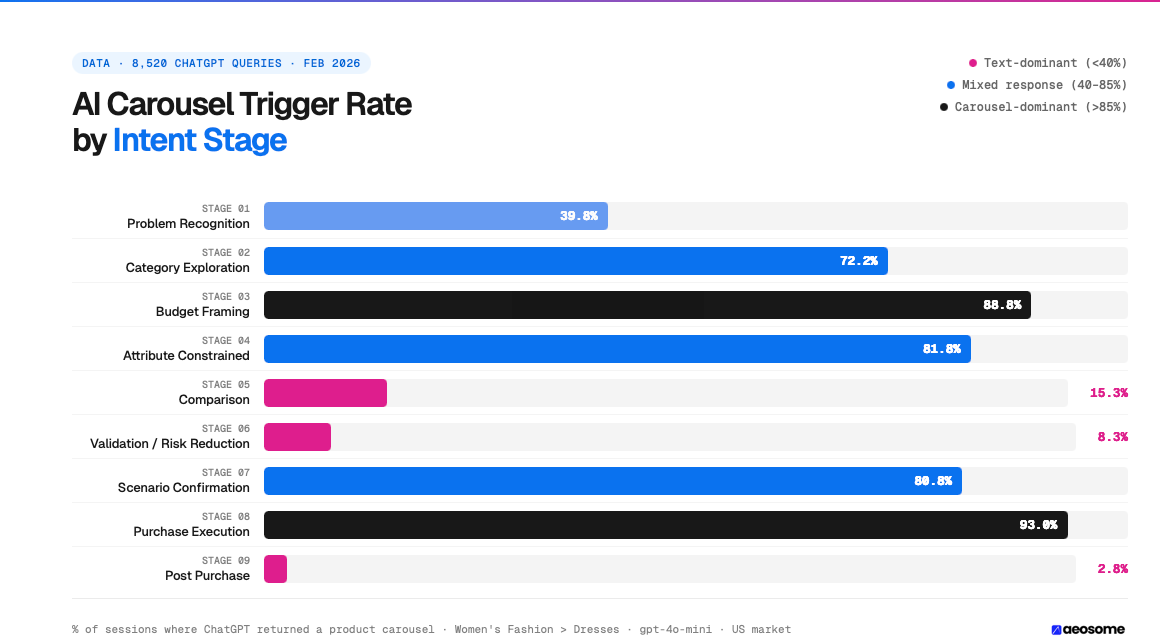
Citation Capsule: AI shopping visibility is not one score. It's nine stage-specific outcomes — one per intent stage — and a brand can dominate Purchase Execution (93.0% carousel trigger rate) while being nearly invisible at Post Purchase (2.8%) in the same dataset (AEOsome Research, 2026).
The 9 Shopping Intent Stages in AI Search
Based on our research across 8,520 ChatGPT queries, every ecommerce shopping query falls into one of nine behavioral intent stages. These aren't theoretical — they're derived from how real customers actually phrase questions to AI assistants.
Stage 1: Problem Recognition
The customer hasn't decided to buy anything yet. They have a problem, a frustration, or a need they're trying to articulate.
"My dress keeps wrinkling after washing. What should I look for instead?" "I never feel comfortable in what I wear to work. Where do I start?"
This is the earliest possible point of influence — before the customer even knows what category they're shopping in. Brands that appear here shape the entire journey that follows.
AI behavior: Product carousels are triggered only 39.8% of the time at this stage. The AI mostly responds with educational content — fabric guides, fit advice, occasion tips. Brands mentioned in that content become part of the customer's mental shortlist before any comparison has begun.
Stage 2: Category Exploration
The customer knows what they're looking for broadly but hasn't applied any constraints.
"What are some reliable dress options for everyday wear?" "What types of summer dresses are most popular right now?"
This is discovery mode. The customer is open to any brand, any price point, any style. Carousel trigger rate climbs to 72.2% — more than double the Problem Recognition rate.
AI behavior: Brands with broad catalog coverage and well-structured product data appear most frequently here. This is where consideration sets form.
Stage 3: Budget Framing
Price becomes the primary filter. The customer is still open about style but has defined what they're willing to spend.
"Best dress under $100?" "What are good quality dresses in the $50–$150 range?"
Budget Framing is a commercial signal the AI reads clearly. Carousel trigger rate jumps to 88.8%. Brands whose product data cleanly maps to price brackets dominate.
AI behavior: Price data quality matters enormously here. Brands with inconsistent, stale, or missing price data are filtered out regardless of brand recognition.
Stage 4: Attribute Constrained
The customer specifies two or more product attributes alongside a category.
"I need a floral, knee-length dress in cotton." "Looking for a wrap dress that's suitable for an office setting."
This is the most data-dependent stage. The AI is matching product attributes to query attributes. Carousel trigger rate reaches 81.8%.
AI behavior: Products with complete attribute coverage — material, occasion, fit type, care instructions — match these queries. Products without them don't appear, regardless of how well the brand performs elsewhere.
Stage 5: Comparison
The customer is weighing two or more specific options against each other.
"ASOS versus Reformation for summer dresses — which is better?" "Lulus vs. Nordstrom: where do I get better quality for the price?"
Comparison intent is the most misunderstood stage. Carousel trigger rate drops sharply to just 15.3% — the AI usually answers in prose rather than product listings. But when it does surface products, brand diversity collapses to an average of 3.28 unique brands. The AI is making a recommendation, not showing a catalog.
AI behavior: Getting a favorable text mention at this stage — "Brand X has stronger fabric quality at this price point" — may be more valuable per mention than appearing in any product carousel. Brand-owned content (product pages, editorial, FAQs) is cited 6.1% of the time at this stage, the highest of any intent type.
Stage 6: Validation / Risk Reduction
The customer has a brand or product in mind but wants reassurance before committing.
"Is Reformation worth the price?" "Are Lulus dresses good quality or do they fall apart quickly?"
This is the trust stage. The customer is one positive signal away from buying — or one negative signal away from walking. Carousel trigger rate is only 8.3%, meaning the AI almost exclusively answers in text.
AI behavior: Brand-owned content, review data, and editorial coverage all influence what the AI says here. A brand that has no authoritative content addressing quality questions is effectively leaving this stage to chance.
Stage 7: Scenario Confirmation
The customer has a specific use case and wants to confirm which option fits best.
"Best dress for a beach wedding that isn't too formal?" "What should I wear to a garden party in summer — smart casual?"
Scenario Confirmation is high-intent and highly specific. Carousel trigger rate is 80.8%. The AI is matching product attributes to a real-world context, not just a keyword.
AI behavior: Brands with rich occasion and use-case tagging in their product data match these queries reliably. Brands without occasion metadata are structurally excluded.
Stage 8: Purchase Execution
The customer is ready to buy. They want to know where, how, and at what price.
"Where can I buy a Lulus midi dress online?" "Buy floral wrap dress under $80 — where's the best option right now?"
This is the stage most brands focus on — and it does have the highest carousel trigger rate of any intent: 93.0%. But optimizing for this stage alone assumes the customer already knows your brand. If they don't, they're not asking for you here.
AI behavior: Urgency signals ("right now", "today"), deal language ("best deal", "cheapest"), and explicit purchase language ("buy", "where to purchase") each add 25–35 percentage points to carousel trigger probability.
Stage 9: Post Purchase
The customer has already bought and needs help — styling advice, care instructions, return guidance, or complementary items.
"How do I style a wrap dress for different occasions?" "How do I wash a silk dress without ruining it?"
Carousel trigger rate is just 2.8% — the AI answers almost entirely in text. But this stage is not commercially irrelevant. Customers who receive useful post-purchase guidance from a brand's AI presence are building loyalty that feeds back into the next purchase cycle.
AI behavior: Long-form content about product care, styling, and fit performs best here. Brands with this content establish themselves as the authority — which influences future recommendations.
The Journey in Practice: How a Real Customer Moves Through All Nine Stages
Consider a customer who starts by asking ChatGPT: "My dresses always look wrinkled by midday. What fabrics should I look for?"
That's Stage 1. The AI recommends polyester blends, ponte, and jersey knit — and mentions several brands whose dresses are made from these materials. The customer notes two or three names.
She comes back a few days later: "What are some reliable everyday dress options?" — Stage 2. The AI surfaces a broader set of brands, but the ones mentioned in Stage 1 already feel familiar.
Next: "Best midi dresses under $100?" — Stage 3. The price filter narrows the field. Brands with clean pricing data in that range appear.
Then: "I need a midi dress that's floral, knee-length, and machine washable." — Stage 4. Attribute matching. Only brands with complete product data make it through.
Later: "Lulus versus Nordstrom for everyday dresses — which is better quality?" — Stage 5. By now, Lulus has appeared at multiple prior stages. It's already in the customer's mental model. This comparison query isn't starting from scratch — it's resolving a preference the customer has been building since Stage 1.
Finally: "Where can I buy Lulus floral midi dress?" — Stage 8. Purchase intent. The brand winning here almost certainly won earlier.
This is why stage-by-stage visibility matters. Purchase Execution is where the conversion happens. But the decision was made across the seven stages that came before it.
Three Real Brands. Three Different Journey Profiles. One Clear Lesson.
We analyzed brand visibility across all nine intent stages using our 8,520-query ChatGPT dataset — the same dataset behind our full brand visibility research. The results reveal three fundamentally different patterns.
Macy's: The Full-Funnel Retail Platform
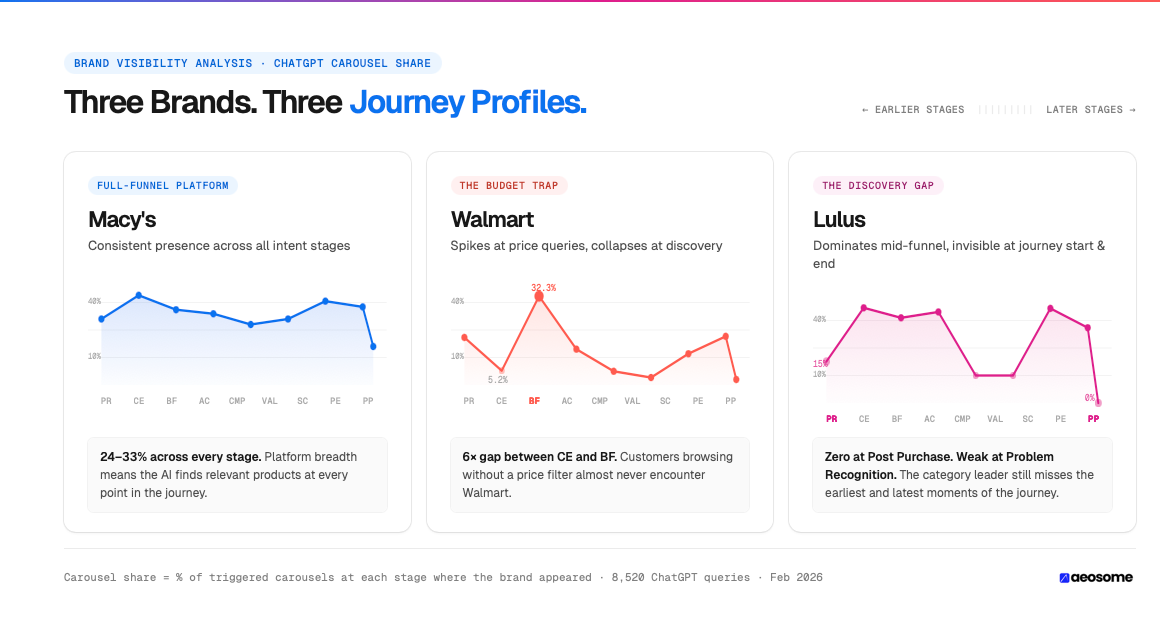
Macy's appears as a product source in 24–33% of carousels across every intent stage from Problem Recognition through Purchase Execution. These are products from hundreds of brands listed on macys.com — not Macy's private-label products specifically. But the distribution illustrates what consistent, even coverage across intent stages looks like.
| Intent Stage | Macy's Carousel Share |
|---|---|
| Problem Recognition | 24.0% |
| Category Exploration | 32.6% |
| Budget Framing | 27.6% |
| Attribute Constrained | 25.9% |
| Validation / Risk Reduction | 24.0% |
| Scenario Confirmation | 30.5% |
| Purchase Execution | 28.4% |
This is what full-funnel AI platform presence looks like. Whether a customer is recognizing a problem for the first time or finalizing a purchase, Macy's-hosted products are present. No single intent stage is dramatically weaker than another.
The even distribution reflects platform breadth — Macy's carries products across multiple tiers and occasions, so its inventory matches almost every query type. Compare this to Zara, which appears in fewer than 3% of carousels at most intent stages (100 unique sessions out of 5,072 triggered). Zara's one exception is Comparison queries, where it reaches 10.1% — suggesting ChatGPT recognizes the brand but does not consistently source its products through structured feeds. Brand recognition and AI carousel presence are not the same thing. The reason is catalog coverage, consistent price data across multiple tiers, and attribute completeness at SKU level. These are the inputs the AI reads regardless of how famous the brand is offline.
That's consistent with what independent research has found about where ChatGPT's shopping carousel actually pulls from: one analysis of 43,000 ChatGPT carousel products found 83% matched products already in Google's top-40 Shopping results, versus only 11% overlap with Bing (Search Engine Land, 2026). The carousel is drawing on structured Shopping-feed data, not classic organic rank — which is exactly why a brand's page-one Google organic position doesn't predict its carousel presence, but its Merchant Center feed quality does.
Walmart: The Budget Trap
Walmart's pattern looks nothing like Macy's.
| Intent Stage | Walmart Carousel Share |
|---|---|
| Problem Recognition | 17.3% |
| Category Exploration | 5.2% |
| Budget Framing | 32.3% |
| Attribute Constrained | 13.0% |
| Validation / Risk Reduction | 2.7% |
| Scenario Confirmation | 11.4% |
| Purchase Execution | 17.7% |
The spike at Budget Framing (32.3%) is comparable to Macy's. But Category Exploration collapses to 5.2% — a 6.2x gap between the two stages. When a customer is just browsing dresses without any price filter, Walmart barely exists in AI search. The moment they add a price constraint, Walmart appears at full strength.
Walmart has one of the largest fashion catalogs in the US. But customers who don't open with price language — who are still exploring, still forming preferences — almost never encounter Walmart in ChatGPT's recommendations. Their consideration set closes before Walmart enters it.
This is the Budget Trap: appearing only when price is the explicit trigger, and being invisible for everything that happens before the customer knows what they want.
Lulus: The Discovery Gap
Lulus is the most carousel-present brand in our entire dataset — appearing in more unique shopping sessions than any other brand across 5,072 triggered carousels. And yet, the intent-stage breakdown reveals a structural gap.
| Intent Stage | Lulus Carousel Share |
|---|---|
| Problem Recognition | 15.1% |
| Category Exploration | 34.6% |
| Budget Framing | 31.0% |
| Attribute Constrained | 33.1% |
| Scenario Confirmation | 34.4% |
| Purchase Execution | 27.4% |
| Post Purchase | 0.0% |
Lulus dominates mid-funnel and late-funnel. Its Category Exploration (34.6%), Budget Framing (31.0%), Attribute Constrained (33.1%), and Scenario Confirmation (34.4%) shares are comparable to Macy's platform numbers. But Problem Recognition drops to 15.1% — nearly half Macy's 24.0% at the same stage. And Post Purchase is zero.
The implication: customers whose journey begins with a problem — not a browse, not a budget search, not a scenario — are significantly less likely to encounter Lulus before they form their consideration set. By the time they reach the middle stages where Lulus excels, the window for early influence has already closed.
For the category leader, this is still a meaningful gap. For a brand with lower mid-funnel presence, the equivalent gap at Problem Recognition isn't a nuance — it's a structural exclusion from the journey before it begins.
Why Most Ecommerce Brands Have This Problem
The pattern we see across Walmart and Lulus — and dozens of other brands in the dataset — isn't random. It follows directly from how ecommerce brands have historically thought about digital marketing.
SEO content is largely transactional. Category pages, product pages, PDP optimization — these target buyers who are already mid-funnel. They don't address the person who's still articulating a problem.
Paid search follows purchase intent. You bid on "buy midi dress" and "best dress under $100" — the equivalent of Stage 8 and Stage 3. Nobody is running campaigns for "why does my dress wrinkle so quickly."
Product feeds are structured for purchase. Price, availability, images. Not fabric care, occasion context, or problem-solving framing. The attributes that make a product visible at Stages 1, 2, and 6 are almost entirely absent from standard commerce feeds.
The result is a brand that is well-resourced at the bottom of the funnel and essentially invisible at the top — which, in AI search, means the AI has no reason to include you when a customer first starts their journey.
As one r/ecommerce commenter put it when discussing this exact problem: "AI keeps recommending my competitors but not us — how to fix this?" The answer, in most cases, isn't technical. It's content and data coverage across intent stages that the brand has never deliberately addressed.
What Each Intent Stage Needs From Your Brand
Showing up across all nine stages isn't a single fix. Each stage requires a different type of signal.
| Intent Stage | What the AI needs from your brand |
|---|---|
| Problem Recognition | Informational content that connects your product category to customer problems. Care guides, fabric explainers, use-case educational content. |
| Category Exploration | Broad catalogue with consistent product data. Clean imagery, complete descriptions, structured metadata. |
| Budget Framing | Accurate, current pricing across your SKU range. Products at multiple price tiers. Clear price framing in product data. |
| Attribute Constrained | Attribute completeness: material, fit, occasion, care, colour. Every attribute is a potential match criterion. |
| Comparison | Brand-owned content that directly addresses "is this worth it" questions. Comparison content, editorial, transparent quality claims. |
| Validation / Risk Reduction | Review data, return policy clarity, quality guarantees. Third-party editorial coverage that the AI can cite. |
| Scenario Confirmation | Occasion and use-case tagging at SKU level. "Dress for a beach wedding" only matches if your product data says "beach", "wedding", or "outdoor occasion." |
| Purchase Execution | Retail distribution across high-citation domains (nordstromrack.com, nordstrom.com, windsorstore.com, lulus.com, target.com). Presence on these platforms multiplies citation surface area independently of your own site. |
| Post Purchase | Styling guides, care instructions, how-to content. Builds brand authority signals for future recommendations. |
Where Does Your Brand Actually Stand?
Here is the honest version of the question most ecommerce teams aren't asking: across all nine intent stages, at what share of relevant AI shopping responses does your brand appear?
Not your Google rank. Not your paid search impression share. Your AI carousel presence, broken down by intent stage, with the gaps made visible.
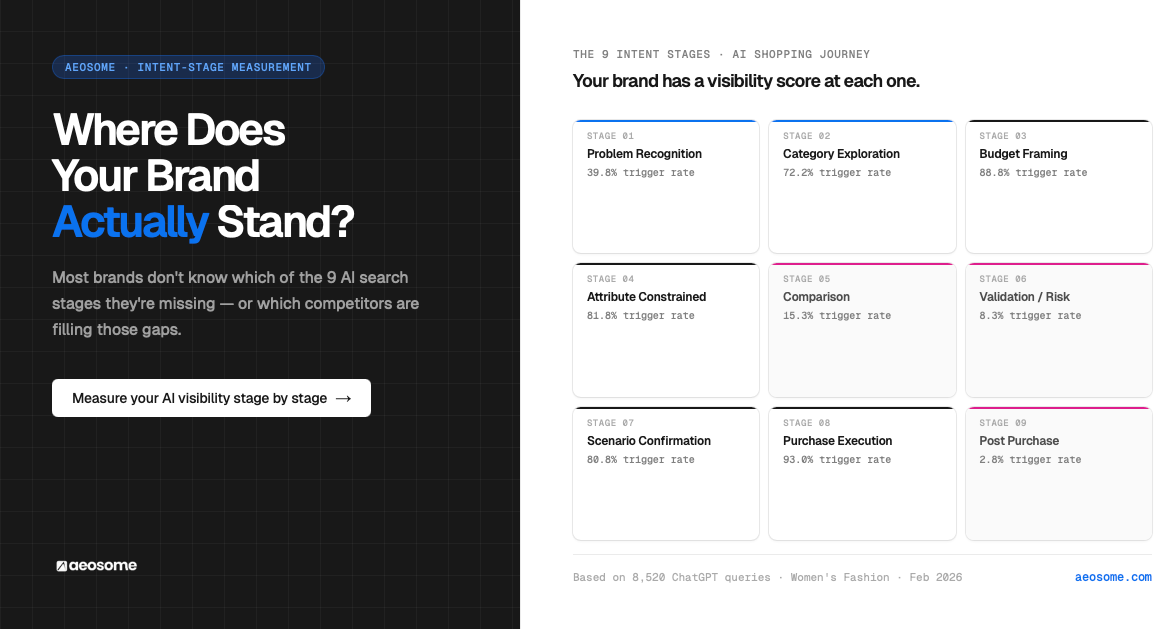
Most brands don't know this number. They know they're "not showing up on ChatGPT" in a general sense — the way the r/ecommerce merchant knew their competitors were appearing but they weren't. What they don't know is which stages they're missing, which competitors are filling those gaps, and which specific changes to product data or content would shift the picture.
This is exactly what AEOsome measures. AEOsome runs structured queries across all nine intent stages for your category, records every carousel response, and maps your brand's visibility stage by stage — the same methodology behind the 8,520-query research dataset this post is built on. The output isn't a generic "AI visibility score." It's a specific, intent-by-intent breakdown that shows you where you're present, where you're absent, and where your competitors are taking the customers you never reached.
If Walmart's data looked like what we showed above, they'd know exactly where to focus: Stage 2. If Lulus's team saw their Problem Recognition gap, they'd know that informational content addressing early-stage customer problems is the next lever to pull.
Your brand has the same profile. You just may not have measured it yet.
Methodology
This analysis draws on 8,520 ChatGPT shopping intent queries executed against gpt-5-mini in the US market, covering the Women's Fashion > Dresses category. Queries were distributed across all nine intent stages and five query styles. Brand carousel share figures represent the percentage of triggered product carousels at each intent stage in which the brand appeared, normalized for differences in trigger rate and query volume across stages. Data was collected in February 2026.
The nine-stage framework itself is AEOsome's own classification, built bottom-up from how the 8,520 queries actually clustered by intent, rather than borrowed from a pre-existing marketing funnel model. Applied here to one category (Women's Fashion > Dresses) and one AI platform (ChatGPT), the stage definitions — the behavioral pattern of a shopper moving from unstructured problem to structured purchase — generalize across categories; the specific carousel-trigger percentages and brand shares reported above do not, and should be treated as evidence from this dataset rather than an ecommerce-wide constant.
Frequently Asked Questions
What are the 9 shopping intent stages in AI search?
The nine stages are: Problem Recognition (customer has a problem, no product in mind), Category Exploration (browsing broadly), Budget Framing (price is the primary filter), Attribute Constrained (two or more specific product attributes), Comparison (evaluating brands or products directly), Validation / Risk Reduction (seeking reassurance before buying), Scenario Confirmation (matching a product to a specific use case), Purchase Execution (ready to buy), and Post Purchase (help after buying). These stages were derived from analysis of 8,520 real ChatGPT shopping queries across the Women's Fashion > Dresses category.
Can a brand have good SEO and still be invisible in AI search?
Yes — and this is one of the most consistent findings in AI search research. A brand can rank on page one of Google for every relevant category keyword and still fail to appear in ChatGPT or Perplexity recommendations. Across the wider web, 80% of the sources ChatGPT, Gemini, and Copilot cite don't rank in Google's top 10 for the matching prompt (Ahrefs, 2025). AI search prioritizes structured product data, attribute completeness, citation signals from retail domains, and content that directly addresses the query's intent — not keyword density or backlink counts. Brands built entirely on traditional SEO signals frequently have the AI visibility gaps described in this post.
Why does my brand only appear in ChatGPT when customers search by price?
This is the "Budget Trap" pattern. It usually means your product data is well-structured for price-constrained queries — pricing is clean, products fall clearly within common budget brackets — but your catalog lacks the attribute depth, occasion coverage, and informational content that would make it relevant at earlier intent stages. The fix is adding coverage upstream: content that addresses Stage 1 (Problem Recognition) and ensuring product metadata covers Stages 4 and 7 (Attribute Constrained and Scenario Confirmation).
Why is the Purchase Execution stage not enough to focus on?
Purchase Execution has the highest AI carousel trigger rate of any intent stage (93.0% in our dataset). But it only reaches customers who already know what they want — and often, who they want it from. A customer who types "where can I buy a Lulus midi dress" has already decided on Lulus. Optimizing only for Purchase Execution means you're visible to people who were already going to find you, and invisible to everyone still forming their preference. The decision happens at Stages 1 through 7. Stage 8 is just where it's executed.
What is AEO and how is it different from SEO for ecommerce?
Answer Engine Optimization (AEO) is the practice of ensuring your brand, products, and content are visible in AI-generated answers from tools like ChatGPT, Perplexity, Google AI Mode, and Copilot. Unlike SEO, which optimizes for ranking in a list of blue links, AEO optimizes for inclusion in synthesized recommendations where the AI selects a small set of brands to mention or show. For ecommerce, this means optimizing product data, attributes, pricing, and content across all nine intent stages — not just the purchase-oriented queries that traditional commerce SEO targets.
How do I know which intent stages my brand is missing in AI search?
Manual testing — asking ChatGPT variations of queries across all nine stages — gives a rough picture but doesn't scale and isn't consistent across runs. A structured measurement approach runs hundreds of intent-matched queries for your specific category, records the output, and maps your brand's appearance rate stage by stage against competitors. AEOsome's research methodology does this systematically, using the same framework behind the 8,520-query dataset referenced throughout this post. The output is an intent-stage breakdown showing exactly where your brand is present, where it's absent, and which competitors are filling the gaps.
About the author. Vijaya Kumar Channalli is a serial SaaS founder and the founder of AEOsome (Tartu, Estonia), which helps eCommerce brands get their products recommended when shoppers ask AI what to buy. He designed the nine-stage intent framework and the query methodology behind the 8,520-query dataset this post is built on, and writes about AI shopping visibility, product feeds, and how Answer Engine Optimization differs from SEO. More at vijay.cc.
Sources: AEOsome Research, 2026 (8,520-query ChatGPT shopping-intent study, Women's Fashion > Dresses, US, gpt-5-mini, February 2026; 5,072-carousel brand visibility analysis); eMarketer, The State of AI Shopping Assistants (June 2026); Digital Commerce 360 / Adobe Analytics, generative AI holiday shopping traffic (January 2026); Ahrefs, AI search overlap study (2025); Search Engine Land, ChatGPT shopping carousel source analysis (March 2026); Productrise, Google AI Mode product-visibility study (July 2026).