The Fashion Brands ChatGPT Recommends Most (5,072 Carousels Analyzed)
We analyzed 5,072 ChatGPT shopping carousels. The winner isn't Zara or ASOS — it's Lulus, a mid-size DTC brand. The pattern has nothing to do with brand recognition.

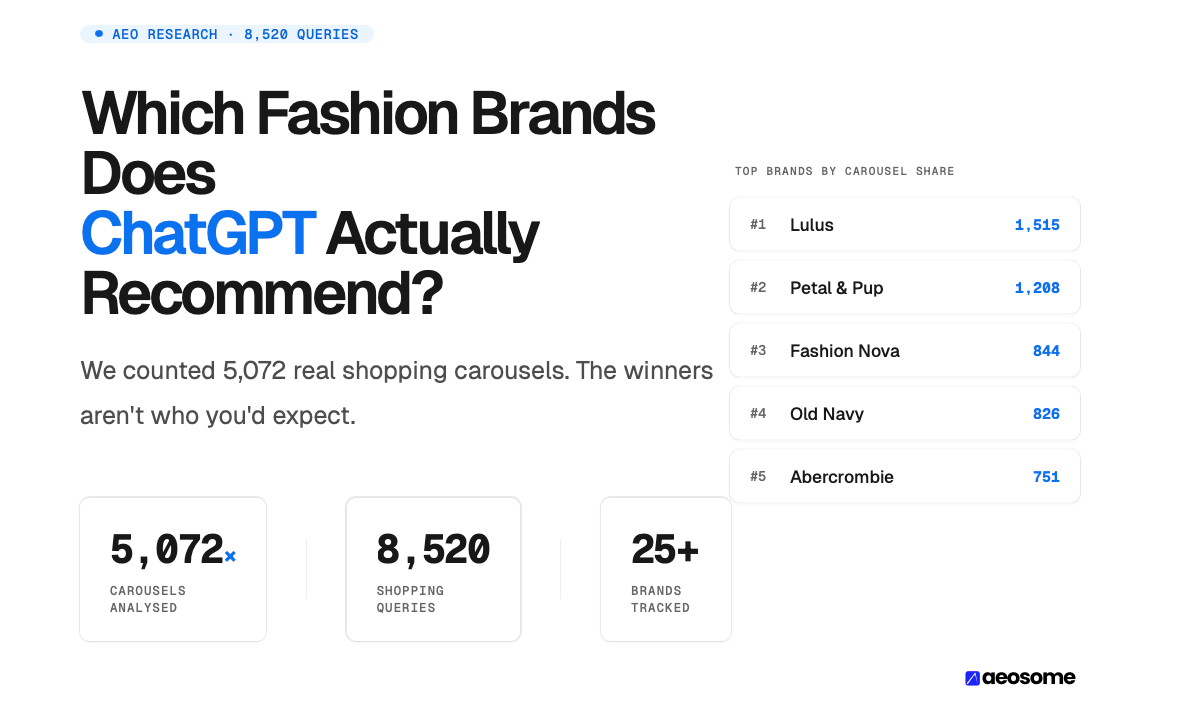
Everyone is talking about AI search. Very few people have looked at the actual data.
We ran 8,520 real shopping queries through ChatGPT and recorded every product carousel that appeared. Across those queries, ChatGPT triggered 5,072 product carousels — each one containing up to 8 products from real brands. We tracked every brand that appeared, how many carousels it showed up in, at what price point, and with what rating.
The results reveal a clear pattern: ChatGPT strongly favors DTC brands with direct-to-consumer product feeds. Department stores appear as product hosts, not as recommended brands.
Key findings from 5,072 ChatGPT shopping carousels:
- Lulus appears in more carousels than any other brand — 1,515 out of 5,072
- Fashion Nova ranks #3, appearing in 844 carousels at an average price of $32
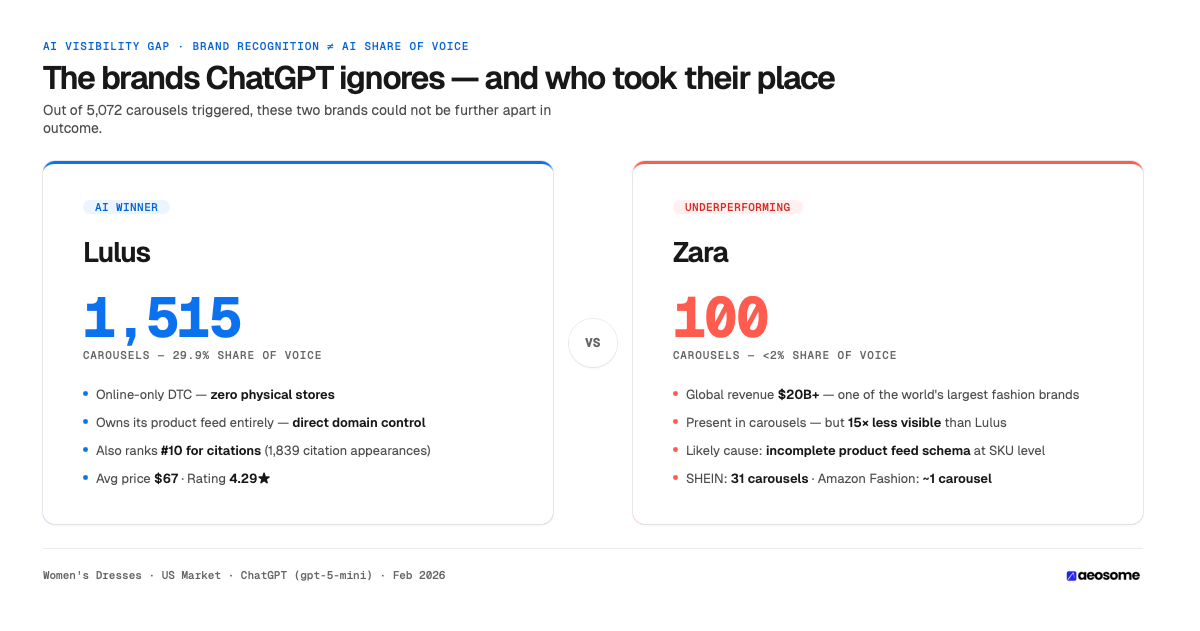
- Zara has 237 confirmed appearances across 100 carousels — visible, but dramatically underrepresented for its market size
- Alibaba is the single most-cited domain in ChatGPT shopping responses — ahead of Nordstrom, Lulus, and every US retailer
- Quince ranks #6 overall with the highest average customer rating of any top-10 brand (4.73 stars)
These are not estimates. They are counts derived directly from the raw JSONL dataset.
Methodology: How We Counted Brands
This distinction matters and is not in most published analyses.
Brand presence counts how often a product linking to a brand's own domain appeared in a carousel. When ChatGPT shows a Lulus dress and the product URL points to lulus.com, that is a confirmed Lulus appearance — Lulus made the product and owns the product page.
Retailer platform presence is a separate metric. When ChatGPT shows a Karen Kane dress and the product URL points to macys.com, the appearance counts toward Macy's as a platform — but Macy's is the retailer hosting that product, not the brand. Counting this as a "Macy's brand appearance" would be incorrect.
The tables below keep these two categories separate.
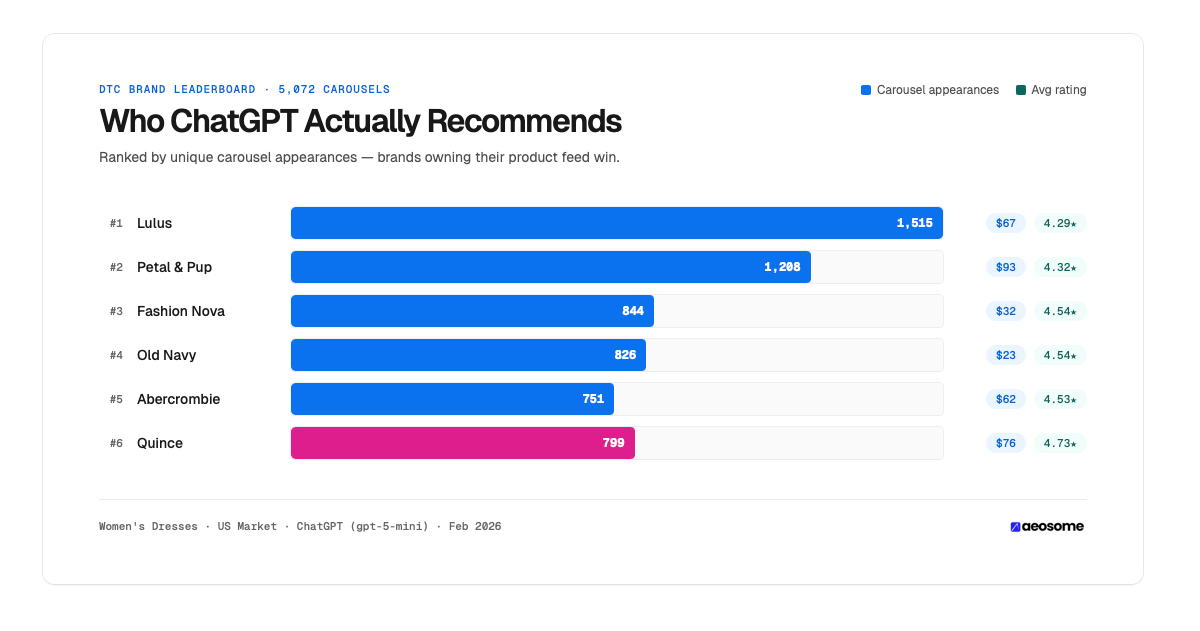
The DTC Brand Leaderboard: Who ChatGPT Recommends
The table below ranks brands whose products link to their own domain — meaning the brand controls the product page, the data, and the feed.
| Rank | Brand | Product Appearances | Carousels Present In | Avg Price | Avg Rating |
|---|---|---|---|---|---|
| 1 | Lulus | 1,940 | 1,515 | $67 | 4.29★ |
| 2 | Petal & Pup | 1,814 | 1,208 | $93 | 4.32★ |
| 3 | Fashion Nova | 1,058 | 844 | $32 | 4.54★ |
| 4 | Old Navy | 1,051 | 826 | $23 | 4.54★ |
| 5 | Abercrombie & Fitch | 924 | 751 | $62 | 4.53★ |
| 6 | Quince | 908 | 799 | $76 | 4.73★ |
| 7 | LOFT | 805 | 672 | $45 | 4.35★ |
| 8 | Ann Taylor | 801 | 700 | $84 | 4.34★ |
| 9 | H&M | 800 | 633 | $41 | 4.21★ |
| 10 | Express | 655 | 517 | $68 | 4.73★ |
| 11 | Windsor | 563 | 443 | $44 | 4.64★ |
| 12 | Baltic Born | 553 | 486 | $87 | 4.50★ |
| 13 | Ever-Pretty | 519 | 414 | $76 | 4.76★ |
| 14 | Gap | 508 | 459 | $72 | 4.53★ |
| 15 | Anthropologie | 450 | 323 | $157 | 4.38★ |
| 16 | Adrianna Papell | 430 | 382 | $163 | 4.39★ |
| 17 | Cupshe | 426 | 366 | $34 | 4.49★ |
| 18 | American Eagle | 413 | 351 | $40 | 4.58★ |
| 19 | ASOS | 351 | 250 | $103 | 4.20★ |
| 20 | Donna Karan | 342 | 311 | $177 | 4.60★ |
| 21 | Oh Polly | 313 | 258 | $112 | 4.84★ |
| 22 | JCPenney | 257 | 221 | $46 | 4.65★ |
| 23 | CIDER | 257 | 199 | $33 | — |
| 24 | Rihoas | 252 | 231 | — | 4.86★ |
| 25 | Mango | 240 | 138 | $61 | 4.24★ |
Note: This dataset covers Women's Fashion > Dresses queries only, US market, on ChatGPT (gpt-5-mini). Rankings reflect share of voice within this specific category and query set. "Appearances" = total product slots across all triggered carousels. "Carousels Present In" = unique queries in which the brand appeared at least once.
Retail Platforms: Where ChatGPT Sources Products
Beyond brand-owned pages, ChatGPT surfaces products from department stores and marketplaces. These platforms are product hosts — the brands on their pages may be different companies entirely. This table shows which retail platforms are being used as sourcing surfaces.
| Platform | Products Surfaced | Carousels Present | Avg Price | Avg Rating |
|---|---|---|---|---|
| Macy's | 1,940 | 1,408 | $108 | 4.48★ |
| Etsy | 1,937 | 1,259 | $106 | 4.62★ |
| Nordstrom | 1,521 | 1,200 | $144 | 4.49★ |
| Walmart | 1,672 | 827 | $23 | 4.46★ |
| Kohl's | 821 | 677 | $51 | 4.42★ |
| eBay | 362 | 207 | $90 | 4.53★ |
| Target | 394 | 313 | $39 | 4.37★ |
| Bloomingdale's | 296 | 278 | $190 | 4.42★ |
| Poshmark | 276 | 168 | $58 | 4.60★ |
What this means for brands: A brand whose products are listed on Macy's, Nordstrom, or Etsy gains additional surface area — ChatGPT can surface their products through the retailer's product page even if the brand's own domain isn't being cited. This is a multiplier effect, not a substitute for owning your own product feed.
The Surprises: Brands Nobody Expected to See Here
The DTC brands nobody saw coming
Four brands in the top 10 were founded after 2005 and have no significant physical retail presence. They are outranking companies that have existed for decades.
Lulus (#1) is an online-only women's fashion retailer with a focused dress catalogue. It appears in nearly 30% of all triggered carousels — more than any department store, any fast-fashion giant, and any brand with a physical store footprint.
Petal & Pup (#2) is an Australian-founded DTC women's fashion brand that sells exclusively online. It ranks above every specialty retailer except Lulus. Its average price is $93 — mid-market, not budget.
Quince (#6) launched in 2018 with a direct-to-manufacturer supply chain model. It averages $76 per dress and carries a 4.73-star average rating — the highest of any brand in the top 10. ChatGPT is not recommending Quince because of brand recognition. It is recommending it because the product data signals quality.
Fashion Nova (#3) ranks above Abercrombie, Gap, LOFT, and Ann Taylor. At an average price of $32, it covers a budget tier that the mid-market brands cannot match.
The ratings paradox
H&M ranks #9 with the lowest average rating of any top-10 brand (4.21★). ASOS ranks #19 with a 4.20★ average. Both are globally recognized fashion brands with massive product catalogues.
Rating average is a stronger predictor of carousel rank than brand recognition. Brands with ratings above 4.70 — Quince (4.73★), Express (4.73★), Windsor (4.64★) — consistently outperform larger brands with lower ratings and bigger marketing budgets.
The extreme end of this trend: Oh Polly (4.84★, rank #21), Rihoas (4.86★, rank #24), and MESHKI (4.87★) all appear in carousels. None of these are household names in US fashion retail.
The Walmart efficiency story
Walmart appears as a retail platform for 1,672 product slots across 827 carousels. At an average price of $23, it covers every budget-framing query in the dataset. When Walmart products appear, they represent a distinct tier — budget-priced items where price is the primary sorting signal.
The Absences: Major Brands ChatGPT Is Not Recommending
This is the finding that should concern major fashion retailers most.
| Brand | Appearances | Carousels | Global Revenue (approx.) |
|---|---|---|---|
| Zara | 237 | 100 | $20B+ |
| SHEIN | 31 | ~23 | $30B+ |
| Amazon Fashion | ~1 | ~1 | N/A |
Zara appears 237 times across 100 carousels. It is present — but it appears in fewer than 2% of all triggered carousels, compared to Lulus at 30%. For a brand with $20B+ in global revenue, this is severe underrepresentation.
SHEIN — one of the highest-traffic fashion destinations on the internet — appears 31 times. Amazon Fashion, the largest apparel retailer in the US by GMV, appears approximately once.
These are not small brands with niche catalogues. They are the dominant players in global fashion retail. Their AI search underperformance is structural, not a sampling anomaly.
The most likely cause: product feed gaps and schema coverage. ChatGPT's shopping surface pulls from structured product data. Brands whose data is inconsistent, underattributed, or poorly structured at the SKU level surface less frequently, regardless of how well-known they are offline.
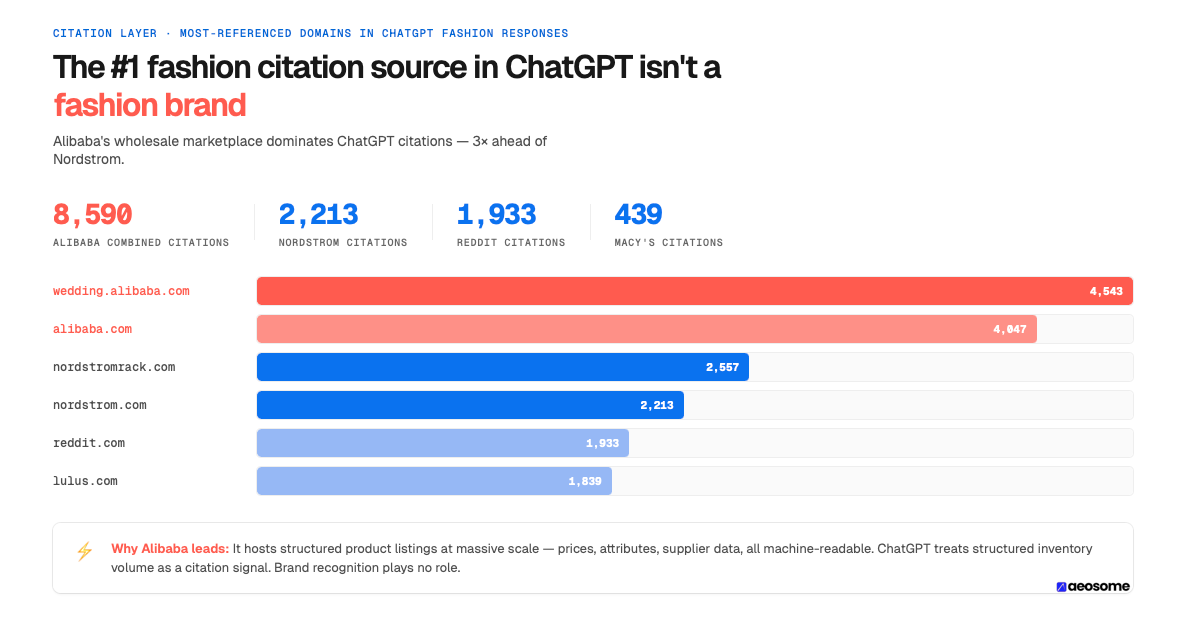
The Citation Layer: Which Domains ChatGPT Sources From
Beyond product carousels, ChatGPT includes citations — source links embedded in the shopping response. The citation data reveals a different visibility story than the product carousel data.
| Rank | Domain | Total Citations | Unique Queries |
|---|---|---|---|
| 1 | wedding.alibaba.com | 4,543 | 2,102 |
| 2 | alibaba.com | 4,047 | 2,013 |
| 3 | nordstromrack.com | 2,557 | 944 |
| 4 | summersalt.com | 2,419 | 965 |
| 5 | yahoo.com | 2,305 | 1,659 |
| 6 | nordstrom.com | 2,213 | 853 |
| 7 | apartstyle.com | 1,975 | 701 |
| 8 | reddit.com | 1,933 | 1,352 |
| 9 | windsorstore.com | 1,870 | 1,109 |
| 10 | lulus.com | 1,839 | 913 |
| 11 | shunvogue.com | 1,657 | 944 |
| 12 | editorialist.com | 1,461 | 951 |
| 13 | tellar.co.uk | 1,405 | 706 |
| 14 | azazie.com | 1,397 | 843 |
| 15 | whowhatwear.com | 1,362 | 1,046 |
Alibaba is the most-cited source in ChatGPT fashion shopping responses — by a significant margin.
wedding.alibaba.com alone generates 4,543 citations across 2,102 unique queries. Combined with alibaba.com (4,047 citations), the Alibaba group accounts for 8,590 total citations — more than three times the citation volume of nordstrom.com (2,213).
This is not a brand play. Alibaba is a wholesale marketplace. ChatGPT is citing it because it hosts structured product listings at massive scale with prices, attributes, and inventory data — all machine-readable signals.
nordstromrack.com is cited more than nordstrom.com (2,557 vs 2,213). The Rack — a discount/off-price channel — generates more citation volume than the flagship. This likely reflects price-sensitive query volumes in the dataset.
reddit.com is #8 with 1,933 citations across 1,352 unique queries. A UGC platform is being cited in shopping contexts at higher volume than target.com (1,233) or dillards.com (1,183). This suggests ChatGPT is using Reddit discussions as authority signals for fashion recommendations.
lulus.com is #10 for citations (1,839) — consistent with its #1 position in the product carousel. Lulus commands both surfaces simultaneously.
For reference, several domains the industry might expect to rank highly are much lower:
- poshmark.com: 442 citations (not in top 15)
- macys.com: 439 citations (not in top 15)
- lyst.com: 134 citations
- depop.com: 29 citations
What Separates the Brands That Win
Five structural patterns explain why the brands in the top 25 appear — and why the brands in the absence list do not.
Pattern: Rating density
Why it works: ChatGPT has no way to assess product quality from brand reputation alone. It uses ratings as a proxy for trustworthiness. Brands with consistent 4.4+ star averages appear significantly more often than equally large brands with sparse or inconsistent review coverage.
Example: Quince (4.73★, #6) outranks H&M (4.21★, #9) despite H&M having substantially higher global brand recognition.
Pattern: Price signal clarity
Why it works: Budget Framing queries ("best dress under $100") trigger carousels 88.8% of the time — one of the highest rates of any query type. Brands whose products have clean, accurate, consistently structured prices match these queries reliably.
Example: Fashion Nova ($32 avg) and Old Navy ($23 avg) both rank in the top 4, capturing every budget-constrained query that their price points match.
Pattern: Broad price range coverage
Why it works: A brand that covers multiple price tiers matches more queries than one concentrated in a single band. Anthropologie ($157 avg) and Adrianna Papell ($163 avg) still appear in the top 16 because their catalogues satisfy occasion and formalwear queries that budget brands cannot.
Pattern: Attribute completeness at SKU level
Why it works: Attribute Constrained queries ("floral, knee-length, cotton dress") trigger carousels 81.8% of the time. Products with complete attribute data — material, occasion, fit, care instructions — match these queries. Products without them do not appear.
Example: Petal & Pup ranks #2 despite being unknown to most US consumers. Its product pages are attribute-dense by design.
Pattern: Direct product feed ownership
Why it works: Brands with their own domain controlling their product URLs have consistent, current, structured data. Department stores hosting third-party products introduce data lag and inconsistency that reduces match rate.
Example: Lulus, Fashion Nova, Old Navy, and Quince all control their own product feeds entirely. Their data is consistent, current, and machine-readable.
How to Improve Your Brand's Visibility in ChatGPT Shopping Results
- Audit your average product rating — brands below 4.3 stars are significantly underrepresented; prioritize review collection before other optimization work
- Check your price data for completeness — every SKU needs a clean, current price; missing or stale prices cause products to be excluded from budget-constrained queries
- Expand your attribute coverage — add material, occasion, fit type, and care instructions to every product page; these are the fields that match Attribute Constrained queries (81.8% carousel rate)
- Maintain your own product feed — brands that control their own domain and product URLs have the most consistent presence; relying solely on retailer product pages reduces your data freshness
- Submit structured product data to aggregators — platforms like nordstromrack.com and windsorstore.com appear in the top 10 citation domains; getting listed there multiplies your citation surface area
- Get listed on high-citation domains — nordstrom.com (2,213 citations), lulus.com (1,839 citations), target.com (1,233 citations) each function as citation amplifiers; a product listed there appears in ChatGPT results via multiple URL paths
- Add JSON-LD product schema to every product page — ChatGPT reads structured data; without it, your page may be invisible regardless of how strong the product is
- Do not rely on brand recognition — Zara's limited presence (100 carousels out of 5,072) is evidence that awareness does not translate to AI visibility at the scale it deserves; structured data does
- Monitor your AI share of voice by category — the leaderboard changes as product feeds update; track your appearances relative to the top 5 brands in your category on a monthly basis
Frequently Asked Questions
Which brands appear most in ChatGPT fashion recommendations?
In our analysis of 8,520 ChatGPT shopping queries across Women's Fashion > Dresses, Lulus appeared in the most unique carousels (1,515), followed by Petal & Pup (1,208), Fashion Nova (844), Old Navy (826), and Abercrombie & Fitch (751). These are all brands that sell primarily through their own direct-to-consumer channels with structured, machine-readable product data.
Why does Zara appear so infrequently in ChatGPT shopping results?
Zara appears in 100 unique carousels (237 product slots) — present, but dramatically underrepresented for a brand of its scale. With over 5,072 triggered carousels in this dataset, Zara appears in fewer than 2%. The most likely cause is product data coverage: ChatGPT's shopping surface relies on structured product feeds, schema markup, and retailer platform integrations. Brands with inconsistent or incomplete product data at the SKU level surface less frequently regardless of global brand recognition.
What is the difference between brand appearances and retailer platform presence?
Brand appearances counts how often products from a specific brand appeared in carousels, measured by the brand's own product URL domain. Retailer platform presence counts how often a department store or marketplace (Macy's, Etsy, Nordstrom) hosted the products that appeared — even if those products belong to other brands. A Karen Kane dress listed on macys.com counts toward Macy's platform presence, not Macy's brand presence. These are two different metrics and should not be combined.
Why does Alibaba rank #1 for citations on ChatGPT?
Alibaba's two domains — wedding.alibaba.com (4,543 citations) and alibaba.com (4,047 citations) — generate 8,590 combined citations, more than any other source by a factor of three. Alibaba hosts structured product listings at massive scale, with prices, attributes, and supplier data that are all machine-readable. ChatGPT treats this structured inventory as a legitimate citation source. This finding is counterintuitive for US fashion marketers, who typically don't consider Alibaba a consumer-facing competitor — but in terms of structured data volume, it dominates.
Does a higher product rating improve ChatGPT visibility?
The data strongly suggests yes. The highest-rated brands in the top 25 — Rihoas (4.86★), Oh Polly (4.84★), Ever-Pretty (4.76★), Quince (4.73★), Express (4.73★) — all rank above significantly larger brands with lower ratings. H&M (4.21★) and ASOS (4.20★), both global fashion brands, rank 9th and 19th respectively. ChatGPT has no brand reputation signal equivalent to Google's domain authority — ratings serve as the primary quality proxy for products it has not evaluated directly.
How does product price affect AI shopping recommendations?
Price affects AI visibility in two ways. First, price-constrained queries ("dresses under $100") trigger carousels 88.8% of the time — brands whose products fall within common budget brackets match more queries. Second, clean and accurate pricing is a data completeness signal — products with missing, stale, or inconsistent prices are less likely to appear in structured carousels. Fashion Nova ($32 avg) and Old Navy ($23 avg) both rank in the top 4 partly because their consistently low price points match a high volume of budget-framing queries.
Summary
- Primary finding: AI shopping visibility is driven by product data quality and feed ownership, not brand recognition — Zara underperforms while Lulus and Fashion Nova dominate
- Top brand by carousel reach: Lulus (1,515 carousels), followed by Petal & Pup (1,208)
- Biggest underperformer: Zara (100 carousels), SHEIN (23), Amazon (~1)
- Most-cited domain: Alibaba (8,590 combined citations) — a wholesale marketplace, not a US consumer retailer
- DTC brands to watch: Quince, Petal & Pup, Baltic Born, Ever-Pretty, Oh Polly — all in the top 25 on structured data strength alone
- Quick win: Ensure your products appear on high-citation domains (nordstromrack.com, nordstrom.com, windsorstore.com, lulus.com, target.com) — each one adds citation surface area independently of your own site
*This research is based on 8,520 shopping intent queries executed against ChatGPT (gpt-5-mini), covering the Women's Fashion > Dresses category in the US market. Queries were run across 9 intent stages and 5 query styles. Brand and retailer citation data was extracted from 5,072 triggered product carousels. Brand presence is measured via product URL domain for brand-owned sites; retailer platform presence is measured separately. Citation counts reflect the actual citations field in the raw JSONL dataset. This dataset represents a snapshot of ChatGPT's commerce behavior as of the run date (February 2026).