Why Your Products Don't Appear in ChatGPT Shopping
50+ tools track AI brand mentions. For ecommerce, that solves the wrong problem entirely. Brand mentions don't drive product recommendations. Here's what actually does.

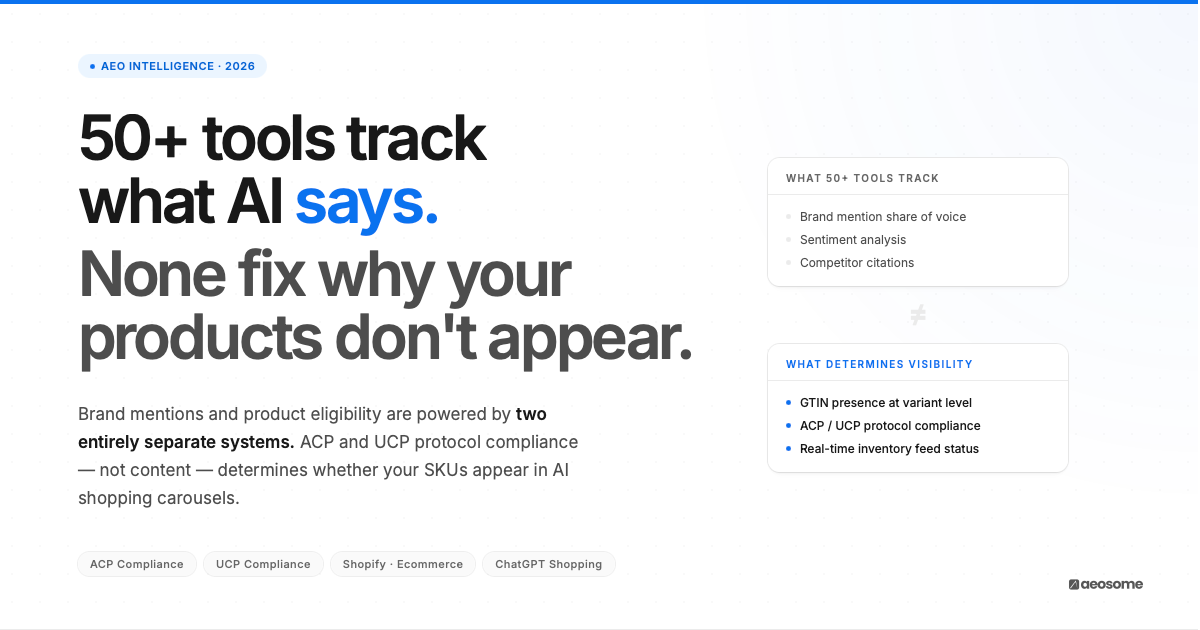
Most AEO tools measure whether AI mentions your brand. That is not the same as getting your products recommended for purchase. Your product feed must satisfy the technical requirements of OpenAI's Agentic Commerce Protocol (ACP) and Google's Universal Commerce Protocol (UCP) before AI agents can recommend or transact your products at all — brand mention tracking cannot diagnose or fix a non-compliant feed. The real bottleneck for ecommerce merchants is protocol compliance: that requires SKU-level feed auditing — a different product category entirely.
Key Takeaways
- 50+ AEO tools now compete to track AI brand mentions (AEOsome market audit, 2026). None audit ecommerce protocol compliance.
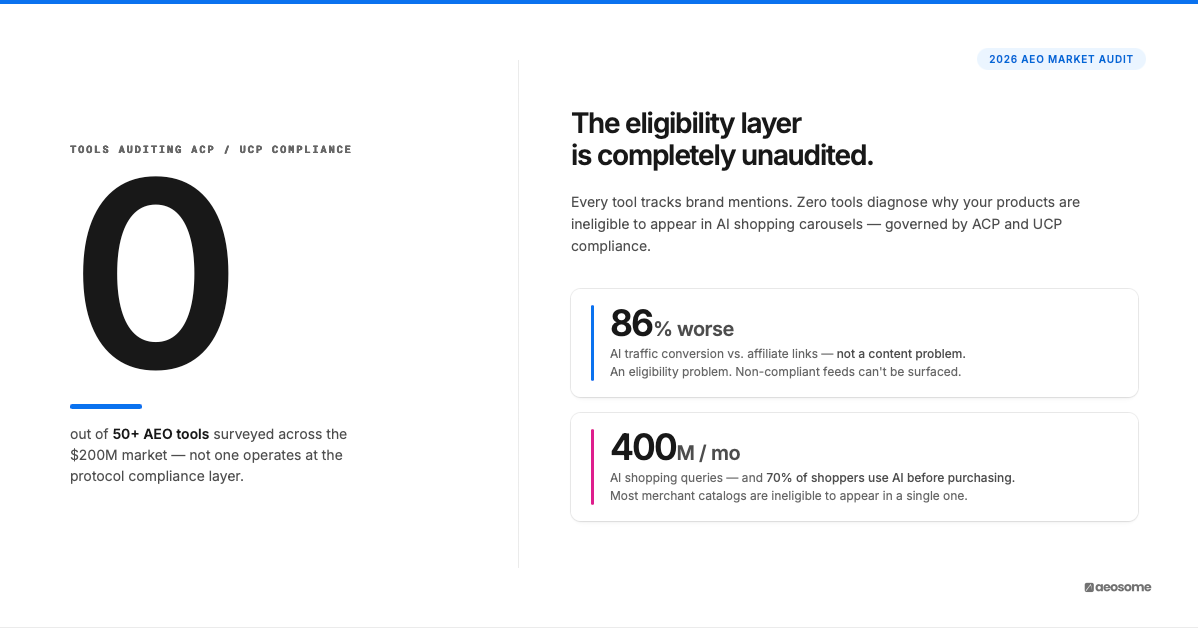
- A one-year academic study found affiliate links converted 86% better than ChatGPT-referred traffic for ecommerce (Digiday, 2026) — but that conversion picture is shifting fast as AI shopping volume scales, which is exactly why eligibility, not conversion tactics, is the durable lever.
- ACP and UCP are hard technical gates. A non-compliant product feed means AI agents skip your products regardless of how much content you publish.
- The compliance failures most merchants don't know about: missing GTINs at variant level, stale inventory data, absent policy URLs, broken feed structure.
- Fixing this requires a Monitor → Audit → Optimize → Verify loop at the SKU level — not a dashboard that counts brand mentions.
The market-monitoring misunderstanding
In the past 18 months, over 50 tools have launched to help brands "optimize for AI search." The pitch is consistent: track how often ChatGPT, Perplexity, Gemini, and Copilot mention your brand. Improve your mention rate. Win AI visibility.
It is a compelling pitch. And for B2B SaaS companies, professional services firms, and publishers, it is roughly the right problem to solve.
For ecommerce brands, it is the wrong problem entirely.
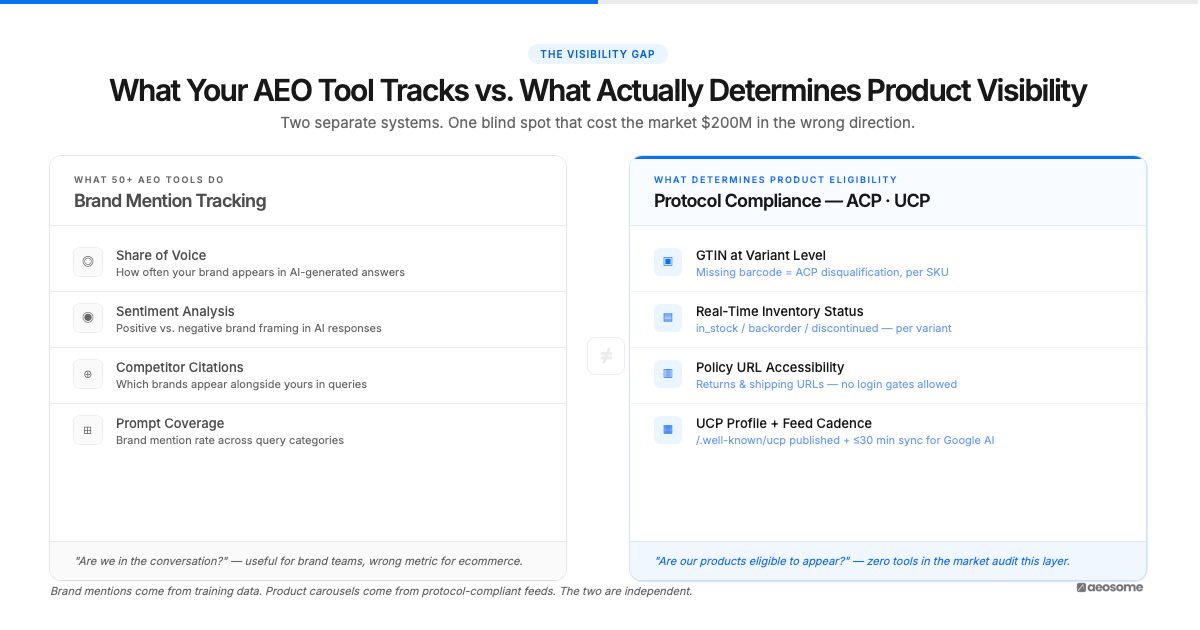
Here is the gap the market has not yet absorbed: AI brand mentions and AI product recommendations are two different things, powered by two different systems, with two different sets of requirements.
When ChatGPT mentions your brand in a paragraph about industry trends, that is brand visibility — the thing those 50+ tools track. When ChatGPT surfaces your specific products in a shopping carousel that a user can click and purchase, that is product eligibility — governed entirely by technical protocol compliance.
No mention-tracking tool can fix a compliance failure. A one-year academic study of ecommerce sites found that affiliate links converted 86% better than ChatGPT-referred traffic (Digiday, 2026) — but that gap is closing as AI shopping volume scales. The more durable problem, regardless of which way conversion rates trend, is that a non-compliant product never gets shown to a shopper in the first place.
What actually happens when a shopper uses ChatGPT to buy something
To understand why tracking is the wrong starting point, it helps to understand what actually happens when a shopper types "best waterproof hiking boots under $200" into ChatGPT.
The AI does not search the web for your product pages. It does not read your blog posts. It queries a real-time product feed that merchants have registered through OpenAI's Agentic Commerce Protocol — a structured data API that works like a modern commerce backbone, not a search index.
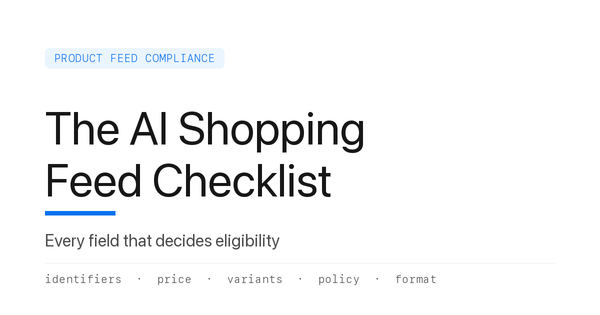
For your product to appear in that query result, your feed must satisfy ACP requirements at the variant level:
- Stable variant IDs — each individual SKU (size 9, color black) needs a persistent identifier
- GTINs (barcodes) — missing GTINs are the single most common eligibility failure
- Real-time inventory status —
in_stock,backorder,preorder,out_of_stock,discontinued— at the variant level, not the product level - Policy URLs — return policy, shipping policy, and seller FAQ URLs must be present and accessible
- Price in ISO 4217 minor units — $79.99 must appear as
7999, not79.99 - Feed freshness — high-velocity items require intraday updates; agents that recommend an out-of-stock product are penalized by the platform over time
If any of these fields are missing, malformed, or stale across your SKUs, your products are not eligible to appear. The AI agent has no mechanism to surface them, regardless of how well-written your product descriptions are or how many times your brand is cited in blog posts.
On Google's side, the Universal Commerce Protocol adds another layer: your store must publish a /.well-known/ucp profile declaring which commerce capabilities you support (Cart, Checkout, Identity Linking, Order). Gemini and Google AI Mode read this profile before deciding whether to initiate a purchase flow with your store. Merchants who have not published a UCP profile are invisible to Google's agentic commerce layer — even if they rank on Google Search.
Shopify's Agentic Plan gets you enrolled. Enrollment is not the same as appearing.
Credit where it is due: Shopify has moved faster on agentic commerce than almost any platform in the market. The Agentic Plan auto-enrolls merchants into Shopify Catalog — a real-time product feed layer that connects directly to ChatGPT, Copilot, Google AI, and Gemini without any integration work from the merchant. Shopify also deploys specialized LLMs to enrich product data, filling in attribute gaps that would otherwise reduce a product's visibility. Brands like Gymshark, Everlane, Fenty Beauty, and Monos are already live. Shopify merchants who signed up for the Agentic Plan are, in a meaningful sense, already in the game.
But enrollment and appearing are two different things.
Shopify Catalog gets your products into the discovery pool. What determines whether they surface in a specific shopping query — and whether they rank above competitors — is the quality and completeness of your variant-level data. Shopify's LLM enrichment helps, but it cannot fabricate data that does not exist in your catalog, and it cannot fix structural compliance gaps that sit below the product description layer.
Here is what still falls through:
GTINs for private-label and custom products. Shopify's LLMs can rewrite a product title. They cannot generate a valid barcode for a product that has never been assigned one. Merchants who sell custom, white-label, or handmade products — a significant portion of the Shopify merchant base — still carry this gap. ACP treats a missing GTIN at the variant level as a compliance failure. The product does not appear regardless of how well everything else is optimized.
Feed freshness for high-velocity SKUs. Shopify Catalog syncs automatically, but the frequency is not always sufficient for fast-moving inventory. ACP recommends intraday upserts for high-velocity items. An agent that surfaces an out-of-stock product receives a trust penalty from the platform — deprioritized in subsequent queries. Merchants selling hundreds of units a day of a small SKU set need to audit whether their sync cadence matches their sell-through rate. This is operational, not structural — but it degrades over time without active monitoring.
The Google channel is a separate setup entirely. Shopify's Agentic Plan handles the ChatGPT and Copilot channels. Google's Universal Commerce Protocol is a different system. To appear in Gemini and Google AI Mode shopping surfaces, your store must publish a /.well-known/ucp profile, maintain a verified Google Merchant Center account with ≥50 approved offers, claim your brand profile in GMC, and provide precise shipping calculations — not flat-rate estimates — because agents use exact shipping in purchase decisions. None of this is automated by Shopify's Agentic Plan. It requires deliberate setup on the Google side.
Variant-level attribute completeness. Shopify Catalog and LLM enrichment improve descriptions. They do not guarantee that the 10–20 decision-making attributes AI agents use for ranking — material, dimensions, fit, use case, care instructions — are present, consistent, and correctly mapped at the individual variant level. Competitors who have invested in structured product data at the SKU level will rank above merchants whose catalog relies on enrichment to fill the gaps.
The honest picture: Shopify has done the hard work of building the pipe. The question is what flows through it. Enrollment gets you in the door. Compliance and data quality determine whether you appear — and where.
The market audit: what 50+ tools actually do
A comprehensive review of the AEO tools market (50+ tools, from $19/mo freemium to $150K/yr enterprise) reveals a consistent pattern: nearly every tool is a brand visibility tracker.
The typical feature set:
- Input a brand name or a set of prompts
- Query ChatGPT, Perplexity, Gemini, and Copilot
- Report back: how often does your brand appear? What sentiment? What competitors appear alongside you?
This is useful for brand teams. It answers "are we showing up in the conversation?" It does not answer "are our products eligible to appear in shopping carousels?" and it cannot answer "what is blocking our SKUs from appearing in purchase-intent queries?"
Of the 50+ tools surveyed, the breakdown is stark:
| Category | Count |
|---|---|
| Brand mention / share of voice trackers | 45+ |
| Tools explicitly targeting eCommerce | 2 |
| Tools with SKU/variant-level auditing | 0 |
| Tools that address ACP or UCP compliance | 0 |
The two eCommerce-focused tools that exist track brand-level visibility in ChatGPT Shopping and Amazon Rufus respectively. Neither addresses the feed compliance layer. Neither operates at SKU/variant level. Neither is aware of ACP or UCP as a compliance framework.
This is not a criticism of those tools — they are doing the right thing for the problem they have defined. The gap is that no tool in the market has yet addressed the eligibility layer that actually determines whether ecommerce products appear.
What protocol compliance actually requires: a checklist
If you are a Shopify merchant trying to assess your own ACP/UCP readiness today, start here.
ACP compliance checklist
- Every variant has a stable, persistent variant ID (does not change when you edit the product)
- Every product has a GTIN (barcode) — especially custom or private-label items
- Inventory status is set at the variant level (not just "in stock" at the product level)
- Return policy URL is accessible and not behind a login
- Shipping policy URL is accessible and not behind a login
- Feed syncs at least every 4 hours for high-velocity SKUs
- Shopify Agentic Plan is activated (handles feed submission to ChatGPT and Copilot automatically — no manual submission required for Shopify merchants)
- Variant titles are descriptive enough for an AI agent to differentiate ("Blue / Size 8" is insufficient; "Cobalt Blue / Women's US Size 8 / Wide Width" is better)
UCP compliance checklist
/.well-known/ucpprofile is published at your domain- Profile declares supported capabilities (at minimum: Checkout, Order)
- Google Merchant Center account is verified with ≥50 approved offers
- Brand profile is claimed in GMC
- Inventory sync is ≤30 minutes for high-velocity items
- Shipping calculations are precise (not flat-rate) — agents use exact shipping for checkout decisions
- Product dimensions, material specs, and key attributes are complete in your GMC supplemental feed
If you cannot check every box in both lists, you have eligibility gaps — not content gaps.
The four-step operational fix
Protocol compliance is not a one-time project. Feeds drift. Inventory changes. New SKUs launch. Policy pages move. The compliance status of a 1,000-SKU catalog is a dynamic number that degrades without active maintenance.
The operational approach that works is a closed-loop system: Monitor what appears, Audit what is blocking what does not, Optimize the specific fields and feed structures causing failures, then Verify that changes produced the intended result.
Monitor: Run systematic shopping queries across purchase-intent prompts for your categories. Measure which SKUs appear, at what rank, with what share of voice. Build a weekly baseline.
Audit: For every SKU not appearing, diagnose the root cause. Is it a compliance failure (missing field)? A competitiveness gap (attribute completeness below winning competitors)? A query-intent mismatch (your product data does not semantically align with what the query asks)?
Optimize: Prioritize fixes by compliance status first — a non-eligible product cannot be ranked, so ranking improvements are irrelevant until eligibility is resolved. Fix GTINs, policy URLs, inventory freshness, and feed structure before touching descriptions or adding attributes.
Verify: Re-run the same query set 48–72 hours after changes. Measure the delta: SKU Visibility Rate, Average Shopping Rank, Share of Voice. This produces the before/after data your leadership needs to justify the work.
This loop runs weekly. Over 6 weeks, a well-operated catalog can reach 90%+ ACP compliance and begin generating meaningful agentic revenue — our benchmark for Shopify stores with 1,000–5,000 SKUs is $10K–$50K in incremental monthly revenue at that compliance threshold (AEOsome Research, 2026).
Why this matters now
April 16, 2026 was a meaningful date for ecommerce. OpenAI relaunched ACP at scale — ChatGPT had already reported 700 million weekly users as of its August 2025 disclosure, and product shopping carousels are now available to that base. 1 million+ Shopify merchants are being onboarded to the platform via Shopify's Agentic Plan. ACP has been open-sourced. Google's Universal Commerce Protocol is live for Shopify, Etsy, Wayfair, Target, and Walmart merchants, with Meta also moving toward agentic commerce for Facebook and Instagram.
The infrastructure is live. The audience is there — 400 million AI shopping queries per month. Seventy percent of shoppers now use AI before purchasing.
The gap is eligibility. Most merchant catalogs were not built to satisfy protocol requirements. The brands that audit and fix their compliance in the next 6 months will own a disproportionate share of AI shopping traffic before the broader market catches up.
Brand mention tracking is the wrong tool for this job. The right tool is one that operates at the SKU level, speaks the language of ACP and UCP, and tells you specifically which products are blocked and why.
FAQ
Does publishing more content help my products appear in ChatGPT shopping carousels?
Content optimization improves your brand's presence in AI-generated answers and editorial responses. It does not affect product carousel eligibility, which is determined by your product feed compliance with ACP and UCP — two technical protocols that are separate from content signals entirely.
My brand shows up in ChatGPT conversations. Why aren't my products appearing in shopping results?
Brand mentions and product carousels are powered by different systems. Brand mentions come from training data and web citations. Shopping carousels come from real-time product feed queries governed by ACP compliance. A brand can have excellent AI visibility and zero product carousel presence simultaneously — the two are independent.
What is the most common reason Shopify products fail ACP compliance?
Missing GTINs (barcodes) at the variant level. Shopify makes GTINs optional; ACP requires them. Merchants who never entered barcode data — especially for private-label or custom products — will fail compliance on every affected SKU.
How long does it take to get a catalog ACP-compliant?
With systematic auditing and a prioritized fix workflow, most Shopify catalogs with 100–5,000 SKUs can reach 90%+ ACP compliance within 6 weeks. The primary constraint is not technical complexity — it is having the tooling to identify which SKUs have which specific gaps, so fixes can be batched and deployed efficiently.
Is UCP compliance required if I am already ACP-compliant?
ACP covers ChatGPT. UCP covers Google AI Mode, Gemini, and Meta commerce surfaces. Both protocols are now live. A multi-protocol strategy is recommended — ACP and UCP are complementary, and the platforms they power do not overlap.
Do I need a developer to fix ACP compliance issues?
Some fixes (GTIN data entry, policy URL updates) can be done directly in Shopify by a non-technical team member. Feed structure issues and variant mapping gaps typically require either a developer or a tool that abstracts the technical layer. The priority is auditing first — without a complete SKU-level compliance report, you cannot know which category your gaps fall into.
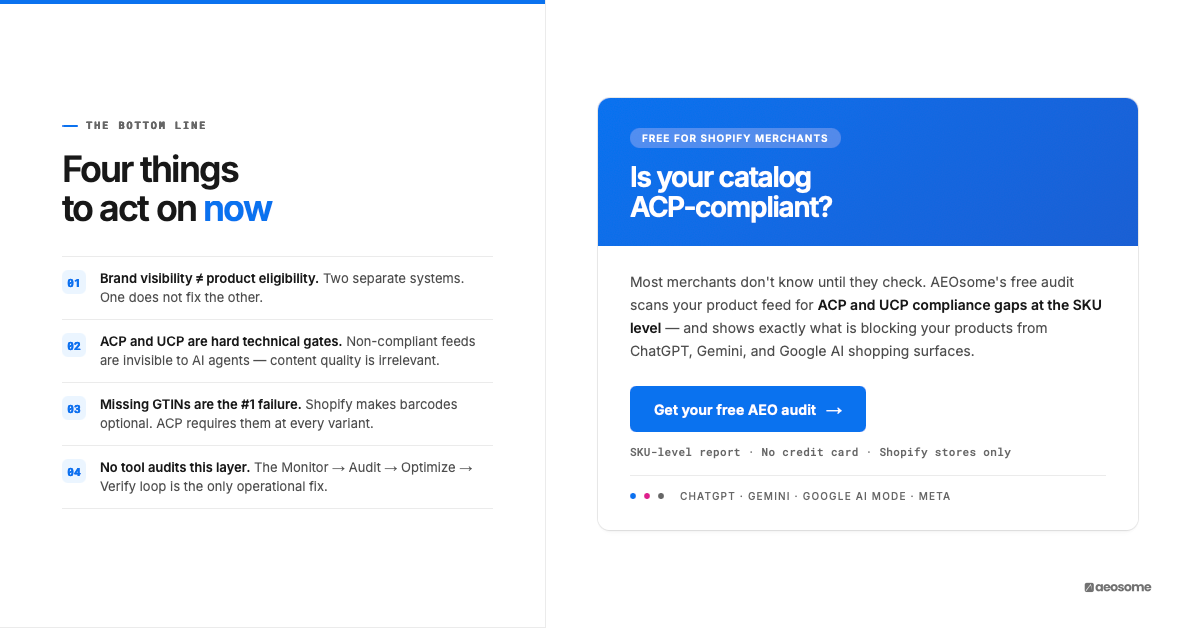
Is your Shopify catalog ACP-compliant? Most merchants don't know until they check. AEOsome's free audit scans your product feed for ACP and UCP compliance gaps — at the SKU level — and shows you exactly what is blocking your products from appearing in ChatGPT, Gemini, and Google AI shopping surfaces. → Get your free audit here
About the author. Vijaya Kumar Channalli is a serial SaaS founder and the founder of AEOsome (Tartu, Estonia), which helps eCommerce brands get their products recommended when shoppers ask AI what to buy. He built AEOsome's SKU-level ACP/UCP compliance auditing methodology and writes about AI shopping visibility, product feeds, and how Answer Engine Optimization differs from SEO. More at vijay.cc.
Sources: AEOsome Research, 2026 (Monitor → Audit → Optimize → Verify compliance benchmark, Shopify stores 1,000–5,000 SKUs; 50+ tool market audit); OpenAI, Agentic Commerce Protocol documentation (2026); CNBC, OpenAI ChatGPT weekly user disclosure (August 2025); Google, Universal Commerce Protocol announcement (2026); Shopify, AI commerce at scale (2026); Digiday, ecommerce ChatGPT-traffic conversion study (2026).