What Is AEO (Answer Engine Optimization)? Why E-Commerce Brands Can't Ignore It in 2026
AEO helps e-commerce brands get cited by AI search tools. 31.3% of Americans now use generative AI search — here's what it means for your store's revenue.

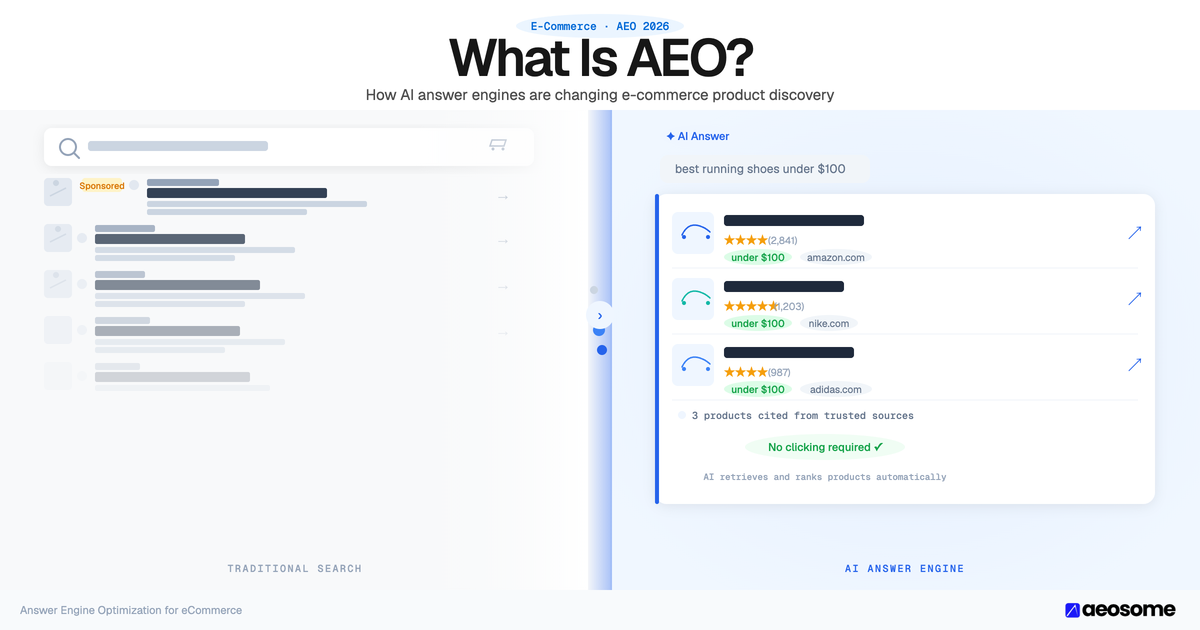
Imagine you've spent two years climbing to the #1 spot on Google for "best running shoes under $100." Traffic is steady. Conversions are decent. Then a competitor launches six months ago with no SEO history — and they're the brand ChatGPT recommends every time a shopper asks.
This isn't a hypothetical. It's the split that's happening right now across e-commerce. Search has two channels today: the traditional results page and the AI answer. According to eMarketer, 31.3% of all Americans now use generative AI search tools in 2026. That's not a niche audience. That's roughly one in three of your potential customers.
Key Takeaways31.3% of Americans used generative AI search in 2026 (eMarketer)Across 27,255 queries, AI platforms cited products 38.1% of the time (AEOsome Research, 2026)Google AI Mode cites products far more often than any other platform (67.3%)Shopping intent, not platform choice, drives the biggest differences in citation ratesAgentic checkout kept moving in 2026 — Google expanded it, OpenAI rebuilt it — but the citation stakes only went upEarly movers in AEO will lock in citation defaults before competitors catch up
What Is Answer Engine Optimization (AEO)?
Answer Engine Optimization is the practice of structuring your brand, products, and content so that AI platforms cite you when shoppers ask questions. According to eMarketer, 31.3% of Americans used generative AI search in 2026 — and when those users ask "what's a good waterproof jacket under $200," a brand either appears in the answer or it doesn't.
AEO covers everything from structured product data and third-party mentions to the way you frame intent in your content. It's not about keyword density. It's about being the clearest, most credible answer to a shopper's specific question.
Citation Capsule: Answer Engine Optimization (AEO) is the practice of optimizing brand and product content so AI platforms cite it in direct answers. With 31.3% of Americans using generative AI search in 2026 (eMarketer), brands that aren't optimized for AI answers are invisible to a growing share of purchase-ready shoppers.
How AEO Differs from Traditional SEO
SEO earns you a link in a ranked list. AEO earns you a mention in a spoken or written answer. The difference matters because AI platforms don't show ten blue links. They synthesize one response, often citing two or three sources.
Traditional SEO rewards domain authority, backlink volume, and on-page keyword optimization. AEO rewards structured data, contextual clarity, and third-party credibility signals. You can rank #1 on Google and still be invisible on ChatGPT — because the signals those systems read are different.
The brands winning on AI platforms right now didn't necessarily win by abandoning SEO. They layered AEO signals on top: structured product feeds, review presence on forums AI trusts, and content written around the exact questions shoppers phrase to AI tools.
AEO vs GEO: Are They the Same Thing?
Generative Engine Optimization (GEO) is the academic and research community's term for the same practice. In real-world usage, AEO and GEO are functionally identical. Both describe how to get cited by AI-powered answer systems.
The vocabulary split comes from where the term originated. "GEO" appears more in academic papers and search science blogs. "AEO" is the term that's taken hold among practitioners and tools targeting e-commerce and marketing teams. If you see both, don't let the terminology confuse you. The underlying goal — getting your brand into AI answers — is the same.
Why Does AEO Matter Specifically for E-Commerce Brands?
Across 27,255 queries run across four major AI platforms, products were cited 38.1% of the time overall (AEOsome Research, 2026). That means more than one in three AI shopping searches result in a specific product being named. For e-commerce brands, that's a citation opportunity — or a missed one.
The 38.1% average also understates the opportunity at the top. Some platforms and some intent types push citation rates well above 50%. The brands showing up there aren't all household names. AI doesn't weight brand budget. It weights relevance and credibility signals.
Citation Capsule: Across 27,255 e-commerce shopping queries analyzed in 2026, AI platforms cited specific products in 38.1% of responses (AEOsome Research, 2026). No product category fell below 28.8%, which means competitive citation opportunities exist across every major e-commerce vertical.
The AI Shelf Is Already Open for Business
Google AI Mode cites products in 67.3% of shopping queries. Microsoft Copilot follows at 45.6%. ChatGPT comes in at 30.6%. Perplexity sits at 8.6% (AEOsome Research, 2026). These aren't identical channels — but none of them are dormant.
| Platform | Product Citation Rate |
|---|---|
| Google AI Mode | 67.3% |
| Microsoft Copilot | 45.6% |
| ChatGPT | 30.6% |
| Perplexity | 8.6% |
The key implication: a brand that optimizes only for one platform misses citations on the others. And a brand that doesn't optimize at all misses all four.
Intent Matters More Than Platform
Shopping intent drives citation rates more than platform choice does. The spread between the highest and lowest intent types (41 percentage points) is wider than the spread between the highest and lowest platforms, excluding Perplexity (36.7 percentage points) (AEOsome Research, 2026). What a shopper is trying to do matters more than which AI they use.
Budget Framing queries — shoppers asking "what's the best [product] under $X," structured around a specific price ceiling — generate a 58.5% citation rate. That's nearly double what the lowest intent type achieves. See the full breakdown across all 9 stages of the AI ecommerce customer journey.
This matters for strategy. If you're writing product content that speaks to price-conscious comparison shoppers, you're targeting queries with naturally high citation rates. If your content only addresses general awareness ("what is a standing desk"), you're working in the low-citation zone.
What Is Agentic Commerce — and Why It Changes Everything?
Agentic commerce is AI completing a purchase on a shopper's behalf — research, comparison, and transaction, without the shopper visiting a single product page. It's not a future concept, and the mechanics moved fast this year. Google expanded its Universal Cart and Universal Commerce Protocol (UCP) program at Google Marketing Live in May 2026, adding live retailer checkout via Google Pay at brands including Nike, Target, Walmart, Sephora, and Wayfair, plus buy-now-pay-later support through Affirm and Klarna (Google, 2026). OpenAI took a different path: it shut down ChatGPT's in-chat Instant Checkout in March 2026 and pivoted to a discovery model that hands the shopper off to the retailer's own app or site to finish the purchase (OpenAI, 2026). The citation question hasn't changed with the mechanics — it's still "do we appear in an answer that can drive a transaction," whether that transaction closes inside the AI surface or one click outside it.
This is a meaningful escalation regardless of which checkout model wins. In traditional AI search, a missed citation means a missed click. In agentic commerce, a missed citation means a missed sale, with little to no page visit in between.
Citation Capsule: Google's Universal Cart and UCP program now handles live, in-surface checkout at major retailers (Google, 2026). OpenAI discontinued ChatGPT's in-chat Instant Checkout in March 2026 and now redirects shoppers to the retailer to complete the purchase (OpenAI, 2026). Either model still depends on citation: brands AI platforms don't cite are invisible to both purchase flows — no impression, no click, no chance to convert.
From AI Search to AI Purchase
The citation stakes are higher in an agentic world. When a human searches, they still see the results page and can choose to scroll. When an agent searches, it picks from what it trusts and completes — or hands off — the transaction. Non-cited brands don't get a second chance.
Think of it this way: your product either lives on the AI shelf or it doesn't. Agentic commerce means the AI can now take items off that shelf and move them toward a cart, whether the cart closes on Google's surface or after a redirect to your own store.
What This Means for Brands That Haven't Started
Citation preferences are not random. They're influenced by training data, third-party mentions, structured signals, and the content that exists today. The brands establishing credibility signals now will have a structural advantage as agentic commerce continues to evolve — and 2026 has already shown that the winning checkout model isn't settled yet.
Defaults harden over time. Early movers in any distribution channel tend to keep their share because the system learns to trust them. AEO is no different.
How Do AI Answer Engines Actually Decide What to Cite?
AI platforms don't cite randomly. They pull from sources that score well on a combination of signals: structured data clarity, third-party credibility, and alignment between the content and the user's actual intent. Understanding what 8,520 ChatGPT shopping queries reveal about citation patterns makes this concrete.
The mechanism isn't a single algorithm you can reverse-engineer in a day. But the inputs are knowable, and they're actionable.
Citation Capsule: AI platforms use three primary signals when deciding which products to cite: structured product data (schema, feeds, attribute completeness), third-party credibility (forum discussions, reviews, editorial coverage), and intent alignment (how well the content matches what the shopper is actually asking). Brands with all three score consistently higher.
The Three Citation Signals That Matter
Structured product data is the foundation. Platforms that can extract clean attribute data — price ranges, materials, sizes, use cases — cite specific products more reliably. Incomplete product data creates uncertainty that AI systems resolve by citing someone else.
Third-party citations matter because AI systems are trained on the broader web, not just your product pages. Tinuiti's tracking found social media citations in AI answers topped 9% across tracked categories in Q1 2026, with Reddit accounting for the dominant share of that growth — and by Q3 2026 that share had climbed further still, running at or near all-time highs across most tracked platforms, with apparel alone reaching 14% (Tinuiti, Q1 2026; Tinuiti, Q3 2026). Your presence on Reddit, in editorial reviews, and in forum discussions isn't optional anymore.
Intent alignment means your content actually matches what the shopper asked. Budget framing content works because it explicitly addresses the price-constraint question. Generic brand storytelling doesn't surface in "best X under $Y" queries because it never answered that question.
Why Ranking #1 on Google Is No Longer Enough
Google AI Mode has a 3.7% ad rate (AEOsome Research, 2026). That means 96.3% of Google AI Mode citations are organic, and the signals driving those organic citations are different from the signals that drove traditional organic rankings. Why ChatGPT recommends your competitors walks through this gap in detail.
HubSpot reported that its customers saw organic traffic drop 27% year-over-year as AI answers displaced traditional clicks, which is part of why the company launched dedicated AEO tooling in April 2026 (HubSpot, 2026). By its Q2 2026 earnings call, 32% of eligible Marketing Hub Pro Plus customers had already activated that tooling, with roughly 16,000 marketers running standalone AEO trials in the quarter — early evidence that brands aren't waiting to react. Gartner separately projected a 25% shift of organic search volume to AI chatbots by the end of 2026 (Gartner, 2024). That projection hasn't been revised, but independent tracking through January 2026 found actual U.S. organic search traffic down a more modest 2.5% year-over-year, with the steepest declines concentrated in mid-sized publishers rather than the web broadly (Search Engine Land, 2026). Ranking #1 still matters, and the industry-wide traffic shift is unfolding slower than Gartner's original forecast suggested. But it no longer guarantees visibility where a growing share of buyers are looking — and the AEO adoption numbers above suggest competitors aren't betting on a slow timeline either.
Can Small and Mid-Market Brands Actually Compete?
Yes — and the data is direct about this. No product category in our research fell below a 28.8% citation rate (AEOsome Research, 2026). That means citation activity exists everywhere, and the floor is high enough to compete in even the most contested categories. See which brands ChatGPT actually recommends for a category-level breakdown.
AI platforms don't weight ad spend. They weight signal quality. A small brand with excellent structured data, genuine community presence on forums AI trusts, and content written around specific shopper questions can outperform a large brand with a weak data foundation.
We've seen this pattern repeat across our research: mid-market brands with focused product lines and strong niche community presence often outperform larger generalist competitors on intent-specific queries. Budget framing queries favor the brand that answers the price question cleanly, not the brand with the biggest catalog.
Scale isn't irrelevant. Bigger brands have more content surface area and more third-party citations by default. But AEO rewards specificity over scale in a way that traditional SEO rarely did.
How Do You Measure AEO Performance?
Measuring AEO is the #1 unsolved pain point in the space right now. Most brand owners don't know their citation rate across platforms, how it compares to competitors, or whether it's changing week over week. Understanding why most AEO tools can't fix the real problem clarifies what's actually measurable and what isn't.
There are three practical approaches today.
Manual query sampling is the starting point. Build a list of 20-30 queries that represent your real customer questions. Run them weekly across the major platforms. Record which products appear, whether yours is among them, and which competitors show up. It's labor-intensive, but it's ground truth.
Citation rate tracking requires a more systematic approach. Tools that monitor AI platform outputs can give you a statistical view of citation frequency across a large query set. The methodology matters here: a 30-query sample and a 3,000-query sample tell very different stories.
GA4 referral signals can act as a proxy. Direct traffic and referral traffic from AI platforms shows up in analytics as users arrive after being cited in an AI answer. It's indirect, but it's a leading indicator that your citation rate is generating actual visits.
Citation Capsule: Measuring AEO performance requires three parallel approaches: manual query sampling for ground-truth monitoring, systematic citation rate tracking across platforms, and GA4 referral signal analysis. In a client case study, Seer Interactive found AI referral traffic converting at 15.9% versus 1.76% for Google organic (Seer Interactive, 2025), making citation rate a high-value metric to track.
The conversion argument for tracking is strong. In that same case study, Seer Interactive found that AI referral traffic converted at 15.9% versus 1.76% for Google organic, across a single client's October 2024–April 2025 traffic (Seer Interactive, 2025). It's one account, not an industry average, but the gap is wide enough — and has been re-cited widely enough through 2026 — that it's worth checking against your own analytics. Traffic from AI citations tends to arrive with much stronger purchase intent. Measuring it isn't just good hygiene. It's revenue intelligence.
| Shopping Intent | Citation Rate | vs. 38.1% Average |
|---|---|---|
| Budget Framing | 58.5% | +20.4pp |
| Attribute Constrained | 50.2% | +12.1pp |
| Purchase Execution | 45.1% | +7.0pp |
| Scenario Confirmation | 42.6% | +4.5pp |
| Comparison | 37.4% | -0.7pp |
| Category Exploration | 37.2% | -0.9pp |
| Validation / Risk Reduction | 27.9% | -10.2pp |
| Problem Recognition | 23.2% | -14.9pp |
| Post Purchase | 17.5% | -20.6pp |
Common AEO Questions for E-Commerce Teams
Is AEO just SEO with a new name?
No, though they share some foundations. SEO optimizes for ranked link placement in search results. AEO optimizes for direct citation in AI-generated answers. The signals differ: SEO rewards backlink authority and keyword density, while AEO rewards structured product data, third-party forum presence, and intent alignment. With 31.3% of Americans using generative AI search in 2026 (eMarketer), treating them as the same strategy leaves citations on the table.
Which AI platform should I focus on first?
Start with Google AI Mode. It cites products in 67.3% of shopping queries — the highest rate of any major platform by a wide margin (AEOsome Research, 2026). It also handles the largest query volume of any AI search tool. That combination makes it the highest-ROI starting point for most e-commerce brands.
My brand ranks #1 on Google. Why don't I show up on ChatGPT?
Because the citation signals are different. Google rankings depend heavily on backlink authority and on-page SEO. ChatGPT's citations depend on structured product data, presence in sources it trusts (forums, editorial reviews, community discussions), and how well your content answers the specific question asked. Our research shows ChatGPT cites products in 30.6% of shopping queries (AEOsome Research, 2026), but the brands appearing aren't always the Google top-ten.
How long does AEO take to show results?
Structural changes typically surface in AI citations within weeks. Improving product schema and feed completeness shows faster results than content changes. Content-based changes — adding intent-aligned pages, building forum presence — take one to three months. Gartner projected a 25% shift of organic search to AI chatbots by end of 2026 (Gartner, 2024); independent tracking through January 2026 shows the shift moving more gradually than that (Search Engine Land, 2026), but the direction is unchanged, so the window to build early advantage is still narrowing.
Why are smaller brands sometimes getting more AI citations than bigger competitors?
AI platforms reward signal quality over brand scale. A smaller brand with complete product attribute data, genuine community presence in forums AI trusts, and content that directly addresses specific shopper questions can outperform a larger brand with a weak data foundation. No product category in our research fell below 28.8% citation rate (AEOsome Research, 2026) — the floor is high enough that focused mid-market brands compete everywhere.
The AI Shelf Is Live. Here's What to Do Next.
The buyer journey now includes an AI stop that can end in a purchase, without the shopper ever visiting your site. That's not a future scenario. Google's Universal Cart is live with major retailers, and even OpenAI's retreat from in-chat checkout in March 2026 didn't remove AI from the path to purchase — it just moved the last click to the retailer. The brands showing up in AI answers are building compounding citation credibility while others are still treating AI search as something to watch.
The 38.1% average citation rate across our research means AI platforms are actively recommending products at scale. The 14.2% AI referral conversion rate (eMarketer, 2026) means those recommendations drive real revenue. And no category below 28.8% means the opportunity exists for every e-commerce vertical.
The gap between knowing this and acting on it closes faster than most brand owners expect.
See how your brand is performing on AI platforms today. AEOsome tracks citation rates across ChatGPT, Perplexity, Google AI Mode, and Copilot — so you know where you stand before your competitors do. Check your AI citation rate
Sources: eMarketer, GEO and AEO FAQ 2026; AEOsome Research, 2026; Tinuiti, Q1 2026 AI Citation Trends Report; Tinuiti, Q3 2026 AI Citation Trends Report; HubSpot launches AEO tool as organic traffic drops 27%, April 2026; Gartner, 2024; Search Engine Land, organic search traffic tracking, 2026; Google, Universal Cart and UCP expansion, May 2026; OpenAI Instant Checkout shutdown coverage, March 2026; Seer Interactive, AI referral conversion case study, 2025.