Why ChatGPT Recommends Your Competitor Products
ChatGPT doesn't rank pages, it selects products from structured feeds. Strong Google rankings don't transfer. Four specific signals determine who appears in AI shopping carousels.

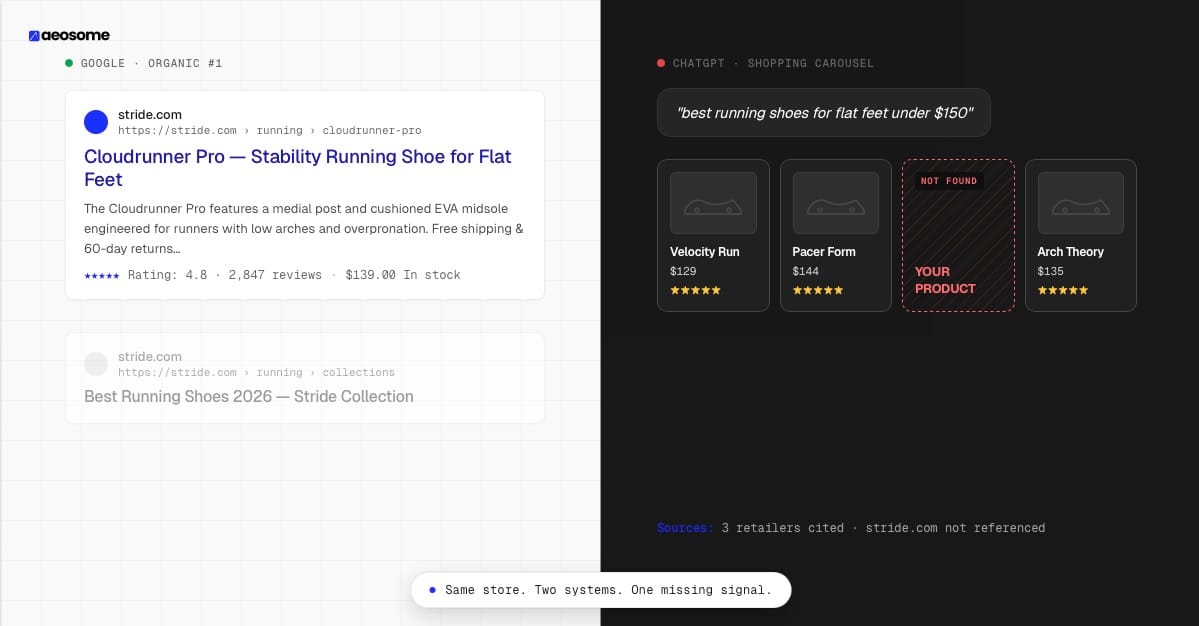
ChatGPT recommends competitor products instead of yours because its shopping carousel is powered by product feed quality, not Google rankings. The four signals that determine which products appear: feed completeness, title clarity, schema at variant level, and review quality are entirely different from SEO signals. Strong Google performance does not transfer to AI shopping visibility. Before assuming your competitor is simply outranking you, work through a step-by-step diagnostic guide to rule out crawler, feed, schema, and entity issues on your own listings first.
TL;DR
- ChatGPT selects products for its carousel from structured product data, not webpage rankings
- Competitors winning in AI search isn't about their SEO, it's about four specific data signals yours may lack
- Being enrolled in Shopify Catalog gets you into the pool; data quality determines whether you appear
- Each signal has a different fix timeline, feed and schema gaps can close in days, review velocity takes weeks
A merchant on r/ecommerce described it plainly: "Page 1 for every product category. ChatGPT recommends our competitors in every single one."
The post got a lot of upvotes. Because it describes something most eCommerce merchants are quietly experiencing right now.
Six years of SEO work. Category leadership on Google. Products customers buy and recommend. And then a customer mentions ChatGPT showed them your competitor first and you weren't in the picture at all.
The instinct is to blame content, or brand awareness, or some technical SEO gap. But the problem is more specific. ChatGPT's shopping carousel and Google search rankings are powered by entirely different systems. What made you visible on Google has near-zero bearing on what makes you visible when a shopper asks ChatGPT to recommend a product.
We know this from our own data. We ran 8,520 shopping intent queries through ChatGPT and tracked every product carousel that appeared. The patterns are consistent and for most Shopify merchants, the gaps are fixable once you know which signal is the bottleneck.
In this article:
- Why Strong SEO Doesn't Protect You in AI Shopping
- How ChatGPT Actually Selects Products for Its Carousel
- Signal 1: Your Google Shopping Feed Is Where ChatGPT Actually Looks
- Signal 2: Product Titles and Descriptions AI Cannot Parse
- Signal 3: Incomplete Schema Makes Products Structurally Invisible
- Signal 4: Review Quality and Velocity, Not Just Star Rating
- How to Audit Which Signal Is Holding You Back
- Frequently Asked Questions
Why Strong SEO Doesn't Protect You in AI Shopping
In traditional search, you optimize for rankings. Page authority, backlinks, keyword density. In AI shopping, ChatGPT doesn't rank pages. It selects products. When a shopper types "best waterproof hiking backpack under $150," ChatGPT makes an editorial judgment: which products best match this exact request? Your product either makes the cut or it doesn't — and the decision happens before the shopper ever sees a result.
| Dimension | Google Search | ChatGPT Shopping |
|---|---|---|
| What you optimize | Keywords, backlinks, page authority | Product feeds, structured data, attribute completeness |
| What the user sees | Ranked links | Product carousels with images, prices, ratings |
| How selection works | Algorithmic ranking of page signals | AI selects products that match stated needs |
| Key signals | Domain authority, on-page content | Feed compliance, schema, review data |
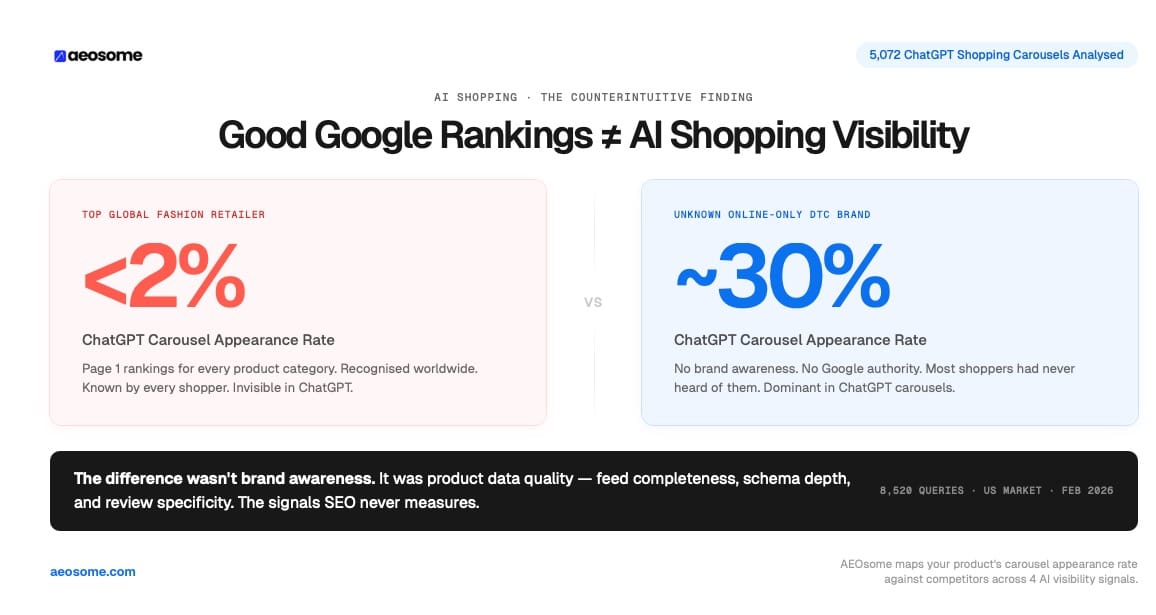
Brand recognition doesn't protect you here, either. In our analysis of 5,072 ChatGPT shopping carousels, one of the world's largest fashion retailers appeared in fewer than 2% of triggered carousels. An online-only DTC brand most shoppers had never heard of appeared in nearly 30%. The difference wasn't brand awareness. It was product data quality. What those 8,520 queries revealed about AI shopping behavior shows the full pattern.
How ChatGPT Actually Selects Products for Its Carousel
OpenAI's March 2026 product announcement describes the mechanism directly: through the Agentic Commerce Protocol, merchants share product feeds so their catalogs are "fully represented in ChatGPT." This is not a search index you can submit to directly. It is a product data evaluation layer and it operates on the quality of what you feed it.
For Shopify merchants, OpenAI confirmed that product data is integrated into ChatGPT through Shopify Catalog. Your products are automatically in the pool. But being in the pool and appearing in the carousel are two different things.
What ChatGPT evaluates when deciding which products to surface:
- Structured product metadata: price, description, availability, attributes at variant level
- Review data: volume, recency, rating, and the specificity of review content
- Query-to-product relevance: how precisely your product attributes match the intent behind the query
OpenAI has also confirmed that product recommendations are not ads and are not influenced by paid placements or commercial partnerships. Products are selected on relevance and data quality alone. That means this is a level playing field and the merchants who understand the signals win it.
Here are the four signals where your competitors are most likely ahead.
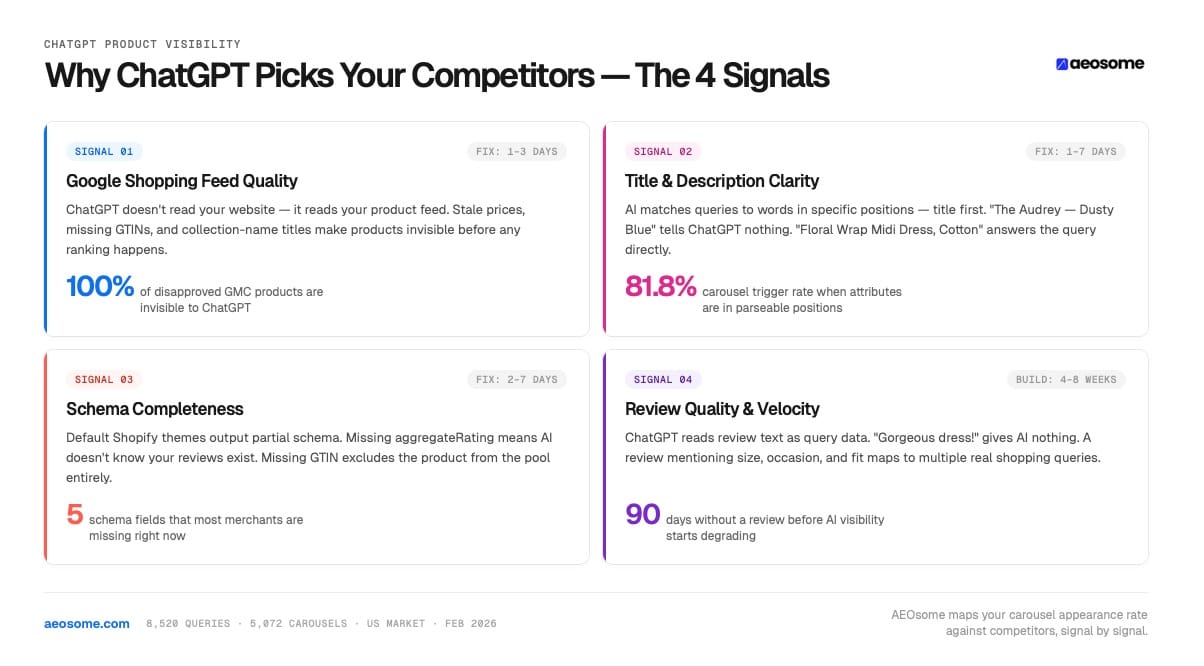
Signal 1: Your Google Shopping Feed Is Where ChatGPT Actually Looks
ChatGPT's product carousel does not pull directly from your website's HTML. It evaluates structured product feed data, the same feed infrastructure that Shopify already submits to Google Merchant Center. OpenAI's ACP documentation confirms that merchants share product feeds so their catalogs are "fully represented in ChatGPT." Shopify Catalog connects your store to this layer automatically. But the quality of that feed is entirely your responsibility.
A weak feed looks like this:
- Product titles using internal collection names ("The Riviera — Sage", "Desert Bloom — Rose")
- Prices that haven't updated since last week's sync
- Missing GTINs (barcodes) on private-label or custom products
- Inventory status set at the product level, not at the variant level
A strong feed looks like this:
- Descriptive titles that lead with product category and key attributes
- Real-time price and availability synced at variant level
- Complete GTINs across all SKUs
- Regular feed updates — not weekly batches
In our carousel data, the brands with the most consistent presence across intent stages shared one structural pattern: they controlled their own product feed and it was current, complete, and descriptive. The brands that appeared only at high-purchase-intent stages or not at all had the thinnest data.
Fix: Log into Google Merchant Center. Filter products by "Disapproved" and "Limited." Every disapproved product is invisible to ChatGPT's product selection layer. For Shopify merchants, the Google & YouTube Sales Channel controls what gets submitted. Every field you leave blank is a query type you won't match.
Signal 2: Product Titles and Descriptions AI Cannot Parse
This is the most common gap and the most fixable.
When someone asks ChatGPT "what's a good floral dress for a summer wedding," it needs to match that query against specific words in specific positions. Title first. Then H1. Then the opening sentence of the description. Terms buried in bullet points or lifestyle copy don't carry the same weight.
A product titled "The Audrey — Dusty Blue" tells ChatGPT nothing about what it is or who it's for. A product titled "Floral Wrap Midi Dress, Dusty Blue, 100% Cotton — Brand Name" answers the query directly.
The ordering matters: product category first, then the attributes that appear in shopping queries (material, occasion, fit), then size range if relevant, then brand name last. To a shopper using ChatGPT to discover a product, your brand name is meaningless until after they've found what they're looking for. Lead with what the product is.
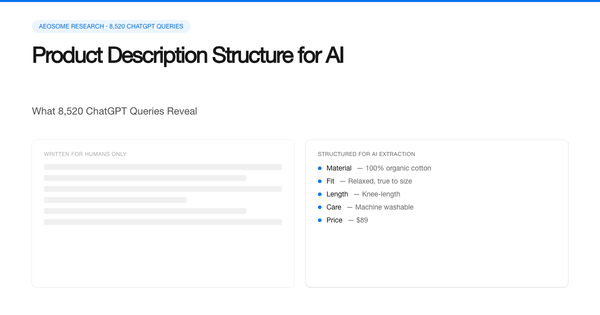
Descriptions have the same problem. Most focus on aspiration and lifestyle copy, language that sounds appealing but gives AI nothing concrete to match. What ChatGPT needs is specificity: the occasion this product fits (garden wedding, beach holiday, office), the body fit (adjustable, inclusive sizing, petite-length available), and the practical detail that maps to real queries (wrinkle-resistant, machine washable, lined).
From our 8,520-query dataset: Attribute Constrained queries: "floral, knee-length, cotton dress" — trigger product carousels 81.8% of the time. But only if your product data contains those attributes in parseable positions. Products without them don't appear, regardless of how well the brand ranks elsewhere. The full breakdown by intent stage shows where this gap is most costly for most merchants.
Fix: Audit your top revenue products. Any title that leads with a brand name, collection name, or creative label needs a rewrite, category and key attributes first. Then add a plain-language description block that covers occasion, fit, and material in the first two sentences. Add a FAQ block of 3–5 questions drawn from real customer emails and reviews, marked up with FAQPage schema.
Signal 3: Incomplete Schema Makes Products Structurally Invisible
Every product page carries two layers of information: the visual content shoppers read, and structured data that machines read. Schema markup is that second layer. Most Shopify themes output a partial version of it automatically, enough to pass a basic validation check, but missing the specific fields that ChatGPT relies on when selecting products for a carousel.
The fields that matter most for AI shopping visibility are usually the ones default themes leave out:
| Schema Field | Why It Matters |
|---|---|
| aggregateRating + reviewCount | ChatGPT uses ratings as a quality signal — without this field it doesn't know your reviews exist |
| material, color, size | Required for Attribute Constrained queries — 81.8% carousel trigger rate in our dataset |
| availability at variant level | AI will not confidently recommend a product with unknown availability status |
| gtin | Required for ACP eligibility — missing GTINs exclude products from the pool entirely |
| offers with current pricing | Stale prices break Budget Framing query matching — the second highest-volume query type |
The brands dominating our carousel dataset share a pattern: complete, dense, variant-level product data. Our brand visibility research found that a smaller DTC brand with attribute-dense product pages ranked #2 across 5,072 carousels, above established retailers with bigger catalogs and weaker schema. The AI wasn't rewarding brand recognition. It was rewarding data completeness.
For merchants who have enrolled in Shopify's Agentic Plan, the feed connection is handled but what flows through that connection is still your responsibility. The protocol compliance gaps that prevent products from appearing go deeper than default theme schema, and most merchants haven't audited them.
Fix: Paste your top three product URLs into Google's Rich Results Test. Note every missing field. At minimum, ensure each product page includes: name, description, image, price, availability, brand, aggregateRating, and gtin. For Shopify merchants, the Google & YouTube Sales Channel controls what product data gets submitted. If your theme's default schema output is incomplete, a dedicated schema app will generate fuller Product markup — check what your theme actually outputs before assuming the default is sufficient.
Signal 4: Review Quality and Velocity, Not Just Star Rating
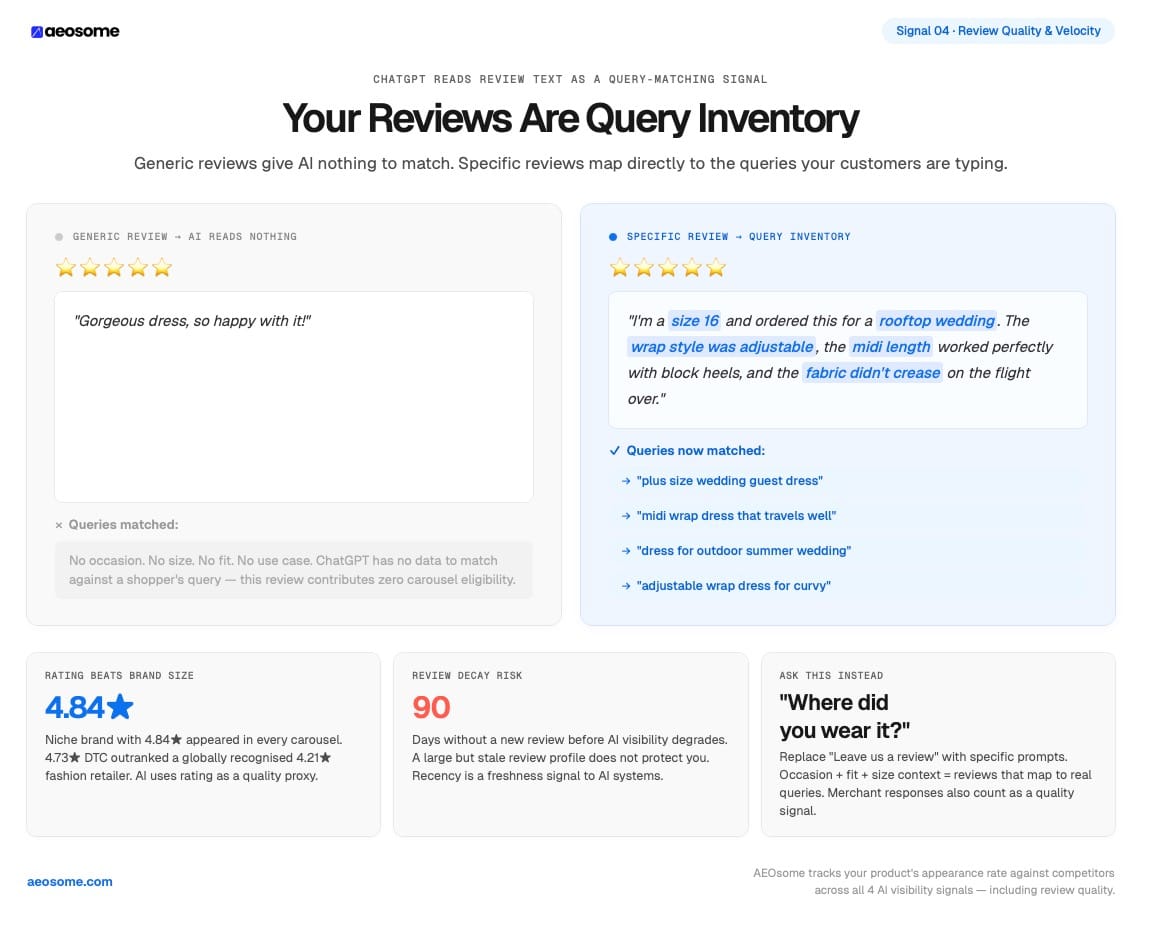
ChatGPT doesn't just read your star rating. It reads your review content.
A review that says "Gorgeous dress, so happy with it" gives ChatGPT nothing to match against a query. A review that says "I'm a size 16 and ordered this for a rooftop wedding, the wrap style was adjustable, the midi length worked perfectly with block heels, and the fabric didn't crease on the flight over" maps directly to queries like "wedding guest dress for plus size," "midi wrap dress that travels well," and "dress for outdoor summer wedding."
This is why rating average is a stronger predictor of carousel rank than brand size.
In our analysis of 5,072 carousels, the pattern holds consistently: a premium DTC brand with a 4.73-star average outranked a globally recognized fashion brand with a 4.21-star average, despite the larger brand having far more total reviews. A niche brand with a 4.84-star average appeared repeatedly despite having minimal brand recognition in the US market. The AI is using ratings as a quality proxy and review text as a query-matching signal. Both matter independently.
Two dimensions determine how much your reviews contribute to AI visibility:
Review velocity: Recent reviews outrank stale ones. A product accumulating detailed reviews consistently outranks a product with a large but ageing review profile. The recency of your social proof matters for the same reason that content freshness matters in search.
Review specificity: Reviews that mention specific use cases, problems, occasions, and measurable outcomes give the AI more material to match against queries. Generic star ratings contribute almost nothing to carousel eligibility.
Fix: Change how you ask for reviews. Instead of "Leave us a review," prompt with something specific: "Where did you wear it? How did it fit compared to your usual size? What made you choose this one?" That framing produces reviews that map to real shopping queries. Respond to every review — platforms and AI systems both treat merchant engagement as an active quality signal. Prioritize reviews marked up with schema on your own product pages; those are the most directly readable by AI at point of selection.
How to Audit Which Signal Is Holding You Back
Run these four checks before making any other changes:
- Google Merchant Center: Log in and filter by "Disapproved" and "Limited." Every flagged product is invisible to ChatGPT's product selection layer. Start here.
- Product titles: Review your top 20 products by revenue. Do the titles start with the product category or your brand name? Any that lead with brand need to be rewritten.
- Schema audit: Run your three best-selling product URLs through Google's Rich Results Test. Note every missing field, particularly
aggregateRatingandgtin. - Review recency: When did your last batch of reviews come in? If a product hasn't received a new review in 90 days, its AI visibility is actively degrading.
Then run the manual test that costs nothing: open ChatGPT and type five queries the way your customers would, the natural language questions they'd actually ask. Note which brands appear. Note which don't. That's your competitive baseline and it's the most direct signal of where you currently stand.
This is what AEOsome does at scale. Instead of running five manual queries, AEOsome runs hundreds across all relevant intent stages for your specific category and maps your product's appearance rate against competitors, signal by signal. The output shows you exactly which of the four signals is the bottleneck, and which competitor is filling the gap you're leaving open.
Frequently Asked Questions
AI keeps recommending my competitors but not us, how do I fix this?
The most common cause is one of four gaps: your Google Shopping feed has missing or stale data, your product titles aren't descriptive enough for AI to match to queries, your schema is incomplete at the variant level, or your review velocity has slowed. Start by identifying which gap applies, each has a different fix timeline. Feed and schema gaps can close in days. Review velocity takes weeks to rebuild.
Can a brand have good SEO and still be invisible in AI shopping results?
Yes and it is one of the most consistent patterns in AI shopping data. A brand can hold page one Google rankings for every relevant category keyword and still fail to appear in ChatGPT shopping carousels. Google rankings and AI carousel selection are powered by completely different signal systems. Traditional SEO builds page authority. AI shopping requires feed compliance, attribute completeness, and review data, signals that most SEO strategies never address.
Can I pay to appear in ChatGPT shopping results?
No. OpenAI has stated explicitly that product recommendations in ChatGPT are not ads and are not influenced by paid placements or partnerships. Products are selected based on relevance signals and product data quality. There is no paid placement mechanism in ChatGPT's shopping carousel.
My store is on Shopify, am I automatically showing up in ChatGPT?
You are automatically enrolled in the pool through Shopify Catalog, which connects your product data to ChatGPT's discovery layer. Enrollment is not the same as appearing. Whether your products surface in a specific query depends on the quality of your feed, the completeness of your schema, and how well your product attributes match what a shopper asked. Enrollment gets you in the door. Data quality determines whether you appear and where.
What actually influences AI product recommendations for eCommerce brands?
The four signals are: structured product feed quality (price accuracy, attribute completeness, GTIN coverage), product title and description clarity (AI needs to parse what the product is and who it is for), schema markup completeness at variant level (aggregateRating, material, availability, brand), and review quality and recency (specific review content that maps to real customer use cases). Google search rankings and domain authority have near-zero influence on this selection system.
Does blocking GPTBot affect whether my products appear in ChatGPT carousels?
Not directly. OpenAI distinguishes between GPTBot, which is used for training data crawling, and OAI-SearchBot, which is used for search features including shopping. Blocking GPTBot in your robots.txt does not affect shopping carousel eligibility. However, blocking OAI-SearchBot will prevent your pages from appearing in ChatGPT search answers. Check your robots.txt and any security apps installed on your store — some Shopify security tools block AI crawlers unintentionally.
About the author. Vijaya Kumar Channalli is a serial SaaS founder and the founder of AEOsome (Tartu, Estonia), which helps eCommerce brands get their products recommended when shoppers ask AI what to buy. Read how we write, source and correct posts in our editorial policy.
This analysis draws on 8,520 ChatGPT shopping intent queries executed across all nine intent stages, US market. Brand carousel share figures are derived from 5,072 triggered product carousels. Data collected February 2026.