AEO vs SEO for Online Stores: What Actually Changes
AEO and SEO share a foundation but reward different things. Here's exactly what changes for an online store doing both — and what doesn't.

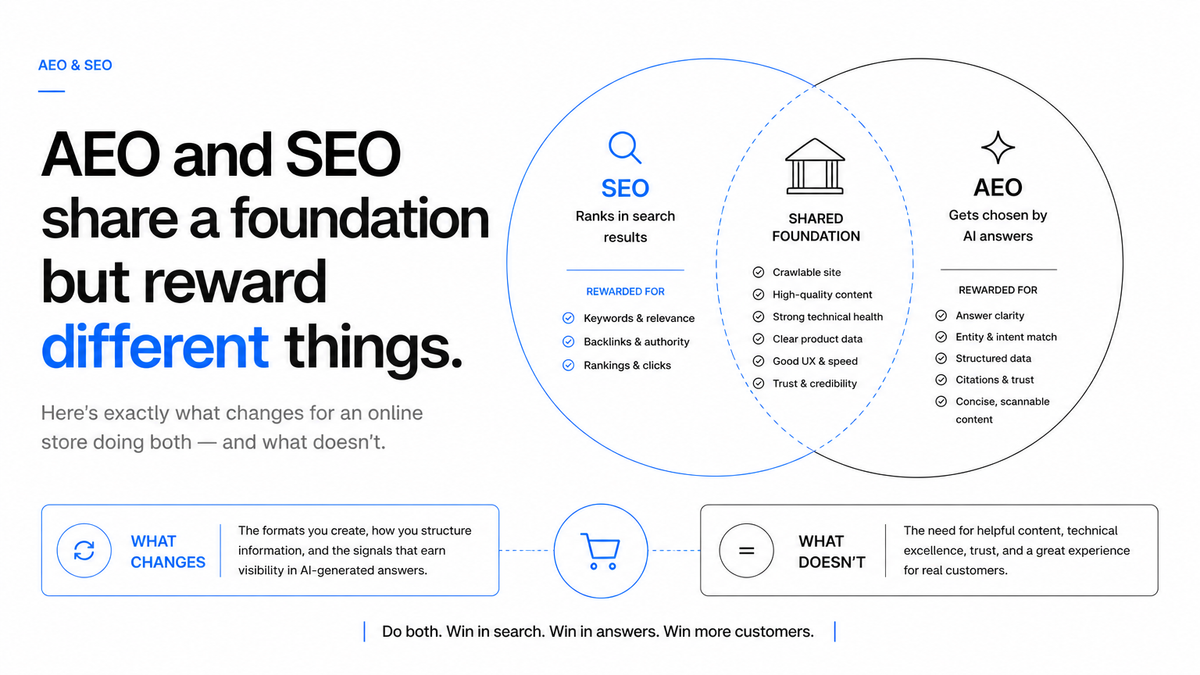
AEO doesn't replace SEO. It shares SEO's technical foundation, then rewards something different on top of it: getting a store's specific products cited or recommended inside an AI-generated answer, not just ranked in a results list. By late 2026, zero-click search has gone from a minority pattern to the majority pattern for many query types. eCommerce teams are asking whether their SEO budget still makes sense.
Key TakeawaysSEO and AEO share a technical foundation — crawlability, structured data, page experience — but reward different things after that: SEO depends on link authority and clicks, AEO depends on extractable, verifiable product data.AI platforms cited a specific product in 35.6% of 22,335 shopping responses AEOsome analyzed across four platforms (AEOsome Research, 2026) — traffic that never shows up in a Google Search Console click report.68.01% of Google searches ended without a click in early 2026, up from 60.45% in 2024 (SparkToro, analysis of Similarweb data, 2026) — SEO's job got harder, not irrelevant.Shoppers clicked a traditional organic result only 8% of the time when an AI summary was present, versus 15% without one (Pew Research Center, 2025) — AEO's payoff isn't click-dependent.AEO doesn't replace SEO. Reallocate incrementally, starting with the SKU-level structured data both channels reward, before shifting budget into AEO-only work.
This post lays out exactly what carries over from SEO and what's new in AEO. Then it covers what a store should actually change: keyword research, content, KPIs, and team ownership.
In this article:
- AEO vs SEO for Online Stores at a Glance
- What SEO Still Does for Your Store
- What AEO Adds
- Where SEO and AEO Genuinely Overlap
- Where SEO and AEO Diverge
- What Actually Changes for an Online Store
- Do You Need Both? The Verdict
- Frequently Asked Questions
- SEO Built the Foundation. AEO Is a Second Scoreboard on Top of It.
AEO vs SEO for Online Stores at a Glance
The practical relationship is simple to state and easy to misapply. The two disciplines share a technical foundation, then reward different things once a page or product record clears that bar.
| Dimension | SEO | AEO |
|---|---|---|
| Unit optimized | Page / domain | Product record or passage (SKU/variant level) |
| Primary surface | Classic search-results list | AI-generated answers (ChatGPT, Perplexity, Google AI Mode, Copilot) |
| Core signal | Link authority, on-page relevance | Extractable, verifiable product data + third-party corroboration |
| Success metric | Rank position, organic clicks | Citation rate, AI-driven product mentions |
| Content format | Long-form pages, category/PDP copy | Structured attributes, feeds, self-contained answerable passages |
| Does clicking matter? | Yes — CTR is a direct ranking and revenue input | No — a citation can influence a purchase with zero click-through |
If you've seen GEO or AIO used for this same idea, AEO vs GEO vs AIO: Do the Distinctions Matter for an eCommerce Store? covers why the terminology debate doesn't change the fixes below.
What SEO Still Does for Your Store
SEO remains responsible for the technical and content foundation an AI platform also depends on to find and trust a store's product data. It isn't obsolete — it's a prerequisite.
Crawlability and indexing, page speed and Core Web Vitals, on-page relevance, link-authority-driven ranking position, and click-through-rate optimization for the classic ten-blue-links result are all still SEO's job. None of them have gone away. An AI platform that can't crawl a product page has no reliable source to cite from in the first place. Neither does one that finds a slow, thin, or duplicate page.
68.01% of Google searches ended without a click in the first four months of 2026, up from 60.45% in 2024 (SparkToro, analysis of Similarweb clickstream data, June 2026). That doesn't mean SEO's job got easier — it got harder.
A shrinking share of searches end in a click. Every page still has to earn that click against tighter odds — while also feeding the structured, extractable data AI platforms need for the queries that don't end in a click at all.
Strong Google Rankings, Invisible in AI: Why Ranking Signals Don't Transfer goes deeper into why your Google rankings don't guarantee an AI citation.
What AEO Adds
AEO adds a second success condition on top of ranking: getting a store's specific products cited or recommended inside an AI-generated answer. It doesn't matter whether the shopper ever visits the ranked page.
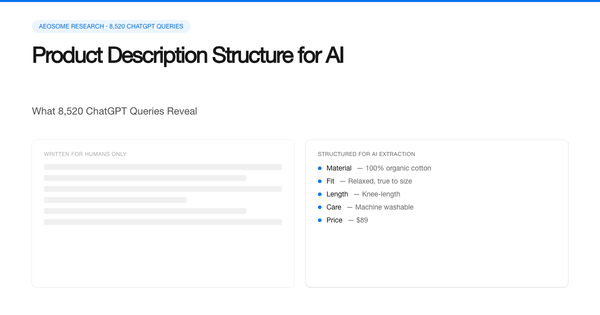
Where SEO's core signal is link authority, AEO's core signal is extractable, verifiable product data. That means complete structured data (Product, Offer, AggregateRating), attribute completeness down to the variant, and corroboration from sources outside the store's own site. An AI platform assembling a shopping answer is checking whether it can trust and extract a clean answer from your data. It isn't checking whether your domain has accumulated enough backlinks to outrank a competitor.
Take a shopper asking an AI platform for "waterproof hiking boots under $150 in size 10." The AI doesn't rank ten pages and let the shopper click through — it extracts a specific boot's price, size availability, and rating directly from product data, then names it. A store with clean feed data and thin backlink authority can still get named. A store with strong backlink authority and gappy variant data often can't.
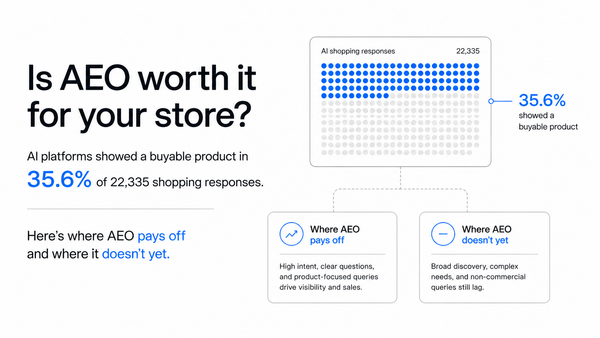
AI platforms cited a specific product in 35.6% of 22,335 shopping responses AEOsome analyzed across four platforms (AEOsome Research, 2026). No product category AEOsome studied fell below a 28.7% citation rate. The opportunity exists across verticals — but the AI never has to send the shopper to your page to capture it.
How AI Product Discovery Actually Works: Feeds, Retrieval, and Carousels breaks down how retrieval and carousels actually surface a product.
Where SEO and AEO Genuinely Overlap
The overlap is real but narrower than most vendor content implies — it's the technical layer, not the ranking-and-reward layer.
Valid Product/Offer/AggregateRating schema, fast and crawlable pages, and accurate, complete product content are work a store should do once and get credit for in both channels. A store with clean structured data and a fast, indexable catalog has already built the foundation both disciplines depend on. The divergence starts only after that foundation is in place.
Several competitor explainers on this exact search query cite an unattributed "ranking-factor overlap" percentage — commonly a "40% overlap" figure with no visible source or methodology behind it. That number isn't used here. Naming the specific factors that carry over is more useful than repeating a recycled statistic that doesn't survive a source check.
Where SEO and AEO Diverge
Past the technical foundation, the two reward different things. SEO still rewards backlink authority and click-through optimization. AEO rewards being independently corroborated across sources and structured at the SKU/variant level — and it pays off without a click.
AI product visibility is won or lost at the SKU/variant level through feed compliance and structured data, not at the brand-mention level. A store can be mentioned favorably in an AI answer without a single one of its products actually being recommended for purchase. Those are two different outcomes that get conflated constantly. SEO's unit of optimization is the page and the domain. AEO's unit is the individual product record.
Users clicked a traditional organic result only 8% of the time when an AI summary was present in the results, versus 15% without one (Pew Research Center, 2025). That's a direct illustration of why AEO's payoff has to be measured differently than a click.
Who Owns AEO — SEO, Content, or Operations? Building the Workflow covers who should actually own this work on your team.
What Actually Changes for an Online Store
Four concrete things change: the unit of optimization, the success metric, the research input, and often the owner.
- The unit of optimization shifts from the page to the product record or passage. SEO teams think in pages and category structures; AEO work has to think in SKUs and variants, because that's the unit an AI platform actually cites.
- The success metric shifts from rank position and clicks to citation rate. A product can be cited and drive a purchase without ever appearing in a Search Console click report.
- The research input shifts from search-volume keywords to the actual question corpus shoppers ask AI. Those questions are phrased conversationally, often with a budget or use-case constraint baked in — not the head-term keywords a traditional keyword tool surfaces.
- The owner often shifts from a single SEO lead to a cross-functional feed/content/ops loop, because AEO work touches the product feed and data pipeline as much as it touches content.
Google's AI Mode surpassed 1 billion monthly users (Google, I/O 2026) — the scale argument for why the metric shift in change #2 matters, not just the mechanism. A citation surface with that much reach doesn't have to convert on rank position to move revenue.
Reconciling product data across every channel a store publishes to is exactly where the SKU-level work in change #1 actually happens. The fix is reconciling identifiers, prices, and variant rows across every feed a store maintains, so the AI has one consistent, complete record to cite from.
Zero-Click Search and What AI Answers Mean for Store Revenue covers what zero-click search actually means for your store's revenue.
Do You Need Both? The Verdict
Yes. AEO doesn't replace SEO, and a store that defunds SEO to chase AEO loses the technical foundation both depend on. Reallocate incrementally: fund the SKU-level structured-data and feed-compliance work first, since it's rewarded by both channels, before shifting budget into AEO-only work.
Average monthly visits across generative AI platforms grew 70% year-over-year, reaching 9.5 billion by May 2026 (Similarweb, July 2026) — traffic growth that traditional search isn't matching. That growth trajectory, not a prescribed budget-split ratio, is the actionable signal here. Several competitor posts assert a specific SEO/AEO budget split (a "70/30 moving to 60/40" allocation is a common example) with no visible methodology behind it. That number isn't used here either: sequence the work instead of guessing a ratio.
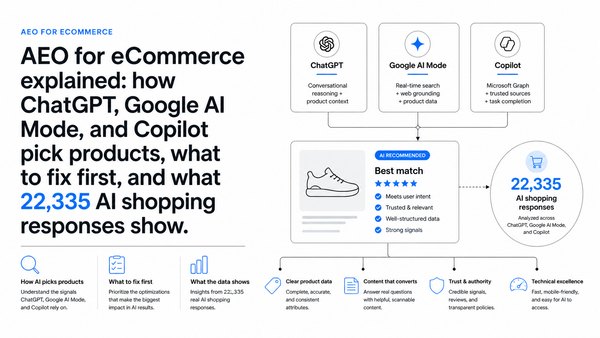
Is AEO Worth It for eCommerce in 2026? What 22,335 AI Shopping Responses Say has the full ROI picture from 22,335 AI shopping responses. AEO for eCommerce: The Complete Guide to Getting Products Recommended by AI is the complete AEO for eCommerce guide. Before adding AEO work on top of your SEO program, see where AEO pays off and where it doesn't yet, based on 22,335 AI shopping responses.
Frequently Asked Questions
Is AEO replacing SEO?
No. AEO adds a second, separately measured success condition — citation inside an AI answer — on top of the technical and content foundation SEO already builds. Stores that stop SEO work lose signals AEO depends on too.
Do I need separate teams or budgets for SEO and AEO?
Not necessarily separate teams, but separate KPIs: rank position and organic clicks for SEO, citation rate and AI-driven product mentions for AEO.
What SEO ranking factors still matter for AEO?
Valid structured data, page speed and crawlability, and accurate, complete product content — the technical foundation both reward. Backlink authority and click-through-rate optimization stay SEO-specific.
How do I measure AEO if it doesn't show up in Google Search Console?
Track citation and recommendation rate directly across the AI platforms shoppers actually use, since that traffic and influence is largely invisible to traditional analytics.
SEO Built the Foundation. AEO Is a Second Scoreboard on Top of It.
AEO and SEO share a technical foundation — crawlability, structured data, page experience — then reward different things: SEO still depends on link authority and click behavior, AEO depends on extractable, verifiable product data and third-party corroboration. Four concrete things change for a store that adds AEO: the unit of optimization, the success metric, the research input, and often the owner.
AI platforms cited a specific product in 35.6% of the 22,335 shopping responses AEOsome analyzed, and 68.01% of Google searches ended without a click in early 2026. Don't defund SEO to fund AEO.
See which of your products are already eligible to be cited, and where the feed-level gaps are before you reallocate a single dollar of budget. Check your AI citation rate
About the author. Vijaya Kumar Channalli is a serial SaaS founder and the founder of AEOsome (Tartu, Estonia), which helps eCommerce brands get their products recommended when shoppers ask AI what to buy. Read how we write, source and correct posts in our editorial policy.
Sources: AEOsome Research, 2026; SparkToro, In 2026, Less than One Third of Google Searches Still Send a Click, June 2026; Pew Research Center, Google users are less likely to click on links when an AI summary appears in the results, July 2025; Google, Sundar Pichai's opening keynote, I/O 2026; Similarweb, AI Search Stats in 2026, July 2026.