Zero-click search costs eCommerce stores informational clicks, but it does not remove the purchase. In AI shopping answers, a product card with a price and a merchant link replaces the ten blue links. Revenue now depends on whether your SKU holds that card, and whose store the card links to.
Key TakeawaysZero-click is real: Google users clicked a result in 8% of visits with an AI summary, against 15% without one (Pew Research Center, 2025).For stores, the answer is often a product card: Google AI Mode showed one in 64.4% of shopping questions, Copilot in 44.5% (AEOsome Research, 2026).That click often goes to a marketplace: 25.2% of Copilot's card slots link to Amazon and 18.2% to Walmart (AEOsome Research, 2026). Being cited is not the same as owning the card.AI-sent visitors are growing fast: AI traffic to US retail sites rose 693.4% in holiday 2025, and Adobe expects +130% this season (Adobe, 2026).The paid shelf is starting: Google AI Mode showed ads in 3.9% of shopping answers and 10.1% of Home answers (AEOsome Research, 2026).
Adobe's 2026 holiday season window opened on 1 November with two numbers pulling in opposite directions. Adobe expects AI traffic to US retail sites to rise 130% year over year. Pew found that Google users click a result about half as often when an AI summary appears.
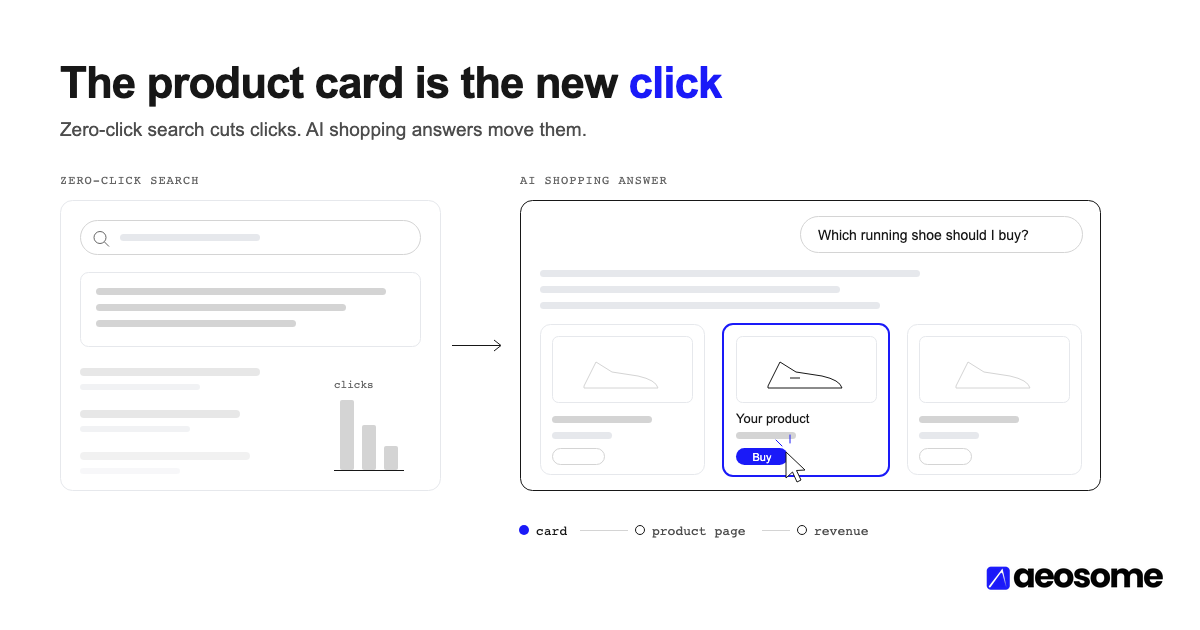
So is zero-click search, a search that ends without a click to any website, costing your store sales? For shopping questions, the answer depends on something most coverage skips: the product card. That's a structured result inside the AI answer, with a product name, a price and a merchant link.
This post reads zero-click through AEO (Answer Engine Optimization), the work of getting your products into AI answers. If the term is new, start with what AEO is and why eCommerce brands need it.
In this article:
- What Happened: Zero-Click Reached the Shopping Funnel
- Why This Matters: For Stores, the Answer Is Often a Product Card
- Where the Click Goes When the Answer Is a Product Card
- What This Means for Store Revenue
- What to Do Before the Holiday Peak
- The Bigger Picture: Zero-Click Becomes Zero-Visit Checkout
- Frequently Asked Questions
- The Click Didn't Disappear. It Moved.
What Happened: Zero-Click Reached the Shopping Funnel
As of November 2026, AI answers reach billions of searchers by Google's count, and two independent measurements show the click going away when they appear.
Pew Research Center tracked 68,879 Google searches by 900 US adults in March 2025. Users who saw an AI summary clicked a traditional result in 8% of visits. Users who didn't see one clicked in 15% (Pew Research Center, 2025). Sessions ended on 26% of pages with a summary, against 16% without.
A field experiment by Agarwal and Sen at the Indian School of Business points the same way. Across more than 1,000 US participants, organic clicks fell by roughly 39.8% when AI summaries appeared (ISB, 2026). The chance of a zero-click search rose by about a third. It is a working paper, not yet peer-reviewed.
Scale makes this matter. Google says AI Overviews has over 2.5 billion monthly active users, and AI Mode has passed 1 billion (Google, May 2026). Those are company-reported figures.
Google disputes the traffic loss. Liz Reid, Head of Google Search, wrote that "total organic click volume from Google Search to websites has been relatively stable year-over-year" (Google, August 2025). Google published no method for that claim. Treat it as Google's position, not a measurement.
Why This Matters: For Stores, the Answer Is Often a Product Card
Zero-click studies measure all searches, not shopping searches. Shopping questions are different: the AI answer often carries its own click target. For a store, the question isn't "will shoppers click?" It's "will they click on mine?"
We analyzed 22,335 answers to shopping questions across four AI engines. Google AI Mode showed a product card in 64.4% of answers, Copilot in 44.5%, ChatGPT in 28.5% and Perplexity in 5.0% (AEOsome Research, 2026). ChatGPT's rate blends three served models with very different card rates (Chapter 6).
| Before AI answers | After AI answers |
|---|---|
| Ten blue links; the click goes to a page you rank | A written answer, often with a strip of product cards |
| Citations and rankings decide traffic | A product index supplies the cards; citations justify the text (a hypothesis from our study) |
| You compete for positions 1 to 3 | You compete for a median of 4 to 7 card slots per answer, depending on the engine |
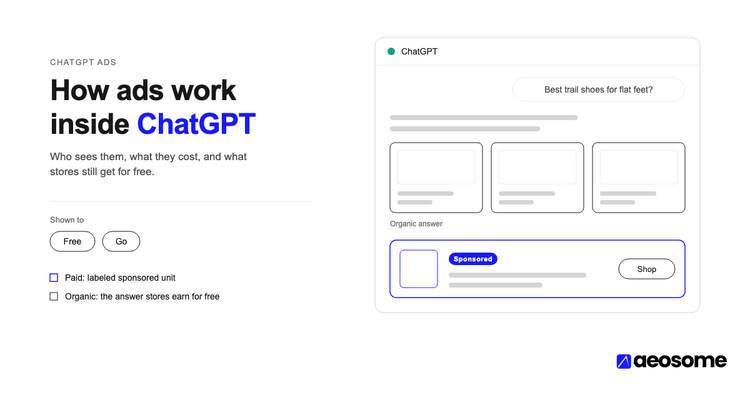
| Ads sit above organic results | Ads appear inside Google AI Mode answers (3.9% of them) |
Citation clicks and card clicks are two different pipes. Pew's 1% measures the first one: links inside the summary. In our ChatGPT study of women's dresses, the store hosting a carded product appears among the answer's cited sources for only 19.1% of card slots (AEOsome Research, 2026, Study 1). When it does, its median position is twelfth.
So a store can lose citation clicks and still gain card clicks, or the reverse. Zero-click headlines only count the first pipe. That's why being cited is not the same as being recommended.
Citation Capsule: In shopping answers, the product card is a second click path that zero-click studies don't measure. Google AI Mode showed a card in 64.4% of shopping answers (Study 2). In our ChatGPT study of women's dresses (Study 1), the store hosting a carded product was among the cited sources for only 19.1% of card slots (AEOsome Research, 2026).
Where the Click Goes When the Answer Is a Product Card
The card click often lands on a marketplace or big-box retailer, not the brand's own store. A brand can appear in AI answers and still send the sale to Amazon or Walmart.
Copilot is the clearest case. 25.2% of its card slots link to Amazon and 18.2% to Walmart. Its top three merchants hold 47.5% of slots (AEOsome Research, 2026).
ChatGPT leads with Walmart, at 11.0% of its card slots, followed by Best Buy and Target (AEOsome Research, 2026). Google AI Mode's product links are redirects, so our study can't say whose store its cards point to.
Brand-owned stores rarely hold the slot. Across Study 2's seven categories, they held 2.2% (Beauty) to 6.6% (Sports) of card slots (AEOsome Research, 2026). Women's dresses were the exception: in Study 1, 42.3% of ChatGPT's slots sat on the brand's own store. Direct-to-consumer (DTC) categories can behave differently. In our data, only women's dresses did.
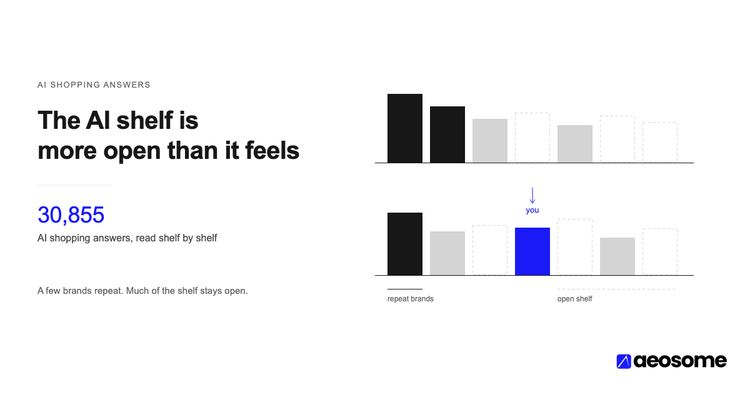
Perplexity runs the other way. 99.3% of its card links are Shopify-style store URLs, but it shows cards in only 5.0% of answers (AEOsome Research, 2026). A friendly shelf that rarely appears doesn't move much revenue.
What this means: zero-click can cost a brand twice. It loses the informational click to its content. It can also lose the card click to a reseller carrying its product. The second loss is the more fixable one: our study suggests cards draw on product data, not on the pages an answer cites. For the mechanics, see how AI product retrieval works.
Citation Capsule: In AEOsome's Study 2, 25.2% of Copilot's product card slots linked to Amazon and 18.2% to Walmart. Brand-owned stores held only 2.2% to 6.6% of slots per category (AEOsome Research, 2026). A zero-click shopping answer can still be a sale, often on someone else's store.
What This Means for Store Revenue
Fewer clicks do not automatically mean less revenue. The loss concentrates in top-of-funnel content, while buying questions shift from links to cards. Measure revenue per AI answer, not sessions.
Impact 1: How-to and care content loses traffic with little offset
Problem-recognition questions got a card 20.4% of the time, and post-purchase questions 14.7% (AEOsome Research, 2026). 57.1% of post-purchase questions got no card on any engine (Chapter 1). Expect the sharpest session declines on how-to, care and "what is" pages. Little in those answers sends the shopper back to you.
Impact 2: Buying questions shift from clicks to cards
Budget-framing questions got cards 54.8% of the time, and attribute-constrained questions 47.0% (AEOsome Research, 2026). These are the "best X under $100" and "waterproof X in size 10" questions. The click still exists. It moved into the card. See why budget-framed queries win product slots.
Impact 3: AI-sent visitors are growing from a small base
Traffic to US retail sites from generative AI tools rose 693.4% in the 2025 holiday season. Adobe added a caveat: "the base of users remains modest" (Adobe, January 2026). For this season, Adobe expects AI traffic to US retail sites to rise 130% year over year (Adobe, September 2026).
Adobe's July 2026 survey of 5,000 consumers adds a quality signal. Among respondents who have used AI for online shopping, 77% report feeling more confident in their purchase. 69% say they are less likely to return an item (Adobe, September 2026). Those are self-reports, not measured conversion rates.
A revenue model you can fill in
What most coverage misses is that a zero-click shopping answer can still be a sale, just not yours. Write the revenue as a chain of five terms:
AI answer revenue ≈ shopping questions in your category
                  × card rate on that engine
                  × your share of card slots (on your own store)
                  × card click-through
                  × conversion rate
Our research measures the second term by engine and the third by category. Your analytics supplies the last two, so start with tracking AI referral traffic in GA4. Slot share is the lever. Mention share isn't.
What to Do Before the Holiday Peak
Measure first, then fix the product data that decides cards, then protect the content that zero-click will thin out. Work in that order.
- This week: measure card presence per engine. Ask your top 20 buyer questions on Google AI Mode, Copilot and ChatGPT, several times each. Record whether a card appears and whose store it links to. One answer is a sample, not a measurement: ChatGPT changed its card decision in 42% of repeat pairs (AEOsome Research, 2026).
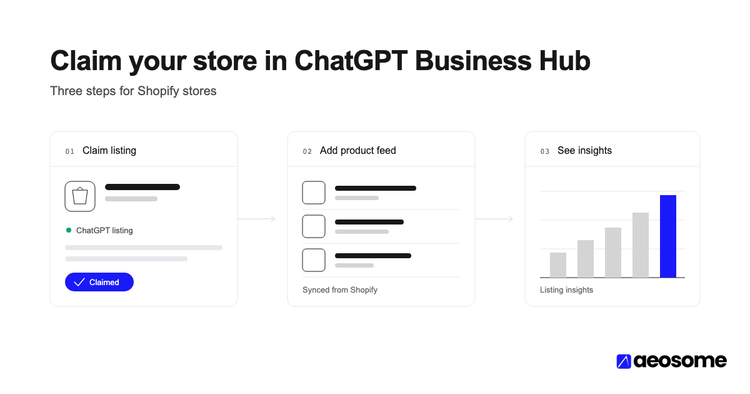
- This month: make your own store the eligible host. Complete GTINs, variant attributes, price, availability and policy URLs. Work through the feed eligibility checklist.
- This month: tag AI referrals in GA4. Make revenue from AI referrals the KPI, not sessions.
- This quarter: rebalance content. Keep informational content for citations and authority. Add product-led answers for budget and attribute questions.
- If you sell Home goods, watch AI Mode ads. Google AI Mode showed ads in 10.1% of Home answers and 0.3% of Beauty answers (AEOsome Research, 2026).
Three moves to avoid:
- Don't cut SEO because sessions fell. AEO layers on top of SEO. See what actually changes when you add AEO to SEO.
- Don't block AI crawlers to win the clicks back. Blocking doesn't restore the click, and card eligibility is a separate question.
- Don't treat one engine as the market. Only 1.6% of questions got a card on all four engines (AEOsome Research, 2026).
The Bigger Picture: Zero-Click Becomes Zero-Visit Checkout
Zero-click is a step toward checkout inside the AI answer. Agentic commerce, where an AI agent completes the purchase for the shopper, can remove the store visit entirely.
Two protocols carry it. ACP (Agentic Commerce Protocol, OpenAI + Stripe) and UCP (Universal Commerce Protocol, Google + Shopify) let an agent buy without a store visit.
The paid layer is arriving inside the answer too. Google AI Mode showed ads in 3.9% of its answers (AEOsome Research, 2026). When it did, its organic card rate was 84.7%, against 63.6% without ads. Ads tend to land on the most commercial answers.
The question for 2027 is not whether shoppers click. It's whether your SKU is the one the agent buys.
Frequently Asked Questions
Does zero-click search hurt eCommerce sales?
It cuts informational clicks: Google users clicked a result in 8% of visits with an AI summary, against 15% without (Pew Research Center, 2025). Shopping answers often carry a product card, though. Google AI Mode showed one in 64.4% of shopping answers (AEOsome Research, 2026). The sale is still there for whoever holds the card.
Do Google AI Overviews reduce traffic to online stores?
Field evidence says outbound organic clicks fall, by roughly 39.8% in one working paper (ISB, 2026). Google says total organic click volume has been "relatively stable year-over-year." The effect on your store depends on your query mix: how-to content loses most, buying questions shift to cards.
Is traffic from ChatGPT and AI search worth more than Google traffic?
Growth is clear: AI traffic to US retail sites rose 693.4% in holiday 2025, and Adobe forecasts +130% this season (Adobe, 2026). Whether each AI visit converts better is something to measure in your own store. Compare AI referral revenue per session against organic search in GA4.
How do I measure revenue from AI answers if shoppers don't click?
Measure card presence and slot share by engine with repeated asks, then track AI referral revenue in GA4. Decide early who owns this work, because it spans SEO, content and product data.
Should my store still invest in SEO if AI answers take the clicks?
Yes. Citations draw on pages the engine retrieves, and cards appear to draw on product data, so you need both. For the cost side, see whether AEO is worth it for your store.
The Click Didn't Disappear. It Moved.
Google users click a result in 8% of visits with an AI summary, against 15% without (Pew Research Center, 2025). For shopping questions, Google AI Mode shows a product card in 64.4% of answers. On Copilot, 25.2% of card slots go to Amazon and 18.2% to Walmart (AEOsome Research, 2026). The click went into the card, and often to someone else's store.
For the full playbook, read the complete AEO for eCommerce guide. Want to see which engines show a card for your products, and whose store it links to? Request a free AI shopping visibility check from AEOsome. We run it as Monitor → Audit → Optimize → Verify.
Methodology: Study 2 covers 22,335 de-duplicated answers (27,255 collected, 4,920 duplicate retries removed) from Google AI Mode, Copilot, ChatGPT and Perplexity. It spans 7 product categories and 9 intent stages, collected in the US from May 5 to 14, 2026. Study 1 covers 8,520 ChatGPT answers to women's-dress questions, collected on February 28 and March 1, 2026. Full details are in Chapter 7: Methodology.
Retrieval note: Adobe's holiday forecast PDF and Google's I/O 2026 page can change, and the ISB research page is undated. All three were retrieved on 6 November 2026.
Vijaya Kumar Channalli is a serial SaaS founder and the founder of AEOsome (Tartu, Estonia), which helps eCommerce brands get their products recommended when shoppers ask AI what to buy. Read how we write, source and correct posts in our editorial policy.