Who Owns AEO: SEO, Content, or Operations? Building the Workflow
Every eCommerce team debates whether SEO, content, or ops should own AEO. That's the wrong question. Meet the workflow that replaces it.

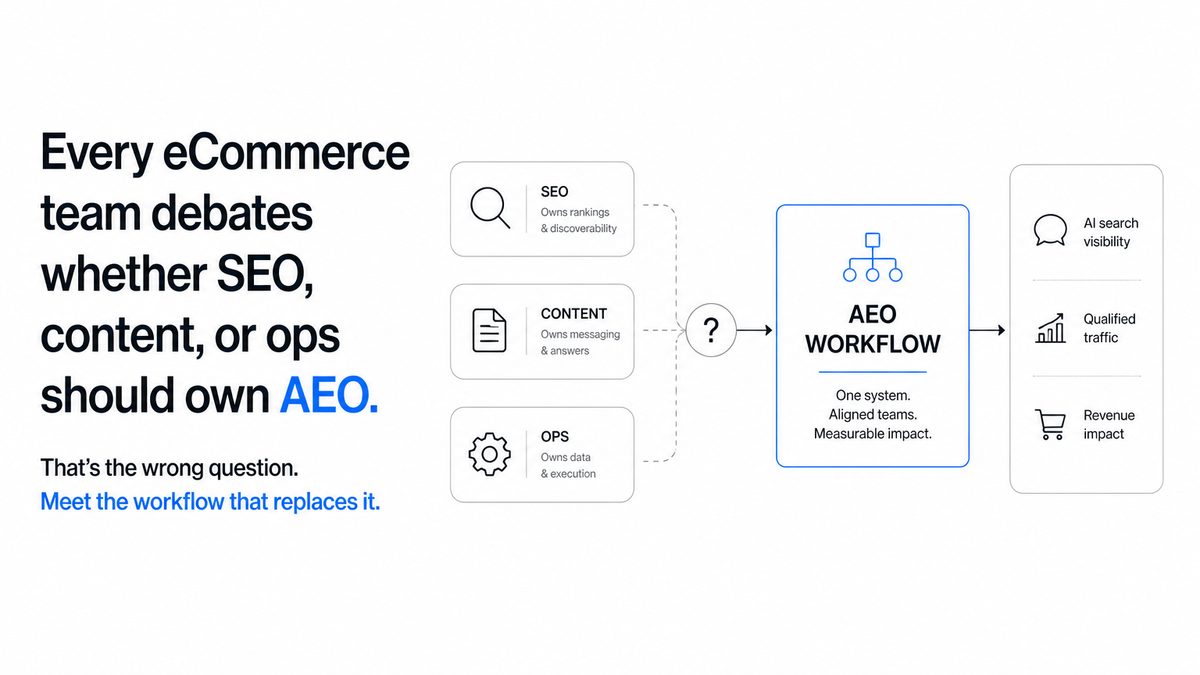
The "who owns AEO" debate is the wrong question for an eCommerce team. AEO fails when it's assigned to one function, because its highest-leverage fixes (structured product data, feed compliance, schema deployment) are operational, not editorial. Teams spend a quarter deciding whether SEO, content, or operations should own AEO. That same quarter, the feed and schema gaps that determine whether any product gets cited at all stay unfixed. This is the same lesson behind AEOsome's own Monitor → Audit → Optimize → Verify loop, built explicitly because no single team can run all four steps alone.
Key TakeawaysThe "who owns AEO" debate is a distraction. AEO stalls when one function owns it, because its highest-leverage fixes are operational, not editorial.AI platforms cited a specific product in 35.6% of 22,335 shopping responses AEOsome analyzed across four platforms (AEOsome Research, 2026). That's the shared number none of the three ownership camps can move alone.The fix is a three-role workflow, not a title. SEO owns query and intent research, content owns answer-ready copy, and operations owns feed and schema deployment, all three reporting to one KPI, product citation rate.Most stores under 5,000 SKUs can build this workflow in 30 days by reassigning existing team members, no new headcount required.
This post covers the three-camp ownership debate and why each camp breaks down for eCommerce specifically. It then covers the workflow model that replaces the debate, and a 30-day sequence to stand it up.
In this article:
- The Debate: Should SEO, Content, or Operations Own AEO?
- Why Picking a Single Owner Doesn't Work for an eCommerce Store
- What Actually Breaks When Nobody Owns the Handoffs
- The Workflow That Replaces the Ownership Question
- How to Build This Workflow in 30 Days
- Where This Model Doesn't Fit
- Frequently Asked Questions
- Stop Debating Ownership. Start Tracking One Number.
The Debate: Should SEO, Content, or Operations Own AEO?
Three camps dominate this conversation, and each one is a reasonable answer to the wrong question. Every ranking page on this exact query defaults to one of them. All three frame AEO ownership as a hiring or org-chart decision, rather than a workflow decision.
The SEO-led camp argues for renaming the existing SEO role's mandate rather than creating a new one. AEO is "just SEO for AI," in this view, so the team that already owns search should own this too. The CMO or marketing-led camp argues the opposite. AI systems pull signals from a brand's whole marketing footprint, not just the SEO team's pages, so ownership should sit above any single discipline. The dedicated-specialist camp splits the difference. It proposes a named AEO hire, distinct from both SEO and content, who owns the initiative end to end.
What Is AEO covers what AEO actually covers, before assigning it to anyone.
Marketing-agency content on this exact query commonly attaches a specific adoption percentage to the dedicated-specialist camp. That figure isn't attributed to a named, checkable methodology in any source reviewed for this post. It isn't repeated here; this cluster applies the same handling to unattributed statistics elsewhere.
Why Picking a Single Owner Doesn't Work for an eCommerce Store
All three camps share the same flawed assumption: that AEO is one kind of work with one natural home. For an eCommerce store, it's at least three kinds of work, and the highest-leverage one isn't editorial.
SEO-led ownership stalls on execution. An SEO lead can identify query gaps and intent mismatches. That's the Monitor and Audit half of the loop. But an SEO lead typically can't ship the fixes that make a product eligible to be cited. Those fixes are GTINs (Global Trade Item Numbers, the barcodes AI platforms use to match a listing to a real product), schema markup, and variant-level data. That's the Optimize half, and it usually needs engineering or operations. SEO rarely has the authority to compel that work on its own.
Content-led ownership stalls on eligibility. A content team can write answer-ready product and category copy all day. If the feed is missing policy URLs or has mismatched identifiers, no amount of copy makes a product eligible to be cited. Better copy on an ineligible product record changes nothing.
A dedicated "Head of AEO" hire without operational authority just moves the same coordination problem onto one person. It doesn't give that person the authority to prioritize engineering's backlog, so the bottleneck moves; it doesn't close.
AI platforms cited a specific product in 35.6% of 22,335 shopping responses AEOsome analyzed across four platforms (AEOsome Research, 2026). No product category AEOsome studied fell below a 28.8% citation rate. That number is the shared KPI none of the three camps can move alone; it takes all three functions working the loop together.
AEO vs SEO for Online Stores: What Actually Changes breaks down what actually changes in the day-to-day work, camp by camp.
What Actually Breaks When Nobody Owns the Handoffs
The failure isn't usually a lack of effort inside any one team. It's the handoff between them. A gap opens where SEO's Audit findings, content's copy, and operations' feed fixes are supposed to meet, and nobody is accountable for closing it.
Three handoff-failure patterns repeat across AEOsome's seven-gate diagnostic work. SEO flags a query-intent mismatch, but there's no ticket path into engineering's feed backlog, so the finding dies in a meeting. Content ships a rewritten product description, but the GTIN and policy-URL gaps underneath it never get fixed; the improved copy is still ineligible to be cited. Operations fixes a feed error, but nobody re-runs the query set to verify the fix actually moved citation rate, so a real win goes unmeasured.
| Workflow Stage | SEO | Content | Operations |
|---|---|---|---|
| Query & intent research | Owns | n/a | n/a |
| Answer-ready copy | Shares | Owns | n/a |
| Schema & feed deployment | n/a | Shares | Owns |
| Eligibility fixes | Shares | n/a | Owns |
| Citation monitoring | Shares | n/a | Owns |
AEO vs GEO vs AIO: Do the Distinctions Matter for an eCommerce Store? names this same ownership gap.
The Workflow That Replaces the Ownership Question
A three-role workflow replaces the ownership question entirely. It reports to one shared KPI (product citation rate) and maps directly onto AEOsome's Monitor → Audit → Optimize → Verify loop, instead of a single job title.
SEO runs Monitor and half of Audit: query fanout research, intent-mismatch detection, competitive gap analysis. It's accountable for identifying where and why products aren't appearing. Content owns the Optimize-step copy: answer-ready product and category descriptions, attribute completeness, and the review and Q&A content that closes competitiveness gaps. Operations or engineering owns the other half of Optimize and all of Verify. That covers GTINs, schema deployment, feed compliance, policy URLs, and re-running the query set after a fix ships.
Why it works: each role has a distinct, checkable deliverable instead of a vague mandate. That's the shape of what this workflow produces when nobody's waiting on a title to be created first.
The AEO Glossary has definitions for every term this workflow touches.
How to Build This Workflow in 30 Days
Start by assigning the Verify step, not the Monitor step. A shared citation-rate dashboard forces the ownership conversation to happen around a number instead of a title. The urgency behind that shift is already visible in how marketers describe their own traffic. 49% say web traffic from search has already decreased because of AI answers. 58% say AI referral traffic carries much higher intent than traditional search traffic (HubSpot, State of Generative AI, 2026). Average monthly visits across generative AI platforms grew 70% year over year, reaching 9.5 billion (June 2025 to May 2026) (Similarweb, July 2026). Pew Research found that users clicked a traditional search result in 8% of visits when an AI summary appeared, versus 15% without one (Pew Research Center, 2025). That's the shift the workflow below has to keep up with.
- Week 1: Run (or request) a baseline citation-rate check across your top 20 SKUs, so all three functions start from the same number instead of three different guesses.
- Weeks 1 to 2: Assign the three roles above to existing team members. This is a responsibility split, not new headcount, for most stores under 5,000 SKUs.
- Week 2: Give operations a dedicated intake path for the eligibility fixes SEO's Audit surfaces, so findings don't die in a meeting. A ticket queue or a shared board both work; the tool matters less than the queue existing.
- Week 3: Ship the highest-priority Critical-tier fixes (missing GTINs, policy URLs) before any content rewrite. Content changes on an ineligible product record don't move citation rate.
- Week 4: Re-run the query set, report the delta on the same shared dashboard from Week 1, and set the cadence. AEOsome's own Verify step re-runs 48 to 72 hours after a change; a monthly cadence is realistic for a first pass.
Track product citation rate and Commerce AEO Readiness Score, not rank position or organic sessions; those are SEO's numbers, not AEO's.
| Statement | Share of Marketers Who Agree |
|---|---|
| Search traffic has decreased because of AI answers | 49% |
| AI referral traffic shows much higher intent than traditional search traffic | 58% |
Is AEO Worth It for eCommerce covers whether this is worth the coordination cost for your catalog size.
Where This Model Doesn't Fit
A three-role split assumes a store has SEO, content, and some operational or engineering capacity to draw on at all. The model needs adapting, not abandoning, when one of those doesn't exist yet.
A solo founder or a two-person marketing team can't staff three separate roles. There, one person rotates through all three hats, but the workflow structure still applies. Monitor → Audit → Optimize → Verify, with citation rate as the shared number, is the coordination discipline that matters, not the headcount.
A dedicated hire does make sense once a catalog is large enough that coordination overhead between SEO, content, and ops becomes the bottleneck itself. At that scale, a named AEO lead who owns the workflow (not the execution) can be worth the headcount. Agencies that manage AI-search visibility for several eCommerce clients should map the same three roles onto each client's own team, not try to own all three functions themselves.
Frequently Asked Questions
Should SEO own AEO?
Partially. SEO is well-positioned to own the Monitor and Audit steps: query research, intent-mismatch detection. But it usually can't ship the schema and feed fixes that determine eligibility without operations involved.
Does AEO belong in marketing or engineering?
Both, split by step. The research and copy work is a marketing function. The structured-data, feed, and schema work that determines whether a product is even eligible to be cited is closer to engineering or eCommerce operations.
Do we need to hire a dedicated AEO role?
Not immediately for most catalogs. Reassign the three-role workflow across existing team members first. A dedicated hire earns its keep once coordination overhead between the three functions becomes the actual bottleneck.
How do we know if the workflow is working?
Track product citation rate on a shared dashboard across all three functions. Our ROI analysis shows how AEOsome measures it at the catalog level.
Stop Debating Ownership. Start Tracking One Number.
Debating ownership wastes the quarter AEO needs to close feed and schema gaps. AEO fails when it's assigned to one function, because its highest-leverage fixes are operational, not editorial. A three-role workflow fixes this (SEO, content, operations) reporting to one shared citation-rate KPI, buildable in roughly 30 days without new headcount for most stores.
AI platforms have cited a specific product in 35.6% of the 22,335 shopping responses AEOsome has measured (AEOsome Research, 2026). Don't spend another meeting deciding who should own raising that number.
See your current citation rate before you spend another meeting deciding who should own raising it. Check your AI citation rate
Vijaya Kumar Channalli is a serial SaaS founder and the founder of AEOsome (Tartu, Estonia), which helps eCommerce brands get their products recommended when shoppers ask AI what to buy. Read how we write, source and correct posts in our editorial policy.