Yes, ChatGPT ads are real. Since February 9, 2026, OpenAI has shown labeled "Sponsored" units to logged-in adults on the Free and Go plans, below the answer. Plus and higher plans see none. Advertisers buy them in OpenAI's self-serve Ads Manager on a CPM or CPC basis. OpenAI says ads never change what the answer says.
Key TakeawaysAds went live on February 9, 2026 for logged-in US adults on Free and Go. Plus, Pro, Business, Enterprise and Edu stay ad-free (OpenAI, 2026).OpenAI's ads business reached a $1 billion annualized run rate in under 200 days (Digiday, August 2026).ChatGPT Ads were available in 89 countries by October 21, 2026, with more than 100,000 advertisers (OpenAI, 2026).In our logged-out sample, Google AI Mode showed ads on 3.9% of its answers; ChatGPT on 0.1% (AEOsome Research, 2026).ChatGPT's product cards are organic: it showed one on 28.5% of shopping questions, with no payment involved (AEOsome Research, 2026).
Last checked: November 16, 2026. ChatGPT's ad product changes every few weeks, so every platform fact below carries its date.
You saw a small "Sponsored" box under a ChatGPT answer. Or you run an online store and wonder whether to buy one. This guide covers both: who sees ads, what they look like, what they cost, how to start, and what it means for stores.
In this article:
- Does ChatGPT have ads?
- Who sees ads in ChatGPT, and who doesn't?
- Where do ads appear in a ChatGPT answer?
- How much do ChatGPT ads cost?
- How to advertise on ChatGPT, step by step
- What do ChatGPT ads mean for online stores?
- Frequently Asked Questions
- Pay for the Slot, or Earn the Shelf
Does ChatGPT have ads?
Yes. OpenAI announced ads on January 16, 2026 and switched them on for US users on February 9, 2026. Since then the product has grown fast, in countries, formats and buying options.
OpenAI first said it would test ads with Free and Go users in the US, keeping paid plans ad-free (CNBC, January 2026). The test began on February 9 for logged-in adults (Axios, February 2026).
Growth followed quickly. The ads business hit a $1 billion annualized run rate in under 200 days. "Reaching $1 billion in ARR in under 200 days shows the scale of the opportunity ahead," said Dave Dugan, OpenAI's VP of Global Ad Solutions (Digiday, August 2026).
On October 21, 2026, OpenAI added 26 countries, bringing ChatGPT Ads to 89. More than 100,000 advertisers had run campaigns by then (OpenAI, October 2026).
ChatGPT ads in one line: a $1 billion run rate in under 200 days, and ads available in 89 countries by October 21, 2026 (Digiday; OpenAI, 2026).
Who sees ads in ChatGPT, and who doesn't?
Only logged-in adults on the Free and Go plans see ads. Every paid plan above Go is ad-free, and some topics never carry ads at all.
| ChatGPT plan | Sees ads? |
|---|---|
| Free (logged in, 18+) | Yes |
| Go | Yes |
| Plus | No |
| Pro | No |
| Business | No |
| Enterprise and Edu | No |
| Logged-out visitors | Not in the ad audience at launch |
Three rules narrow the audience further. Users under 18 don't see ads. Ads don't appear near politics, health or mental health topics. OpenAI says it will "never" sell user data to advertisers (CNBC, January 2026).
Users also get controls. They can see why an ad was shown, dismiss it and give feedback (CNBC, 2026). OpenAI's help center lists the current controls (OpenAI Help Center).
Who sees ChatGPT ads: only logged-in adults on the Free and Go plans. Plus, Pro, Business, Enterprise and Edu users see none, and nobody sees ads near health, mental health or politics (CNBC, 2026).
What this means for you: the ad audience is the free tier. Your most engaged, paying ChatGPT users never see a sponsored unit.
Where do ads appear in a ChatGPT answer?
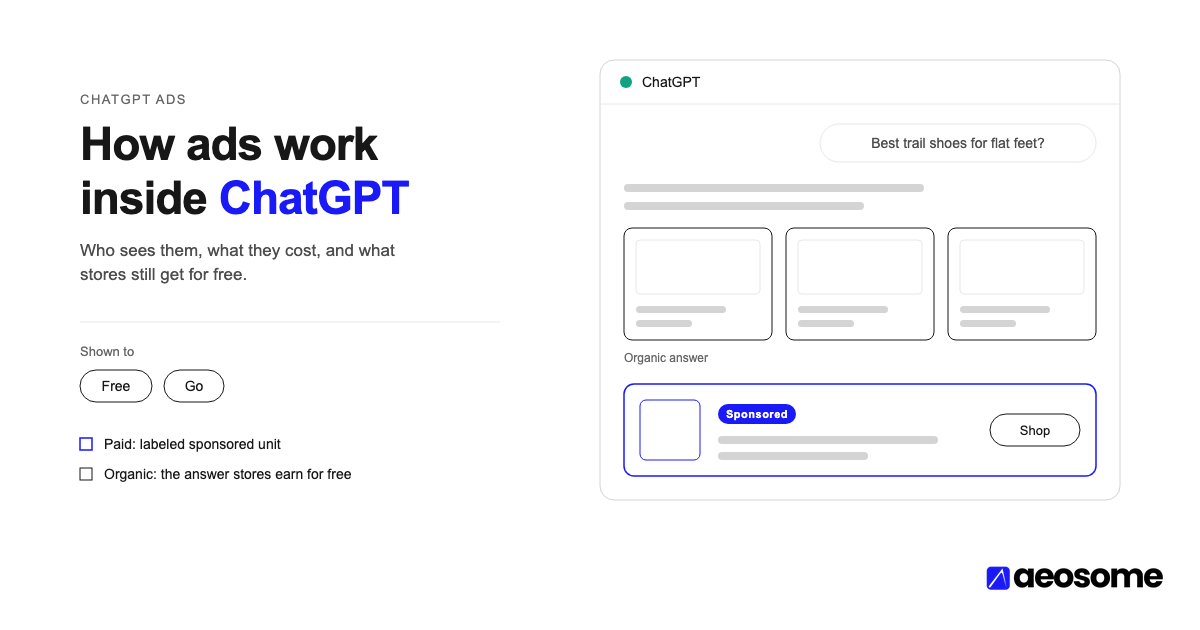
The ads ChatGPT shows sit below the answer, labeled "Sponsored" and visually separated from the model's text. A newer format places visual ads beside images ChatGPT is generating.
Three formats exist today:
- Sponsored unit under the answer. The launch format. It appears after the response ends, matched to the conversation (Axios, 2026).
- Product ads from a feed. Advertisers can run product campaigns from a product catalog in Ads Manager, with new campaign controls added in November (Search Engine Land, November 2026).
- Visual ads during image generation. Announced October 5, 2026 as a US test with a limited group of advertisers (TechCrunch, October 2026).
OpenAI picks ads partly from the context and intent of the current conversation (Axios, 2026). OpenAI says answers stay uninfluenced by advertising, and conversations aren't shared with advertisers (CNBC, 2026). Advertisers get aggregate reporting, not chats.
How much do ChatGPT ads cost?
ChatGPT paid ads started as a premium, managed buy and are now self-serve with no minimum. OpenAI publishes no average CPM or CPC, so your cost depends on your bids.
The price path in 2026:
| When | How you buy | What changed |
|---|---|---|
| February | Managed, by invitation | Adweek reported a $60 CPM and a $200,000 minimum commitment (eMarketer) |
| May 5 | Self-serve Ads Manager beta (US) | CPC bidding added next to CPM; no minimum spend (OpenAI, May 2026) |
| November 9 | Cost targets | Target CPA and Target CPC replace Max Bid and Max CPC (Search Engine Journal, November 2026) |
Treat the launch figures as reported, not official. OpenAI didn't publish them.
The November change matters for stores. A cost target sets the average you pay across many auctions, not a cap per auction. Campaigns on the old Max Bid and Max CPC settings run until December 31, 2026 (Search Engine Journal, 2026).
What this means for you: a small store can now test with a small budget. Budget for learning, since there's no public benchmark to compare against.
How to advertise on ChatGPT, step by step
Here is how to run ads on ChatGPT today. Open an Ads Manager account, pick a goal, build a campaign, pass review and track results.
- Check eligibility. ChatGPT Ads must be available in your country (89 as of October 21, 2026). Your category must also pass OpenAI's ad policy review.
- Create an account. Sign up at OpenAI's Ads Manager with your OpenAI account and add billing. OpenAI verifies new accounts before full access (OpenAI Help Center). Larger brands can also buy through agencies or technology partners.
- Pick an objective. Reach is bought per thousand impressions (CPM). Clicks are bought per click (CPC). Conversion campaigns now use Target CPA.
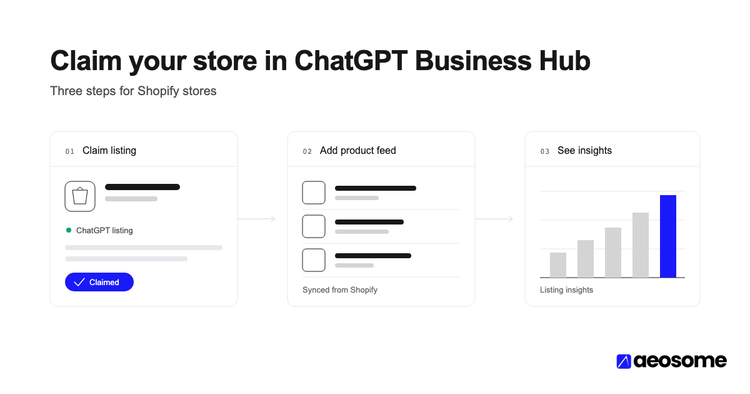
- Choose the campaign type. Run a standard ad, or a product campaign from your catalog. If you sell on Shopify, first make your feed eligible for ChatGPT Shopping.
- Write the ad and set limits. Add your copy, image and landing page. Then set budget, bid target and location.
- Pass review and launch. Ads go through review before they serve.
- Track results. Ads Manager reports impressions, clicks, spend, CTR, average CPC and conversions through a conversion pixel (OpenAI, May 2026). Also track ChatGPT traffic in GA4, so you can separate paid clicks from organic visits.
Don't skip step 7. Without it, spend isn't tied to orders.
What do ChatGPT ads mean for online stores?
For eCommerce stores. This section is about the part of ChatGPT you can't buy.
Using ChatGPT for advertising means paying for a labeled slot below the answer. The product cards inside the answer are not for sale. Stores have two routes into ChatGPT, and only one of them stops when the budget does.
OpenAI has said its product results are chosen independently and are not ads (OpenAI, September 2025). That organic shelf is large. ChatGPT showed a product card on 28.5% of shopping questions in our 22,335-answer study (AEOsome Research, 2026).
Earning that shelf is AEO (Answer Engine Optimization): making your products the ones AI picks on its own. Read what AEO is and why eCommerce brands need it.
| Paid route | Organic route | |
|---|---|---|
| Where | Sponsored unit below the answer | Product cards inside the answer |
| How you get in | Ads Manager, bids and budget | Product feed, structured data, reviews and prices the model can read |
| Label | "Sponsored" | None |
| When it stops | When spend stops | Builds over time |
Our own data shows ads and organic cards meet on the same shopping questions. We collected our data while logged out, so we could not see ChatGPT's logged-in ad audience. In that sample, Google AI Mode was the only engine where ads were more than a trace: 3.9% of its answers. ChatGPT sat at 0.1%, Copilot and Perplexity at 0.0% (AEOsome Research, 2026).
Google AI Mode's ads vary by intent stage. They appear on 1.8% (Post Purchase) to 6.0% (Scenario Confirmation) of its answers (AEOsome Research, 2026). Here are the nine shopping-intent stages behind that split.
Ads also land where organic slots are richest. When Google AI Mode showed ads, its organic card rate was 84.7%; without ads, 63.6% (AEOsome Research, 2026). Paid units sit next to organic cards. They don't replace them.
Ads and organic cards together: Google AI Mode answers with ads showed organic product cards 84.7% of the time, against 63.6% without ads (AEOsome Research, 2026, Study 2).
Before you buy a slot, check your organic position. Start with how AI shopping assistants choose which products to show and how feeds and retrieval decide the product carousel. For the Google side, see how Google AI Mode shows products and ads.
Frequently Asked Questions
Can you advertise on ChatGPT?
Yes. Advertisers in 89 countries can buy through the self-serve Ads Manager or OpenAI's technology partners (OpenAI, October 2026). Your category must pass policy review.
Do ads change ChatGPT's answers?
OpenAI says no. Ads are labeled, sit apart from the answer, and don't influence responses (CNBC, 2026). Product results inside the answer are chosen independently (OpenAI, 2025).
Can I turn off ChatGPT ads?
Plus, Pro, Business, Enterprise and Edu plans have no ads. Free and Go users can dismiss an ad, see why it was shown and give feedback (CNBC, 2026).
Do advertisers see my chats?
No, according to OpenAI. Conversations aren't shared with advertisers, and advertisers get aggregate reporting only (CNBC, 2026).
Pay for the Slot, or Earn the Shelf
ChatGPT ads reach Free and Go users only. They grew to a $1 billion run rate in under 200 days (Digiday, 2026). The product cards inside the answer are still free: ChatGPT showed one on 28.5% of shopping questions (AEOsome Research, 2026).
Before you spend on ads, see whether your products already appear organically. Request a free AI citation check from AEOsome. We run it as Monitor → Audit → Optimize → Verify.
Methodology: Study 2 covers 22,335 de-duplicated answers (27,255 collected, 4,920 duplicate retries removed) from ChatGPT, Google AI Mode, Microsoft Copilot and Perplexity. It was collected in the US, in English, logged out, May 5 to 14, 2026. Full details are in Chapter 7: Methodology.
Retrieval note: OpenAI's ad pages and help center change often. All platform facts were checked on November 16, 2026.
Vijaya Kumar Channalli is a serial SaaS founder and the founder of AEOsome (Tartu, Estonia), which helps eCommerce brands get their products recommended when shoppers ask AI what to buy. Read how we write, source and correct posts in our editorial policy.