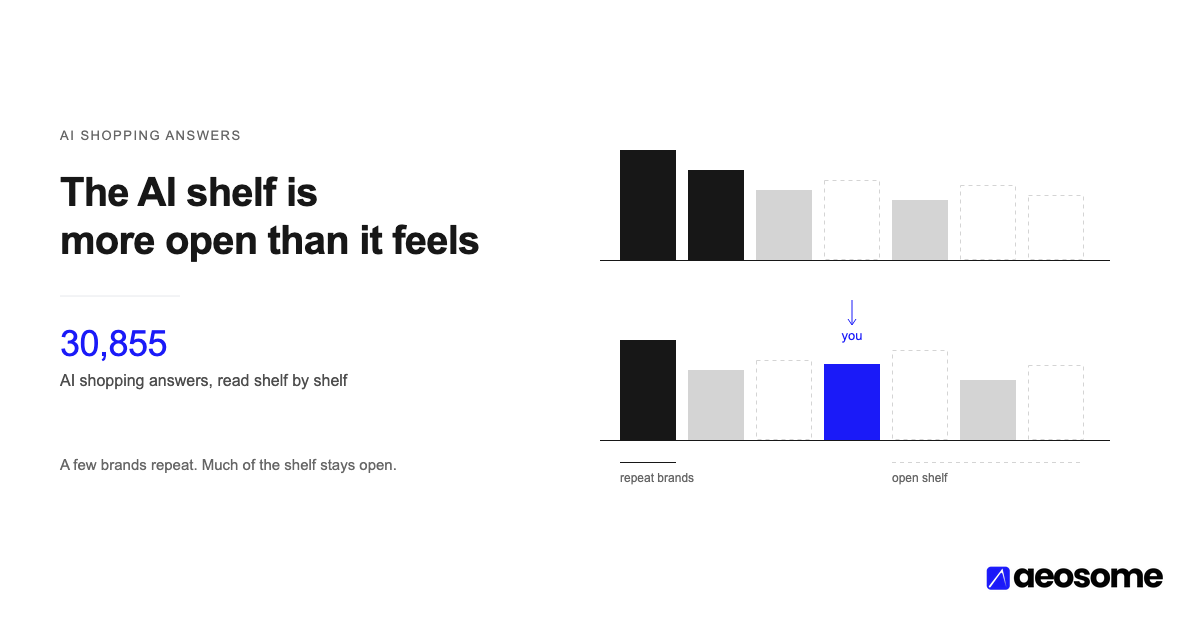
AI tends to name the same brands because they dominate what it cites (editorial lists, Reddit threads, retailer listings) and, we suspect, its memory. But the shelf is less fixed than it looks. Across 22,335 answers on four engines, two engines share only 0.25 to 0.42 of their brands (AEOsome Research, 2026).
Key TakeawaysTwo engines answering the same question share a brand overlap of only 0.25 to 0.42. Between 18% and 41% of question pairs share no brand at all (AEOsome Research, 2026, Study 2).Asking ChatGPT the identical question again shared only 25% of brands across 1,286 pairs (AEOsome Research, 2026, Study 1).Electronics is the only concentrated category: Samsung, Apple, Sony, LG and Google take 29% of its slots (AEOsome Research, 2026, Study 2).Rating does not predict presence: across 110 brands, the correlation is negative (Spearman −0.24) (AEOsome Research, 2026, Study 1).Google AI Mode's shopping sources are 35.1% community content, and Reddit appears in 51.8% of its answers (AEOsome Research, 2026, Study 2).
Ask ChatGPT for the best moisturizer, then ask Google AI Mode the same thing. You may see some familiar names twice, and maybe not yours.
Shoppers now get a short list of named brands instead of ten blue links. If your brand isn't on it, it doesn't exist for that shopper.
We asked the same shopping questions on four AI engines, tens of thousands of times. Here is why the same brands repeat, how much, and how a smaller brand gets in. This work is called AEO (Answer Engine Optimization). If the term is new, start with what AEO is and why eCommerce brands need it.
In this article:
- Why do the same brands appear again and again in AI answers?
- Is AI choosing the best brands or the most talked-about ones?
- Why are AI recommendations so inconsistent?
- Where does AI actually learn about your brand?
- How can a smaller brand break in?
- How do you get your brand cited in ChatGPT, Perplexity and AI Overviews?
- What quick changes move AI citations within weeks, and how do you measure them?
- Frequently Asked Questions
- The Shelf Is Redrawn on Every Ask
Why do the same brands appear again and again in AI answers?
AI builds each answer from the sources it retrieves, and probably from what its model remembers. Brands that dominate editorial "best of" lists, Reddit threads and retailer listings tend to dominate the answer.
Each engine leans on a different pool: ChatGPT on editorial sites, Google AI Mode on community content, Copilot on retailers (AEOsome Research, 2026).
Memory matters too. In our ChatGPT study, 61% to 81% of brand mentions in the answer text appear in no cited source title (AEOsome Research, 2026). Model memory is our hypothesis for why.
The repetition is real only on some shelves. Electronics is the only concentrated category: Samsung, Apple, Sony, LG and Google take 29% of its slots. Beauty and Health are the flattest, with 300 to 470 brands per subcategory and no brand above 20% of any subcategory (AEOsome Research, 2026).
In Skincare, even the top brand, CeraVe, holds under 10% of slots (AEOsome Research, 2026).
What this means for you: first check whether your shelf is concentrated or flat. In our reading, flat shelves reward presence at the right stage. Concentrated shelves mean displacing a named incumbent at a specific stage.
Is AI choosing the best brands or the most talked-about ones?
Not the best rated, by our data. Rating doesn't predict which brands make the list, though it does predict where they rank once on it.
Rating does not predict presence. We checked 110 Study 1 brands with at least 50 slots. Average rating and carousel presence correlate negatively (Spearman −0.24). Quince, rated 4.74, is in 13% of carousels. Lulus, rated 4.30, is in 30% (AEOsome Research, 2026).
Inside the carousel, quality signals take over. In Study 1, the most-reviewed product leads 33.1% of the time, the cheapest only 9.4% (AEOsome Research, 2026).
Lab work points the same way. In controlled tests on skincare products, well-known brands were recommended 100% of the time when all products had the same specifications. That dominance disappeared with "less than a +0.1-star rating advantage for a competitor" (Chu and Hou, arXiv, 2026). It is a preprint, not yet peer-reviewed.
One caution: our data has no brand-recognition variable (AEOsome Research, 2026). We measured rating, not discussion. Our reading is that presence tracks how widely a brand is discussed and listed.
Citation Capsule: Across 110 brands in AEOsome's ChatGPT study, a brand's average rating did not predict how often it appeared in carousels (Spearman −0.24). Quince, rated 4.74, appeared in 13% of carousels; Lulus, rated 4.30, in 30% (AEOsome Research, 2026). Rating predicts rank inside a carousel, not presence.
Why are AI recommendations so inconsistent?
Each engine reads a different web, and one answer is a sample. The same question gives different brands on different engines, and often on a second ask.
Brand overlap between engines is modest. It is 0.42 for ChatGPT and Google AI Mode on 1,133 questions, and 0.31 for Copilot and Google AI Mode on 1,737. The Perplexity pairs sit at 0.25 to 0.29 (AEOsome Research, 2026).
Between 18% and 41% of question pairs share no brand at all. Re-asking the same engine doesn't settle it either. In Study 1, 1,286 pairs of identical ChatGPT questions shared only 25% of brands and 6% of products. One retry pair in five (19.8%) shared no brand (AEOsome Research, 2026).
The served model adds noise. In Study 2, when ChatGPT re-answered a question, its card versus no-card decision matched 90.2% of the time with the same model. It matched only 25.5% when the model switched (AEOsome Research, 2026). We cover that routing effect in why your products show up in ChatGPT one day and disappear the next.
What this means: inconsistency is the opening for a smaller brand. The shelf is redrawn on every ask.
Citation Capsule: When four AI engines answer the same shopping question, their brand overlap is only 0.25 to 0.42. Between 18% and 41% of question pairs share no brand at all (AEOsome Research, 2026, Study 2). There is no single "AI shortlist" for a category.
Where does AI actually learn about your brand?
Mostly from pages you don't own. Brand-owned sites are a small share of what AI engines cite, and the mix differs by engine and by shopping stage.
Study 1's 177,952 ChatGPT citations were 46.0% editorial, 26.7% retail and only 10.3% brand-owned (AEOsome Research, 2026). Study 2 shows each engine has its own web.
In Study 2, Google AI Mode is the community engine. Reddit appears in 51.8% of its answers, and YouTube is its single most-cited domain at 13.0% of sources. Copilot is the retail engine: amazon.com alone is 12.4% of its citations. Perplexity is 44.0% editorial and 18.9% community (AEOsome Research, 2026).
Stage matters as much as engine. Google AI Mode cites Reddit in 71% to 79% of problem, comparison, validation and post-purchase answers (AEOsome Research, 2026).
Review and editorial sites are the largest source type on ChatGPT and Perplexity, so they shape what the answer text says. In our reading, the lever at comparison and validation stages is third-party content and community presence.
How can a smaller brand break in?
Pick the engines, stages and subcategories where the shelf is open. Then get named in the sources that engine reads.
- Map your shelf. Is your subcategory flat, like Beauty and Health, or concentrated, like Smartphones? Flat shelves have room for hundreds of brands.
- Pick the engine whose web you can win. Editorial for ChatGPT and Perplexity, community for Google AI Mode, retail and marketplace for Copilot.
- Target the stage, not the whole category. In our data, different names tended to lead different stages. In Home, Breville led exploration (24%), Ninja comparison (23%) and Shark problem questions (18%) (AEOsome Research, 2026).
- Get into third-party lists and threads. Earn places on "best of" and comparison pages. Join real Reddit threads in your category honestly, as a participant.
- Keep brand facts consistent everywhere. AI repeats what its sources say, so keep your brand facts consistent across the web.
Incumbents are less protected than they look. Even when the shopper names a brand, other brands hold 46% to 52% of the card slots on every engine (AEOsome Research, 2026).
Brand demand tends to pay off too. In Study 2, brand-named questions got product cards more often than generic ones on Google AI Mode (70.2% against 62.4%). Copilot and ChatGPT showed the same pattern; Perplexity was the exception (AEOsome Research, 2026).
For the product side, see the product-level signals that decide which competitor products get picked.
How do you get your brand cited in ChatGPT, Perplexity and AI Overviews?
Make sure each engine can reach your site. Then earn mentions on the sources each one prefers.
ChatGPT. Allow OAI-SearchBot, OpenAI's search crawler. OpenAI states: "Sites that are opted out of OAI-SearchBot will not be shown in ChatGPT search answers" (OpenAI, Overview of OpenAI Crawlers). GPTBot is a separate crawler for model training. Blocking it does not remove you from ChatGPT search. Here is what blocking GPTBot actually does.
Google AI Overviews and AI Mode. Google's guidance is plain. "There are no additional requirements to appear in AI Overviews or AI Mode" (Google Search Central, AI features and your website). Being indexed and eligible for a snippet is the bar. Both features may fan out, "issuing multiple related searches across subtopics and data sources." That's why community and comparison pages matter there.
Perplexity. It cites the most distinct domains per answer (8.7) and leans editorial (AEOsome Research, 2026). Trusted review and "best of" pages are the main route in.
Citation Capsule: OpenAI says sites opted out of OAI-SearchBot "will not be shown in ChatGPT search answers" (OpenAI, Overview of OpenAI Crawlers). GPTBot is a separate training crawler. Blocking GPTBot does not remove a store from ChatGPT search; blocking OAI-SearchBot does.
What quick changes move AI citations within weeks, and how do you measure them?
Access fixes act fastest. Source-building takes longer. Measure with repeated asks and a rate, never a single screenshot.
Fast, within days:
- Crawler access. Check robots.txt for OAI-SearchBot and Googlebot. OpenAI says "it can take ~24 hours from a site's robots.txt update for our systems to adjust" (OpenAI).
- Brand facts. Fix wrong or conflicting facts on your pages.
Over weeks:
- Third-party pages and threads. Get listed on comparison pages and answer real category questions in community threads.
- Dated pages. ChatGPT is the only engine in our study whose sources carry publication dates, and more than half of them do. Refresh stale pages.
These changes can show up within weeks. We don't promise a lift figure.
A common mistake is measuring once. A single answer is a sample, not a measurement. Ask repeatedly and report a rate. Measure per engine, per intent stage and, for ChatGPT, per served model (AEOsome Research, 2026). A brand measured on one engine measures that engine, not AI. Track slot share, not just presence. Here's how to check how your brand appears across AI engines.
Frequently Asked Questions
Why is my brand never mentioned when AI recommends products in my category?
Usually your brand is missing from the sources that engine reads at that stage. Once earned, presence tends to travel: of 564 brands with at least ten card slots, only 10 appear on exactly one engine (AEOsome Research, 2026).
Why isn't my eCommerce site showing up when shoppers ask AI chatbots for products?
A brand mention isn't a product recommendation. On ChatGPT in Study 2, 95.9% of card-bearing answers name at least one brand that is not on the shelf (AEOsome Research, 2026). To fix the product side, diagnose why your products are missing from AI shopping results and see why products don't appear in ChatGPT Shopping.
What do AI chatbots look at when customers search for products?
Editorial lists, community threads, and retailer and marketplace listings. Inside ChatGPT's carousel, one standard deviation of rating doubles the odds of rank one (AEOsome Research, 2026, Study 1). The product's host is among cited sources for only 19.1% of Study 1's slots. Our hypothesis is that cards come from a product index.
What has worked to make a brand show up in AI answers?
Our data points to third-party presence at the right stage. Crawler access is a documented requirement from OpenAI and Google. Consistent brand facts is our recommendation, not a measured effect. Test each change with repeated asks, comparing rates before and after.
The Shelf Is Redrawn on Every Ask
AI does repeat brands, but less than it feels. Engines share only 0.25 to 0.42 of their brands for the same question. Only Electronics is concentrated, with five brands holding 29% of slots. Rating doesn't predict presence (Spearman −0.24) (AEOsome Research, 2026). Our reading: being talked about matters more.
Want to see which brands AI names in your category, and where your brand is missing? Request a free AI citation check from AEOsome. We run it as Monitor → Audit → Optimize → Verify.
Methodology: Study 1 covers 8,520 ChatGPT answers to women's-dress questions, collected on February 28 and March 1, 2026. Study 2 covers 22,335 de-duplicated answers (27,255 collected, 4,920 duplicate retries removed) from ChatGPT, Google AI Mode, Microsoft Copilot and Perplexity. It spans 7 US product categories, collected May 5 to 14, 2026. Full details are in Chapter 7: Methodology.
Retrieval note: OpenAI's crawler page and Google's AI features page can change. Both were retrieved on November 14, 2026.
Vijaya Kumar Channalli is a serial SaaS founder and the founder of AEOsome (Tartu, Estonia), which helps eCommerce brands get their products recommended when shoppers ask AI what to buy. Read how we write, source and correct posts in our editorial policy.