What Is Google Shopping AI Mode? A Merchant FAQ
Google Shopping AI Mode, explained for merchants: what it is, how it differs from classic Shopping listings, and which signals you can influence.

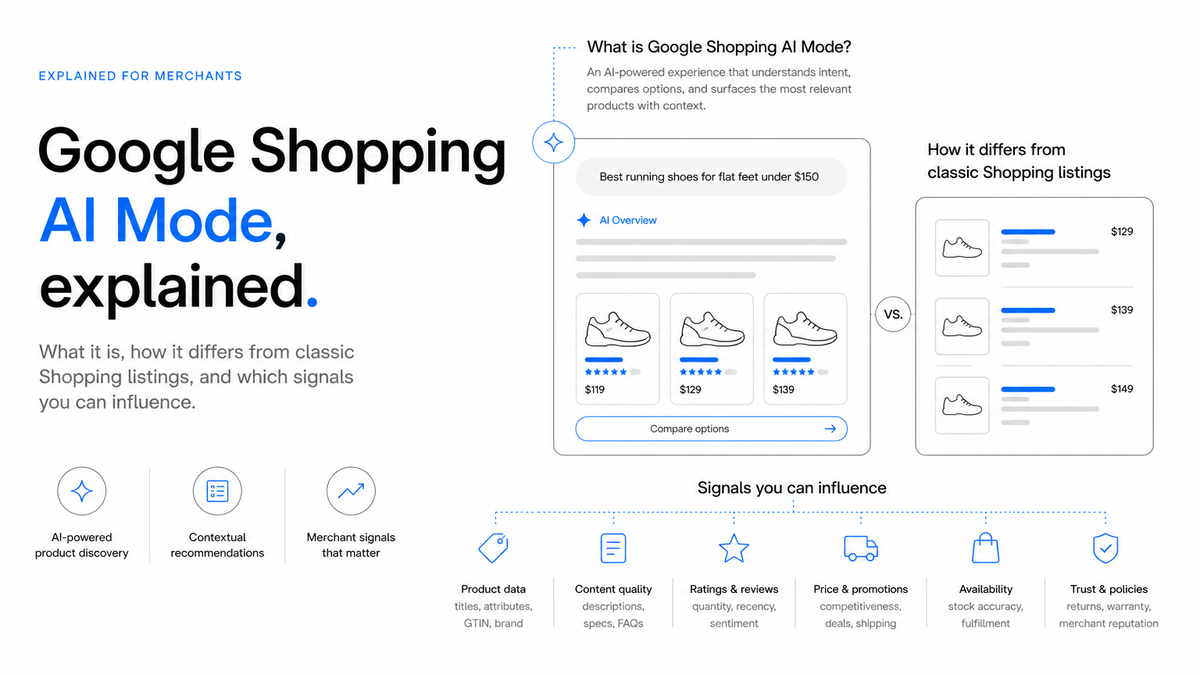
Google Shopping AI Mode is a conversational product-discovery experience inside Google Search, powered by Gemini. It answers shopping questions with a curated product panel, not a page of shopping ads. It reads the same Merchant Center feed (your product catalog on Google) as classic Shopping. It just shows far fewer products, chosen by data completeness more than bid.
Coverage of AI Mode is scattered across three separate Google announcements: Universal Cart, the Universal Commerce Protocol, and new Merchant Center AI tools. This FAQ ties them together. It answers the 10 questions merchants ask most, covering what AI Mode is, how it ranks your products, and what's changing at checkout.
Last updated: October 9, 2026. Reviewed quarterly as Google's AI shopping features change.
Key TakeawaysGoogle AI Mode passed 1 billion monthly active users within a year of its broad rollout (Google, I/O 2026 keynote)Google's Shopping Graph now indexes more than 60 billion product listings (Google, 2026)A September 2026 Productrise study of 2 million-plus listings found only 1.28% of products in Google's Popular Products carousel also appeared in AI Mode the same day, and AI Mode showed an average of 3.9 listings per query versus 27.8 on the carousel (Productrise, via Search Engine Journal, 2026)In-chat checkout runs on the Universal Commerce Protocol (UCP), Google and Shopify's open standard announced January 11, 2026, and on Universal Cart, Google's own checkout feature live since May 19, 2026 with retailers including Nike, Sephora, Target, Walmart, and Wayfair (Google, 2026)61% of US holiday shoppers used an AI platform or feature while shopping last season, meaning roughly two in five still used none (Google / Ipsos, 2026)
What Is Google Shopping AI Mode?
Google Shopping AI Mode is a conversational shopping experience inside Google Search, powered by Gemini and the Shopping Graph. It answers product questions with a curated panel instead of a page of shopping ads.
Gemini interprets multi-turn, natural-language questions, like "find a waterproof jacket under $150 for hiking in the rain." It can follow up with clarifying prompts the way a salesperson would. The Shopping Graph is the data layer underneath both AI Mode and classic Shopping: the database connecting listings, prices, and availability across Google. It now indexes more than 60 billion product listings (Google, 2026).
That scale matters less than selection. AI Mode doesn't show you more of the catalog. It shows you a short, chosen slice of it, and the next question explains how that slice differs from what you're used to.
How Is Google AI Mode Different From Classic Google Shopping Listings?
Classic Google Shopping shows a dense grid of ad-ranked listings. AI Mode shows a short, conversational product panel chosen by relevance and data quality, not bid alone.
| Classic Google Shopping | Google AI Mode | |
|---|---|---|
| Format | Grid of shopping ads / Popular Products carousel | Conversational product panel inside an AI answer |
| Listings per query (avg.) | 27.8 | 3.9 |
| Primary ranking input | Bid plus feed data | Structured-data completeness plus query fit |
| Overlap with the other surface | N/A | 1.28% of matched products appear on both |
| Price (same product, both surfaces) | Baseline | 21.6% higher on average |
Source: Productrise, via Search Engine Journal, September 2026.
AI Mode shows far fewer products per query than classic Google Shopping: 3.9 versus 27.8 on average. The two surfaces overlap on just 1.28% of matched products (Productrise, via Search Engine Journal, 2026).
Strong Google rankings don't carry over to AI Mode the way most merchants assume. A page one position in classic Shopping says nothing about whether AI Mode will select the same product.
Is Google Shopping AI Mode the Same Thing as AI Overviews?
No. AI Overviews are the AI-generated summary box that can appear above regular results for any query. AI Mode is a separate, fuller-page conversational experience a shopper opts into, with its own shopping panels and follow-up prompts.
Both can touch a shopping query. AI Mode is the deeper, multi-turn surface this FAQ covers.
Does Google AI Mode Use My Merchant Center Feed?
Yes. AI Mode draws on the same Merchant Center product data, via the Shopping Graph, that powers classic Google Shopping. There's no separate feed to submit.
That means titles, GTINs, pricing, availability, and images all carry over unchanged. Google added one new layer at Google Marketing Live 2026: Conversational Attributes. It lets you describe products the way shoppers phrase questions, not the way a product-grid title is written.
The feed fields that decide eligibility across AI shopping surfaces covers what Merchant Center actually requires before AI Mode will consider a product at all.
Which Product Data Signals Matter Most in AI Mode?
Google hasn't published a ranked list of which product attributes matter most in AI Mode. Its shopping responses most often surface price, reviews, and available inventory (Google, via TechCrunch, November 2025). The system can only weigh attributes your feed actually includes.
The practical contrast is with bid-driven classic Shopping ranking. A product with sparse attributes can lose a slot to a lower-bid competitor with complete data. That's especially true when a query names a constraint like size, material, or color. Filling in structured product schema is the lever you control, not your bid.
Do I Need to Change Anything in Google Merchant Center for AI Mode?
Not structurally. Your existing feed keeps working. The opportunity is filling in two additions Google introduced at Google Marketing Live 2026: Conversational Attributes and AI Performance Insights.
Conversational Attributes add richer, question-shaped product descriptions on top of your standard fields. AI Performance Insights shows brand visibility against competitors inside AI shopping surfaces. It's rolling out in Australia, Canada, India, New Zealand, and the US (Search Engine Land, 2026). Google also added Ask Advisor, an in-product AI assistant for Merchant Center tasks, at the same event (Search Engine Land, 2026).
Why Do Prices and Sellers in AI Mode Sometimes Differ From Google Shopping?
AI Mode and classic Shopping select from overlapping but different slices of the Shopping Graph. Matched products can show a different first-listed seller and a different price, not because either surface is wrong.
Among products that appear on both surfaces, the first-listed seller differs 49.6% of the time (Productrise, via Search Engine Journal, 2026). Prices differ in 38.1% of matched cases, and AI Mode shows the higher price in 68.4% of those, an average premium of 21.6% (same study, 2026).
Treat this as a selection difference, not a pricing error to fix. The two surfaces pull from different slices of your feed at different moments.
Can Shoppers Buy Directly Inside Google AI Mode?
In some cases. Universal Cart, Google's checkout feature, has been live since May 19, 2026. Retailers include Nike, Sephora, Target, Ulta Beauty, Walmart, and Wayfair, plus Shopify merchants Fenty and Steve Madden (Google, 2026). Otherwise, AI Mode hands the shopper to the retailer's own site.
Universal Cart collects items a shopper saves across Search, Gemini, YouTube, and Gmail, watches for price drops, and flags incompatible items. It checks out through Google Pay where supported, or passes the shopper through to your site (Google, 2026).
How this compares to ChatGPT's instant checkout walks through the equivalent feature on OpenAI's side.
What Is the Universal Commerce Protocol (UCP), and Do I Need to Support It?
UCP is Google and Shopify's open standard, announced January 11, 2026 at NRF's Big Show. It lets AI Mode and Gemini complete a purchase without sending the shopper to your website. You need it only if you want in-chat checkout, not for basic product discovery.
Etsy, Wayfair, Target, and Walmart signed on as co-developers, alongside more than 20 backers including Visa, Mastercard, Stripe, American Express, Best Buy, and Home Depot (FashionNetwork, 2026). UCP is distinct from OpenAI's Agentic Commerce Protocol (ACP), which runs ChatGPT's own in-chat checkout. The two protocols serve the same function for different platforms, and supporting one doesn't automatically mean you support the other.
Will Google AI Mode Replace Google Shopping Ads?
Not yet. AI Mode remains a smaller, more selective surface than classic Google Shopping, which still returns listings on the large majority of shopping queries. Treat AI Mode as an additional surface to earn, not a replacement to plan around.
That selectivity is the real takeaway from every number in this FAQ. AI Mode isn't a smaller version of Google Shopping. It's a more selective one, where fewer slots mean data completeness decides who fills them, not incremental bid increases.
Related Resources
- Product feed compliance for AI shopping, the field-by-field checklist for the Merchant Center data AI Mode reads.
- Product schema for AI recommendations, the structured-data layer behind the Shopping Graph.
- ChatGPT Instant Checkout for Shopify: What Changed at the Buy Button, the OpenAI counterpart to UCP.
- Strong Google rankings, invisible in AI, on why classic Shopping rank doesn't predict AI Mode placement.
- Google Merchant Center Help, official, for feed setup and attribute specs.
Fewer Slots, Higher Stakes
Google AI Mode has passed 1 billion monthly active users. It shows 3.9 listings per query against classic Shopping's 27.8, and overlaps with the Popular Products carousel on just 1.28% of matched products. None of that makes AI Mode small. It makes AI Mode selective, and selective means your data quality, not your bid, decides whether you get one of the few slots available.
See how your store performs today. Check your AI citation rate.
Vijaya Kumar Channalli is a serial SaaS founder and the founder of AEOsome (Tartu, Estonia), which helps eCommerce brands get their products recommended when shoppers ask AI what to buy. Read how we write, source and correct posts in our editorial policy.