What Is Generative Engine Optimization?
Generative engine optimization (GEO) means getting cited in AI answers, not ranked in results. What it is, how it differs from AEO, and why it matters for your store.

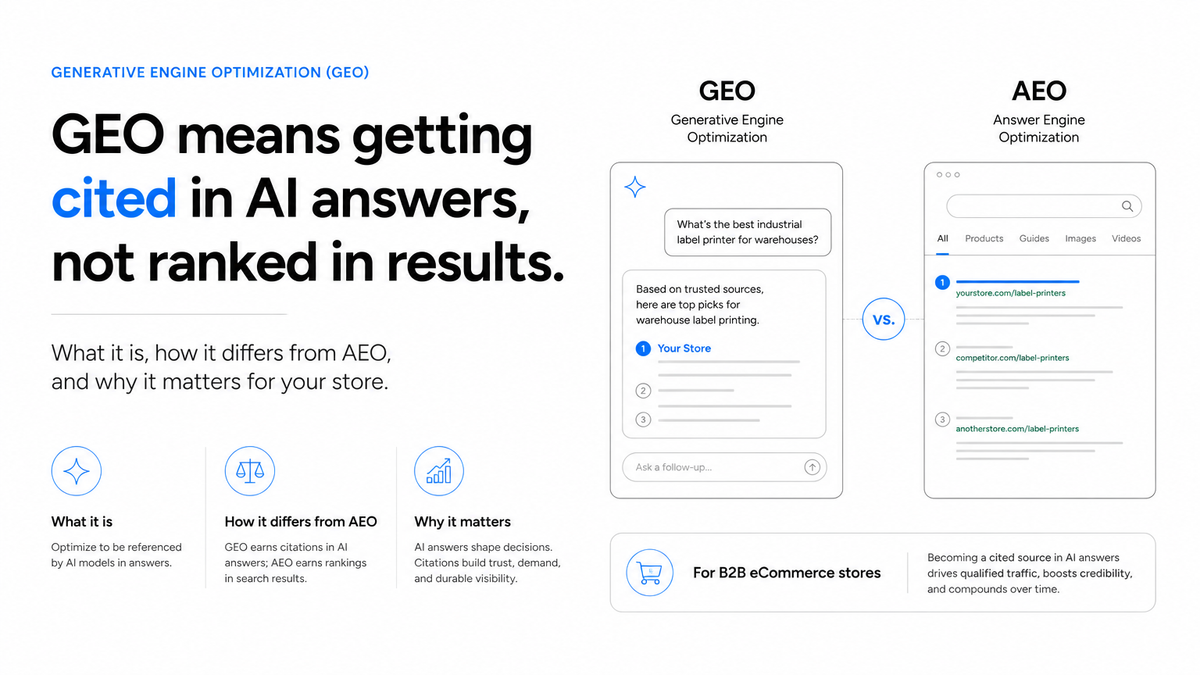
Generative engine optimization (GEO) is the practice of structuring content and data so generative AI systems, ChatGPT, Perplexity, Google AI Mode, Gemini, can extract, synthesize, and cite it directly in their answers, instead of a searcher clicking through a ranked list of links. For a store, that's not abstract: AI platforms cited a specific product in 35.6% of 22,335 shopping responses AEOsome analyzed across four platforms (AEOsome Research, 2026).
This page defines GEO plainly. If you want to know whether the GEO, AEO, and AIO label split actually matters operationally for a store, the full breakdown lives in a dedicated comparison post rather than here.
Last updated: October 8, 2026. Reviewed quarterly as AI platforms change.
Key TakeawaysGEO means earning a citation inside a generated AI answer, not a position in a ranked list of linksWeb visits across generative AI platforms grew 70% year-over-year, reaching 9.5 billion monthly visits by May 2026 (Similarweb, 2026)AI platforms cited a specific product in 35.6% of 22,335 shopping responses AEOsome analyzed, and no category studied fell below 28.7% (AEOsome Research, 2026)AEO is the practitioner term that has taken hold in eCommerce and marketing tooling for the same underlying behavior as GEOFor a store, the unit of optimization is product data (titles, attributes, GTINs, reviews), not blog prose
In this article:
- What Is Generative Engine Optimization, Exactly?
- How Does GEO Differ from SEO?
- Is GEO the Same Thing as AEO? (Briefly)
- Why Does GEO Matter for eCommerce Specifically?
- How Generative Engine Optimization Connects to AI Shopping Assistants
- Getting Started with GEO for Your Store
- Frequently Asked Questions
- The Answer Is the New Results Page
What Is Generative Engine Optimization, Exactly?
GEO is structuring content and data so generative AI systems can extract, synthesize, and cite it when answering a user's question, rather than linking to it in a ranked list. The term comes from academic and industry research on generative AI search, where "generative engine" describes a system that composes a new answer instead of returning a list of links to click.
"Optimization" in this context doesn't mean keyword density. It means structure, evidence, and extractability. Can a generative system read your page, trust what it says, and lift a specific claim or product into its answer?
A generative engine isn't one single product. ChatGPT, Perplexity, Google AI Mode, and Gemini all run the same basic pattern. They read a question, pull in sources, and write a new answer, instead of showing you a page of results to click through yourself. The details of how each one retrieves and ranks sources differ. The shift they all represent doesn't: the system is now the thing standing between your content and the reader, not a results page.
This matters now because AI-generated search is growing far faster than traditional search. Web visits across generative AI platforms grew 70% year-over-year, reaching 9.5 billion monthly visits by May 2026 (Similarweb, 2026). That's not a slow, speculative shift. It's already the traffic curve your store is competing inside.
How Does GEO Differ from SEO?
SEO earns you a position in a ranked list of links. GEO earns you a citation inside a generated answer, where the reader may never click through at all.
The mechanism is different. Classic search is retrieval plus ranking: a crawler indexes pages, then a ranking algorithm orders them by relevance and authority signals like backlinks. A generative engine still retrieves candidates. Then it synthesizes a new answer from what it finds, choosing which sources to cite and which to leave out.
That changes what performs well. Backlinks and keyword density don't transfer cleanly into a synthesis process. Structured, extractable, well-sourced content does, because the system has to be confident enough in a claim to state it as fact.
That confidence is the real currency. A page can rank on Google through domain authority built over years. It can still never get picked up by a generative engine if its product data is incomplete or its claims aren't verifiable. The two systems reward different things, even when they're answering the same search.
Ranking alone has stopped guaranteeing visibility, even on Google itself. 68.01% of Google searches ended without a click in early 2026, up from 60.45% in 2024 (SparkToro, analysis of Similarweb data, 2026). More than two-thirds of queries now resolve without a visit to any website.
Is GEO the Same Thing as AEO? (Briefly)
Functionally, yes, for almost all practical purposes. GEO is the term that emerged first in research and technical AI-search literature. AEO (Answer Engine Optimization) is the term that has taken hold in eCommerce and marketing tooling for describing the same work.
The short version is that the distinction isn't operationally load-bearing for a store. The full breakdown, including where AIO fits, is here. This page won't re-run that comparison. It's just the plain-English definition of the GEO half of it.
Why Does GEO Matter for eCommerce Specifically?
Because generative engines increasingly answer shopping questions directly, naming specific products, not just brands. That means your store's visibility now depends on whether your product data is citable, not just whether your pages rank.
AI platforms cited a specific product in 35.6% of 22,335 shopping responses AEOsome analyzed across four platforms (AEOsome Research, 2026). No product category studied fell below a 28.7% citation rate (AEOsome Research, 2026). There's no safe corner of eCommerce where this isn't already happening.
Consumer behavior backs this up directly. 72% of US consumers now regularly or occasionally consult tools such as ChatGPT, Claude, or Gemini for shopping ideas and gift recommendations (Optimove Insights, Holiday Shopping Report 2026). That's not a niche early-adopter habit anymore.
Citation rates also aren't even across platforms, which is why optimizing for just one leaves real citations on the table. Google AI Mode cites a product in 64.4% of its shopping responses, Copilot in 44.5%, ChatGPT in 28.5%, and Perplexity in 5.0% (AEOsome Research, 2026).
How Generative Engine Optimization Connects to AI Shopping Assistants
When a shopper asks an AI assistant what to buy, the assistant runs a GEO-style process end to end. It retrieves candidate products, evaluates their data quality and credibility, then synthesizes a recommendation. Your product feed, structured data, and third-party signals are the raw material that assistant is optimizing over.
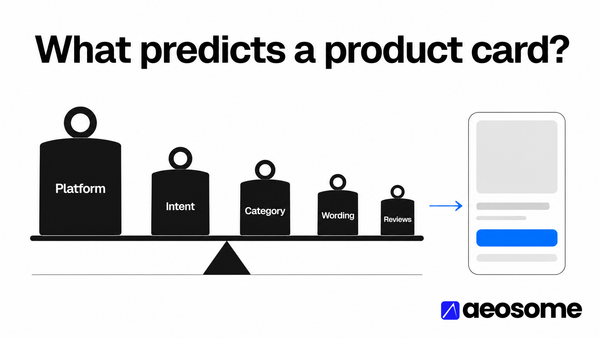
Three signals drive whether a product gets cited. Structured product data completeness is the foundation: price, material, size, and use case, filled in at the variant level. Third-party credibility matters because AI reads the wider web, not just your product pages, so reviews, forums, and editorial coverage carry real weight. Intent alignment means your content answers the exact question a shopper asked, not a generic version of it.
None of these three signals is a black box you have to guess at. Each one is documented, and each one is something you can audit and fix directly. That's a different kind of problem than "improve brand awareness" or "get more backlinks." It's closer to a checklist than a campaign.
Here's the common misconception worth naming directly: a brand being mentioned in an AI answer is not the same as a specific product being recommended for purchase. One is awareness. The other is a citation that can drive a sale. Our research into how AI product discovery actually works breaks down that distinction with the full dataset.
If you run a store and not just a content site, this is the point to ask a concrete question. Does your current citation rate reflect any of this, or are you flying blind on it? If your products aren't showing up, this diagnostic guide walks through the usual causes.
Getting Started with GEO for Your Store
Start with a product-data and feed audit, not a content calendar. Citation depends more on structured-data completeness than on new blog posts.
Three concrete starting points:
- Product schema and structured data. Make sure titles, attributes, GTINs, and availability are complete and accurate at the variant level, not just the parent product.
- Feed attribute completeness. A generative engine can't cite what it can't confidently read. Missing fields create doubt, and doubt gets resolved by citing someone else.
- Measure your current citation rate. You can't improve what you don't track. Sample the real questions your shoppers ask and run them against the major platforms.
None of these three require a new content calendar, a redesign, or a new hire to start. They're fixes to data you already have. That's also why they tend to show results faster than content work. A cleaner feed can change what a generative engine cites within its next refresh cycle. New pages take longer to get indexed, read, and trusted.
Is GEO worth the effort for eCommerce in 2026? walks through what 22,335 AI shopping responses we analyzed say about where it pays off first.
Frequently Asked Questions
What does GEO stand for in marketing?
GEO stands for Generative Engine Optimization: optimizing for AI systems that generate answers, rather than search engines that rank links.
Is generative engine optimization the same as AEO?
Functionally, yes, for almost all practical purposes. See the full AEO vs GEO vs AIO breakdown for the nuance between the terms.
Does GEO apply to eCommerce stores, or just content and blog sites?
It applies to both, but the unit of optimization differs. For a content site, it's prose and citations. For a store, it's product data and feed structure at the SKU and variant level.
How do I know if GEO is working for my store?
Track whether AI platforms cite your specific products in shopping-intent queries, not just whether your brand gets mentioned. What AEO means for eCommerce specifically covers how to measure that.
The Answer Is the New Results Page
GEO means earning a citation inside a generated answer, not a position in a ranked list of links. AEO is the eCommerce-world name for the same underlying work. For a store, what's being optimized is product data, not prose.
The numbers are the reason this isn't optional. Generative AI traffic grew 70% year-over-year to 9.5 billion monthly visits by May 2026 (Similarweb, 2026), and AI platforms already cite a specific product in 35.6% of shopping responses (AEOsome Research, 2026). If generative engines never cite your product pages, you don't exist in the answer, regardless of where you rank on Google. That's a measurable gap, not a vague one, and it's closeable with the same product-data work most stores already have in some form.
See how your store performs today. Check your AI citation rate.
Vijaya Kumar Channalli is a serial SaaS founder and the founder of AEOsome (Tartu, Estonia), which helps eCommerce brands get their products recommended when shoppers ask AI what to buy. Read how we write, source and correct posts in our editorial policy.