ChatGPT Instant Checkout for Shopify: What Changed
OpenAI promised ChatGPT Instant Checkout for Shopify merchants, then scaled it back. Here's what changed at the buy button, and what to do about it now.

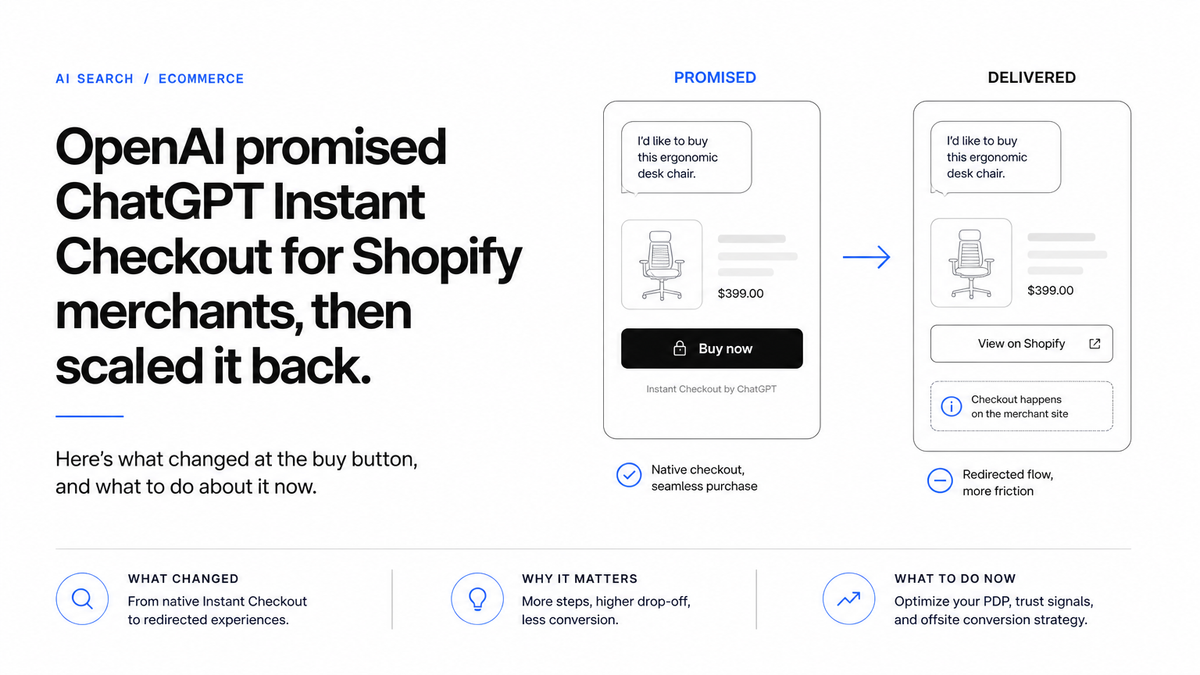
OpenAI promised ChatGPT Instant Checkout for "over a million" Shopify merchants in September 2025. By February 2026, roughly 30 were actually live. On March 6, 2026, OpenAI confirmed it's scaling the feature back. For most Shopify stores today, the Buy button redirects shoppers to your own checkout instead of completing the sale inside the chat.
Key TakeawaysOpenAI launched Instant Checkout in ChatGPT on September 29, 2025, promising "over a million" Shopify merchants in-chat buying (OpenAI; Stripe Newsroom, 2025).By February 2026, roughly 30 Shopify merchants were actually live, per Forrester analysts Sucharita Kodali and Emily Pfeiffer. The Information put the figure as low as a dozen (The Information, cited in Forrester, 2026).On March 6, 2026, OpenAI confirmed it's scaling back Instant Checkout to focus on product discovery, moving deeper transaction flows to ChatGPT Apps instead (OpenAI, via Digital Commerce 360, 2026).The Buy button most Shopify merchants see now redirects shoppers to the merchant's own checkout, in an in-app browser or a new tab, instead of completing the purchase natively inside the chat window (Shopify; Modern Retail, 2026).Merchants who completed Instant Checkout orders paid OpenAI a 4% fee starting January 26, 2026, stacked on top of standard payment processing (PYMNTS; TechRadar Pro, 2026).
A merchant who turned on Instant Checkout in November 2025 expected a new, self-contained sales channel inside ChatGPT. Today, the same Buy button on that same product listing does something different, and nothing in the merchant's dashboard explained why.
That gap between what merchants set up and what the feature does now is the real story here. Most of what's written about Instant Checkout dates from the September 2025 launch window and has never been updated to reflect it.
Here's the full timeline: what changed, why OpenAI changed it, and what a Shopify merchant actually needs to do about it right now.
In this article:
- What Happened to ChatGPT Instant Checkout
- What Actually Changes at the Buy Button
- Why OpenAI Pulled Back
- What This Means for Shopify Merchants
- Your Next Steps
- The Bigger Picture: Discover in AI, Buy on Site
- FAQ
- The Promise Was a Million Merchants. The Reality Was Thirty.
What Happened to ChatGPT Instant Checkout
Instant Checkout launched with a promise of more than a million Shopify merchants gaining in-chat buying. Six months later, fewer than 30 had ever gone live, and OpenAI had started redirecting the feature elsewhere.
OpenAI launched Instant Checkout inside ChatGPT on September 29, 2025, built on the Agentic Commerce Protocol with Stripe handling payment. The first wave covered US Etsy sellers, with Shopify integration announced as coming soon. OpenAI named four Shopify brands at launch: Glossier, SKIMS, Spanx, and Vuori. The headline claim was that more than a million Shopify merchants would eventually get access (OpenAI; Stripe Newsroom, 2025).
The first Shopify merchants went live on November 20, 2025: Spanx, Skims, and Glossier, the same three brands named at launch (OpenAI; Shopify, 2025). Shopify followed in December 2025 by announcing Agentic Storefronts, its own sales-channel wrapper for agentic commerce (Shopify; Modern Retail, 2025). Enrollment is visible under Shopify Admin's Agentic sales channel.
Then the fee landed. Starting January 26, 2026, OpenAI began charging a 4% fee on every completed Instant Checkout order (PYMNTS; TechRadar Pro, 2026). That fee stacked on top of whatever payment processing already cost the merchant.
By February 2026, adoption numbers came in far short of the launch promise. Forrester analysts Sucharita Kodali and Emily Pfeiffer put live Shopify merchants at roughly 30. The Information reported a figure as low as a dozen (The Information, cited in Forrester, 2026). Both numbers describe the same gap: a feature promised to over a million merchants reached a few dozen in practice.
On March 6, 2026, OpenAI confirmed what the adoption numbers already suggested. It's scaling Instant Checkout back to prioritize product discovery (OpenAI, via Digital Commerce 360, 2026). ACP now serves as infrastructure for other apps, rather than a native payment experience.
What Actually Changes at the Buy Button
The button still says Buy. For most Shopify merchants, it no longer completes the sale inside the chat window. It hands the shopper off to the merchant's own checkout instead.
Under the original Instant Checkout model, a shopper confirmed shipping and payment without leaving the chat. ChatGPT collected the order details and Shopify Payments processed the transaction. The completed order appeared in the merchant's Shopify admin like any other sale. The shopper simply never saw a Shopify checkout page.
Under Agentic Storefronts, the model Shopify announced in December 2025 that became the default as OpenAI pulled back, the flow changes at the handoff. ChatGPT still surfaces the product and still shows a Buy button. Tapping it opens the merchant's own checkout instead of completing payment inside the conversation. That handoff happens in an in-app browser on mobile, or a new tab on desktop (Shopify; Modern Retail, 2026).
The practical difference shows up in what each model asks of the merchant.
| Native in-chat checkout (original model) | Redirect to site (Agentic Storefronts) | |
|---|---|---|
| What happens when a shopper taps Buy | Order completes inside the ChatGPT conversation | Shopper is sent to the merchant's own checkout |
| Who processes payment | Shopify Payments, via ACP | Standard Shopify checkout, same as any other order |
| Where the order lands | Shopify admin, same as any other order | Shopify admin, same as any other order |
| What the merchant has to build | Nothing beyond enabling the channel | Nothing beyond enabling the channel |
| OpenAI fee on the order | 4% on completed orders, from Jan 26, 2026 | Not charged on a redirect-completed order |
For a merchant who never built a custom Instant-Checkout-specific integration, this isn't a migration. The redirect model runs through the same Shopify catalog, checkout, and admin dashboard every order already uses. That's also why getting your product schema and JSON-LD right matters, regardless of which checkout model a shopper lands on.
Why OpenAI Pulled Back
Checkout inside a chat window turned out to be harder to get shoppers to trust. It also converted worse than simply sending shoppers to the merchant's own site.
OpenAI's own explanation centers on complexity, not just conversion. The company told Digital Commerce 360 it's prioritizing product discovery instead. Inventory status, sales tax, and pricing, it said, are better handled by individual merchant apps. A single native checkout flow inside chat wasn't built for that complexity (OpenAI, via Digital Commerce 360, 2026).
Outside reporting adds a second, blunter reason: conversion. Walmart's Daniel Danker said in-chat checkout converted at roughly one-third the rate of sending shoppers to the retailer's own site (Walmart, via trade press, 2026). He called native in-chat checkout "a very temporary moment" in how AI shopping will work (Walmart, via trade press, 2026).
Forrester's research points the same direction from a different angle. As of March 2026, completing a purchase inside an answer engine remained users' least-adopted use case (Forrester, 2026). Asking an AI for product recommendations, meanwhile, kept growing.
Put together, the three data points describe the same shape: shoppers were comfortable asking ChatGPT what to buy, and uncomfortable finishing the purchase there. Sending them back to a checkout page they already trust fixed the comfort problem, and the conversion gap, at the same time.
That's a narrower, more specific failure than "agentic commerce isn't ready." Discovery inside ChatGPT kept working. Completing the transaction there didn't.
What This Means for Shopify Merchants
For most Shopify merchants, nothing needs to be rebuilt. The redirect model works through Shopify's existing catalog, checkout, and admin, with no custom Instant-Checkout-specific integration to maintain.
Three concrete things follow from the retreat.
First, merchants who never built a custom Instant Checkout integration lose nothing in this retreat. Agentic Storefronts needs no dedicated build on your end. It runs through the sales channel Shopify already ships (Shopify Help Center, 2026).
Second, if you were live on Instant Checkout and paying the 4% fee, check your status. Confirm whether that fee still applies once your flow moves to the redirect model. The fee was tied to orders completed natively in chat, not to a general ChatGPT Shopping presence. It's worth confirming rather than assuming it carries over.
Third: the part most coverage of this story misses is that the retreat doesn't reduce the value of showing up in a ChatGPT product conversation. If anything, it raises the stakes. Checkout now happens back on your own, fully controlled site, where your existing conversion tools, upsells, and brand experience already work.
That reframe matters more than the checkout mechanics ever did. Agentic commerce is an infrastructure problem, not a marketing problem. AI product visibility is won or lost at the SKU and variant level, through feed compliance and structured data. It doesn't depend on which company happens to process the final payment.
The retreat doesn't change that calculus. It confirms it. The checkout button was never the durable asset. Being eligible to show up in the conversation in the first place is.
Eligibility is exactly what the Agentic Commerce Protocol covers at the protocol level. The mechanics that actually decide whether a product surfaces are still the same five, and none of them changed on March 6, 2026:
- The Shopify product feed checklist for ChatGPT Shopping eligibility
- Structured product data and schema requirements for AI recommendations
- Whether reviews pull ranking weight in AI shopping
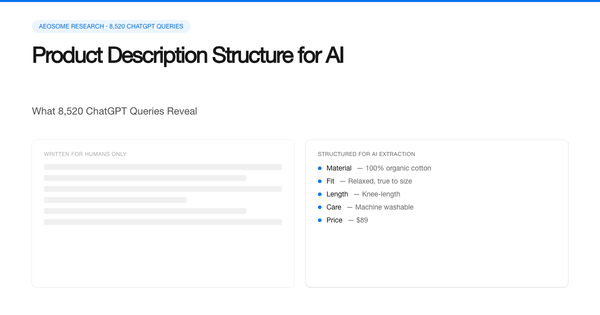
- What 8,520 ChatGPT shopping queries reveal about product descriptions
- Why budget-framing queries win ChatGPT product slots
Your Next Steps
Don't build anything new for in-chat checkout. Do check your Agentic Storefronts settings, and keep investing in feed and content eligibility.
None of this requires guessing. Here's the order of operations, most urgent first.
- This week: Check Shopify Admin → Sales channels → Agentic to see your current enrollment, and confirm whether any legacy Instant Checkout settings still apply to your store (Shopify Help Center, 2026).
- This month: If you were live on Instant Checkout and paying the 4% fee, confirm with Shopify or OpenAI whether that fee structure still applies under the redirect model, or whether it reverts to standard processing costs.
- This quarter: Don't delay feed, schema, and description work waiting to see which checkout model "wins." Eligibility for AI shopping surfaces doesn't depend on which party completes the payment. Run the product feed and policy eligibility checklist above, and if you're not sure where your catalog stands, start with why your products don't show up in AI shopping results.
- Ongoing: Re-check this status periodically. OpenAI has changed this feature twice in six months, and Shopify's own description of Agentic Storefronts reaching ChatGPT "by default" is still a rollout in progress, not a finished state.
Do not:
- Don't build or commission a custom in-chat checkout integration right now. The model it would target is the one OpenAI just moved away from.
- Don't assume opting out of Agentic Storefronts removes you from ChatGPT shopping results. Enrollment and visibility are separate questions.
The Bigger Picture: Discover in AI, Buy on Site
The industry is converging on a split model. AI assistants are good at surfacing products, not yet trusted for completing the purchase, and merchants should plan around that split rather than the reverse.
Forrester's guidance to merchants is to treat answer engines strategically (Forrester, 2026). Diversify across platforms, focus on discoverability, and keep checkout control on your own site, rather than betting on any one assistant to own the purchase.
Shopify's own framing lines up with that split. Purchases are "coming inside ChatGPT" through Agentic Storefronts as a discovery-to-handoff model, not a native-payment model (Shopify, 2026). Discovery happens in the chat. The transaction happens where it always has.
The take-rate math explains why that split makes sense even for merchants who stay enrolled in native checkout where it's still available. A completed Instant Checkout order costs roughly 7 to 9%. That's OpenAI's 4% fee stacked on standard Shopify Payments or Stripe processing (PYMNTS; TechRadar Pro, 2026). That cost structure disappears once an order routes through your own redirect-based checkout instead.
None of this is a reason to wait on the eligibility work. A full merchant playbook walks through that checklist end to end.
FAQ
Is ChatGPT Instant Checkout still available for Shopify stores?
Yes, for the small number of merchants already live. But OpenAI confirmed on March 6, 2026 that it's scaling back new rollout. ChatGPT Apps and redirect-based checkout are the focus now (OpenAI, via Digital Commerce 360, 2026).
Why did OpenAI stop ChatGPT Instant Checkout?
OpenAI cited the complexity of managing inventory, sales tax, and pricing directly inside chat. Forrester and Walmart both reported that in-chat checkout converted far worse than sending shoppers to the merchant's own site (Digital Commerce 360; Forrester, 2026).
What is Shopify's Agentic Storefronts, and how is it different from Instant Checkout?
Agentic Storefronts, announced by Shopify in December 2025, surfaces products inside ChatGPT. It completes the purchase on the merchant's own storefront, in an in-app browser or new tab. Payment finishes there, not natively inside the chat (Modern Retail, 2026).
Do I still pay a fee if my store used ChatGPT Instant Checkout?
Merchants who completed Instant Checkout orders paid OpenAI a 4% fee, starting January 26, 2026. That stacked on top of standard payment processing (PYMNTS; TechRadar Pro, 2026).
Does this change affect whether my products appear in ChatGPT shopping results?
No. Product discovery and checkout are separate layers. The retreat changes how a purchase is completed, not whether a product can be surfaced in a ChatGPT shopping conversation.
The Promise Was a Million Merchants. The Reality Was Thirty.
Instant Checkout promised a million-plus Shopify merchants and native in-chat checkout. Six months later, roughly 30 merchants had gone live, the 4% fee had arrived, and OpenAI had already started redirecting the feature elsewhere. The promise and the reality turned out to be two different products wearing the same feature name. Nothing a typical Shopify merchant needs to build changed as a result.
If you want a faster read on where your catalog stands, regardless of which checkout model wins, AEOsome runs a free audit and citation check. It flags which Shopify products are eligible for AI shopping surfaces today, and which feed or schema gap is holding the rest back.
Vijaya Kumar Channalli is a serial SaaS founder and the founder of AEOsome (Tartu, Estonia), which helps eCommerce brands get their products recommended when shoppers ask AI what to buy. Read how we write, source and correct posts in our editorial policy.