Brand Mentions vs Product Recommendations: Why AI Citing You Isn't the Same as Selling You
AI can name your brand and still show a competitor's product. Learn how a brand mention differs from a product recommendation and what to measure.

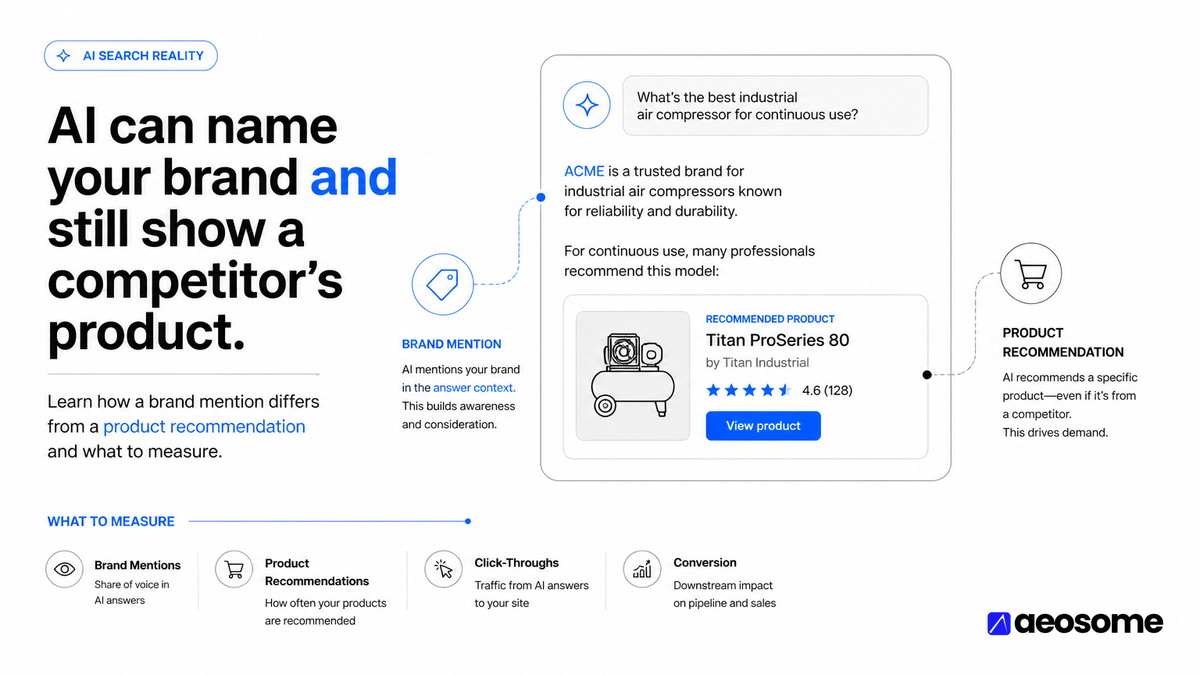
A brand mention is AI naming you in a sentence. A product recommendation is AI showing a specific, purchasable product with a price and a link. They are different outcomes with different inputs, so being cited does not mean you are being sold. Measure product cards, not just mentions.
Your monthly report says ChatGPT mentioned your brand 40 times. Then a shopper asks it for the best option in your category and gets a row of product cards. Your name sits in the paragraph above the row. None of your products is in it.
That gap is what most "AI visibility" reports miss. They count how often AI says your name. This post defines the difference, shows how often the two diverge in our data, and covers what to measure and fix instead. If you're new to the field, start with what AEO (Answer Engine Optimization) is, a planned post in this cluster.
Key TakeawaysOnly 21.8% of the brands Perplexity names in its answer text reach its product cards (AEOsome Research, 2026).On ChatGPT, 95.9% of card-bearing answers name at least one brand that is not on the shelf (AEOsome Research, 2026, Study 2).The host of a surfaced product is among the cited sources for just 19% of 40,544 card slots (AEOsome Research, 2026, Study 1).The platform decides whether a card appears: Google AI Mode 64.4%, Copilot 44.5%, ChatGPT 28.5%, Perplexity 5.0% (AEOsome Research, 2026, n = 22,335).Asking the same question twice changes whether ChatGPT shows a card in 42% of pairs (AEOsome Research, 2026).
In this article:
- What Is the Difference Between a Brand Mention and a Product Recommendation?
- How Often Does AI Name a Brand Without Recommending Its Products?
- Why Does a Citation Not Lead to a Product Card?
- What Does It Take for a Product to Be Recommended?
- Should You Track Brand Mentions or Product Recommendations?
- Where Do Mentions and Recommendations Still Overlap?
- Frequently Asked Questions
- Count the Cards, Not the Quotes
What Is the Difference Between a Brand Mention and a Product Recommendation?
A mention is the model using your brand name in prose. A recommendation is a structured product object (name, price, merchant link) shown to the shopper. Different outputs, different inputs.
Our study uses a strict definition. An answer "shows a product card" when the engine's structured response contains at least one product object. A product mentioned in the text does not count (AEOsome Research, 2026, methodology).
In short: A brand mention is your name appearing in an AI answer's text. A product recommendation is a structured product card with a price and a merchant link. Only the card puts a purchasable SKU in front of the shopper (AEOsome Research, 2026).
We think of it as a four-rung ladder: named, cited, carded, bought. Most reports stop at the first rung. The data shows the rungs are loosely coupled, so climbing one does not guarantee the next.
| Rung | What the shopper sees | Who controls it |
|---|---|---|
| Named | Your brand in the answer text | The model's language and training |
| Cited | Your page in the answer's source list | Retrieved pages and their rankings |
| Carded | Your product, with a price and link | Your product data and selection signals |
| Bought | A completed checkout | Your offer, price and buy path |
Ask your reporting source which rung it measures. If the answer is "named," you have a visibility number, not a sales number. For the mechanics behind each rung, see how AI product discovery actually works (feeds, retrieval and carousels), a planned post in this cluster. GEO (Generative Engine Optimization) and AIO are near-synonyms for the same work, as AEO, GEO and AIO compared explains.
How Often Does AI Name a Brand Without Recommending Its Products?
Often. In our data, the answer text and the product shelf routinely disagree.
On ChatGPT in Study 2, 95.9% of card-bearing answers name at least one brand that is not on the shelf (AEOsome Research, 2026). On Perplexity, only 21.8% of the brands named in the text reach its cards. The text and the shelf are two separate lists.
Whether a card appears at all depends heavily on the engine. The spread is 59 points across platforms, from Perplexity at 5.0% to Google AI Mode at 64.4% (AEOsome Research, 2026, n = 22,335 deduplicated responses).
A mention is not nothing. When a shopper names a brand and ChatGPT shows a carousel, the brand was in it 87.3% of the time (AEOsome Research, 2026, Study 1). In Study 2 that fell to 65.2% on ChatGPT and 68.8% on Google AI Mode, and other brands held 46% to 52% of the slots.
We read this as a problem of unprompted discovery. Your name helps once a shopper already asks for you. These figures cover branded questions only, so they can't tell us about shoppers who don't.
What this means for you: Treat "we were mentioned" as a leading indicator at best. It tells you the model knows your name. It doesn't tell you a product was shown.
Why Does a Citation Not Lead to a Product Card?
Because the page an answer cites and the product it shows come from different places.
In Study 1, the host of a surfaced product was among the cited sources for 19% of 40,544 card slots. The median position was twelfth. Also, 61% to 81% of brand mentions in the text appear in no cited source title (AEOsome Research, 2026). The sources justify the sentence. They rarely supply the shelf.
Why would that happen? Here is our reading, and it is a hypothesis, not a measured result. A product index may supply the cards, while retrieved pages supply the citations. Citations then justify the text and do not select the shelf.
The pattern is confirmed. The mechanism is our interpretation of it.
In short: Citing a brand and carding its product are separate events. In AEOsome's ChatGPT data, a surfaced product's host was a cited source for only 19% of 40,544 card slots (AEOsome Research, 2026).
What this means for you: Earning citations through editorial coverage or Reddit threads will not by itself put a SKU on the shelf. For the wider picture, see what the 22,335-response study found.
What Does It Take for a Product to Be Recommended?
Eligibility comes first, then selection. A SKU needs complete, accurate product data to be shown at all. Only then does it compete on signals such as ratings and reviews.
Eligibility inputs are mostly operational. They include product feed fields, GTINs, accurate price and availability, and Product and Offer structured data. Google documents how to mark these up in its Search Central product structured data guide, and Schema.org defines the Product type.
Agentic commerce adds protocols on top. ACP (Agentic Commerce Protocol, from OpenAI and Stripe) covers checkout inside ChatGPT, and OpenAI publishes its commerce documentation for merchants. UCP (Universal Commerce Protocol, from Google and Shopify) is the equivalent on Google's side. We define both in ACP and UCP defined.
Selection is where ratings and reviews matter. Inside ChatGPT's eight-slot carousel, one standard deviation of rating doubles the odds of rank one (odds ratio 2.1). Review count multiplies them by 1.7 (AEOsome Research, 2026, Study 1). That is an association in our data. It does not prove that adding reviews causes a higher rank.
Two published guides cover the data side: the feed fields that gate eligibility and how to mark up Product data with GTINs. For the full playbook, read the complete guide to getting products recommended by AI.
What this means for you: The fix is operational (feeds and schema), not PR.
Should You Track Brand Mentions or Product Recommendations?
Track product recommendations as the primary metric and mentions as context. Report a rate, not a single answer.
A single answer is a sample, not a measurement. Asking ChatGPT the same question twice changes whether it shows a card in 42% of pairs. The cause is the served model, not the question (AEOsome Research, 2026, Study 2). So a one-off check can mislead you in either direction.
Run each category question repeatedly. Do it on each platform and at each intent stage, then record whether a card for your SKU appeared, not whether your name did. Report the share of runs, by SKU.
| Brand mention | Product recommendation | |
|---|---|---|
| What the shopper sees | Your name in the text | A product card with price and link |
| Where it comes from | Model language and retrieved pages | Product data and selection signals |
| What you control | Brand reputation, coverage | Feed, schema, reviews, price |
| How to measure | Mentions per prompt set | Card rate per SKU, repeated asks |
Mention tracking still earns a place. It helps with brand protection and with spotting wrong descriptions. For those uses, measure slot share, not presence. Our reading is that a named brand gets its own shelf alone about half the time at best (AEOsome Research, 2026).
Our own loop is Monitor → Audit → Optimize → Verify, run at the SKU level. For how this differs from search, see how AEO differs from SEO. For who should carry the metric, see who should own this metric, a planned post in this cluster.
What this means for you: Change the headline KPI in your next report from "mentions" to "card rate by SKU."
Where Do Mentions and Recommendations Still Overlap?
They are related, not independent, and these surfaces are young.
Some caveats apply. The study is a snapshot: Study 2 was collected May 5 to 14, 2026. ChatGPT's model routing varied by collection day. Also, 60% of its answers came from gpt-5-3-mini, which showed a card 3.7% of the time (AEOsome Research, 2026, Study 2). Our card definition counts only structured products, so a text-only recommendation falls outside it.
A mention can also shape consideration and may prompt a later branded search. We have not measured that, so we don't claim it either way. We might be wrong about the mechanism, and the rungs may couple more tightly as these products mature. For the revenue side, see what zero-click answers mean for store revenue, a planned post in this cluster.
Frequently Asked Questions
If ChatGPT mentions my brand, will it recommend my products?
Not necessarily. Mentions are prose, while product cards are structured objects built from different inputs (AEOsome Research, 2026). On ChatGPT, 95.9% of card-bearing answers named a brand that was not on the shelf.
Does being cited by AI drive sales?
A citation links to a page. It does not put a SKU on the shelf. Only 19% of card slots sat on a cited host in our Study 1 data (AEOsome Research, 2026). We have no revenue outcomes to report, so treat citations as one input.
How can I tell if AI is recommending my products or just naming my brand?
Run your category questions repeatedly on each platform. Record whether a product card for your SKU appears, not whether your name does. Report the share of runs, since one answer is only a sample.
Why does AI name my brand but show competitors' products?
Cards come from product data and selection signals. The text draws on retrieved pages and the model's own knowledge. Even when a shopper names your brand, other brands held 46% to 52% of the slots in Study 2 (AEOsome Research, 2026).
Is brand mention tracking useless?
No. It is useful for brand protection and context. It is not enough as a sales metric, because no mention report shows whether a SKU was eligible to appear.
Count the Cards, Not the Quotes
Three numbers carry the argument. On ChatGPT, 95.9% of card-bearing answers named a brand that was not on the shelf. On Perplexity, 21.8% of text mentions reached its cards. And a surfaced product's host was a cited source for 19% of card slots.
Methodology: the findings come from AEOsome's AI Shopping Visibility Study 2026. Study 2 holds 22,335 deduplicated responses from four platforms, seven categories and nine intent stages, collected May 5 to 14, 2026 (US, English, logged out). Study 1 holds 8,520 ChatGPT answers to women's-dress questions, collected on February 28 and March 1, 2026. Read the full methodology and ten things we did not expect.
Want to know whether your products, not just your name, appear? Run a free AEOsome citation check and see which SKUs make the shelf.
Vijaya Kumar Channalli is a serial SaaS founder and the founder of AEOsome (Tartu, Estonia), which helps eCommerce brands get their products recommended when shoppers ask AI what to buy. Read how we write, source and correct posts in our editorial policy.