How to Choose an AEO Platform or Agency: A Buyer's Checklist for eCommerce
Choosing an AEO tool or agency for your store? Ask these questions first: real answers or estimates, SKU or brand level, and what the price covers.

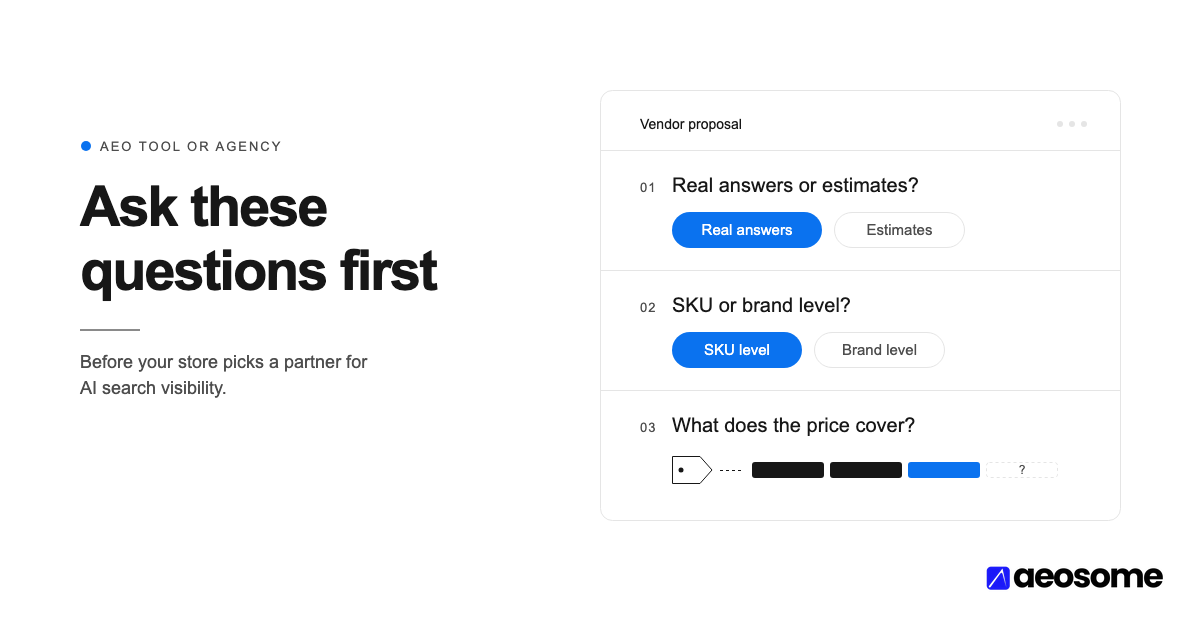
Choose an AEO platform or agency by testing six things. Does it measure real AI answers? Does it work at product level? Does it fix what it finds? Is its method open? Does it fit your store? What does the price cover? A provider that fails on real answers or product level is a reporting dashboard, not a fix.
You have a budget and three vendor calls booked. Every demo shows a dashboard with a "visibility score." None of them tells you what the score is made of.
AEO (Answer Engine Optimization) is the work of getting your products shown when shoppers ask AI what to buy. GEO (Generative Engine Optimization) is the same goal under a different label. If you're new to the field, start with what answer engine optimization is. The category is young, so there is no standard way to compare AEO tools. Many comparison pages are published by the vendors being compared.
This guide gives you six questions that work on any platform or agency. Each comes with a good answer and a red flag. It names no vendors and ranks nothing. Disclosure: AEOsome builds AEO software, so the same questions apply to us. The evidence comes from our AI Shopping Visibility Study 2026.
Key TakeawaysChatGPT showed a product card in 28.5% of its shopping answers, a rate that mixes three served models (AEOsome Research, 2026, Study 2).On the same days and categories, gpt-5-3-mini showed a card 3.7% of the time and gpt-5-5 65.3% (AEOsome Research, 2026, Study 2).The platform matters more than the question: a 59-point spread across platforms against 22 across categories (AEOsome Research, 2026, Study 2).Only 1.6% of 5,583 questions asked on all four engines got a product card on all four (AEOsome Research, 2026, Study 2).A surfaced product's host is among the cited sources for only 19% of 40,544 card slots (AEOsome Research, 2026, Study 1).
In this article:
- Does It Measure Real AI Answers, or Estimate Them?
- Does It Work at Product Level, or Brand Level Only?
- Does It Only Monitor, or Does It Also Fix?
- Is the Method Open?
- Platform or Agency: Which Fits Your Store Size?
- What Does the Price Actually Cover?
- Put It Together: A One-Page Scorecard
- Frequently Asked Questions
- Ask for the Raw Answers
Does It Measure Real AI Answers, or Estimate Them?
Ask whether the provider sends real questions to real AI engines and stores the answers. The alternative is a model that extrapolates from search data or panels. Only the first is a measurement.
Then ask three follow-ups. Which engines? We study ChatGPT, Google AI Mode, Microsoft Copilot and Perplexity, and a provider covering one of them covers a fraction of the shelf. How many questions? Hundreds per category give you a rate, while a handful give you anecdotes. How often? A monthly screenshot is a sample, not a trend.
The hardest test is model routing. ChatGPT's served model changed by collection day, not by question (AEOsome Research, 2026, Study 2). In our May 2026 run, gpt-5-3-mini answered 60% of questions and showed a card 3.7% of the time. gpt-5-5 answered 30% at 65.3%, and gpt-5-3 answered 9% at 72.2%.
One caveat keeps this honest. gpt-5-3 answered only on May 5, when we collected Electronics, so its rate is tied to that category. The clean contrast is 3.7% against 65.3%, because those two models shared collection days and categories (AEOsome Research, 2026, Study 2).
That blended 28.5% will not replicate. The next run's rate depends on how many questions the small model answers that day (AEOsome Research, 2026, Study 2). The full breakdown is in our platform-by-platform results.
In short: On the same days and categories, gpt-5-3-mini showed a product card 3.7% of the time. gpt-5-5 showed one 65.3% of the time (AEOsome Research, 2026, Study 2). A provider must record the served model to separate a real change in your visibility from a change in routing.
So ask: "How do you tell a real change in my visibility from a change in routing?" A good answer names the model field they store. Walk away from a single blended score with no per-engine breakdown, or "we track AI visibility" with no question count.
Does It Work at Product Level, or Brand Level Only?
A brand mention is not a product recommendation. Ask whether the provider reports on individual SKUs a shopper can buy, or only on whether your name appeared.
Our study uses a strict definition. An answer shows a product card when the engine's structured response contains at least one product object. A product named in the text does not count (AEOsome Research, 2026, see methodology below).
The two measures drift apart. In Study 1, a surfaced product's host was among the cited sources for 19% of 40,544 card slots. And 61% to 81% of brand mentions in the text appear in no cited source title (AEOsome Research, 2026, Study 1). More in ten things we did not expect. Citation tracking can look healthy while no product of yours reaches the shelf. Our upcoming post on brand mentions versus product recommendations covers this gap in depth.
Shopping intent matters too. Budget Framing questions ("best X under $100") produced a card 54.8% of the time. Post Purchase questions did so 14.7% of the time (AEOsome Research, 2026, Study 2). Ask for results by product or variant, and by intent stage.
Engines also disagree with each other. Of 5,583 questions asked on all four, 1.6% got a card on all four and 21.9% on none. Where two engines both show cards, their product sets overlap by a Jaccard index of only 0.01 to 0.05 (AEOsome Research, 2026, Study 2).
In short: Brand-level tracking and product-level visibility are different measurements. A surfaced product's host was a cited source for only 19% of 40,544 ChatGPT card slots (AEOsome Research, 2026, Study 1). Mention counts say little about whether a SKU was shown.
Be wary of a report that counts "mentions" and "citations" but never a purchasable product, or one blended "AI visibility score" that hides how far the engines disagree.
Does It Only Monitor, or Does It Also Fix?
Monitoring tells you a product is missing. It does not make the product appear. Ask what happens after the report.
In our reading, SKU-level visibility depends mostly on three inputs. The first is the product feed: GTIN, price, availability and policy URLs. OpenAI's product feed specification lists fields such as gtin, availability, return_policy and seller_tos. The second is structured data. Google documents Product markup in its merchant listing structured data guide, built on the schema.org Product type. The third is the product description itself.
If those are unfamiliar, read why products don't appear in ChatGPT Shopping. Then work through the product feed eligibility checklist and our guide to Product schema with GTIN.
Then ask three things. Who does the fixing: the vendor, your developer or your agency? How is each fix verified? Is the same measurement rerun afterward to confirm lift? A closed loop runs measure, audit, change, re-measure. Without the last step, nobody knows whether the change worked.
A monitoring-only tool can still be the right buy. If you have developers who own the feed and schema, a clean measurement layer may be all you need. The warning sign here is "optimization" that turns out to be a list of generic content tips.
Is the Method Open?
If you cannot see the sample questions and the raw answers, you cannot check the score. Ask for five things: the question list, sample raw answers per engine, metric definitions, collection dates and the number of repeat runs.
Hold providers to the standard we hold ourselves to. Our research pages label every figure with its study, its basis and, for ChatGPT, the served model. Sample sizes and collection dates sit in the methodology note at the end of this post. We also keep our public corrections page, which lists numbers we got wrong.
Repeat runs matter because answers are only partly stable. In Study 1, 1,286 pairs of identical question texts agreed on card versus no card 96.0% of the time. Yet they shared only 25% of brands and 6% of products (AEOsome Research, 2026, Study 1).
In short: Across 1,286 identical question pairs, ChatGPT agreed on card or no card 96.0% of the time. The products overlapped only 6% (AEOsome Research, 2026, Study 1). Whether products appear is stable. Which products appear is not, so "rank #1 for a prompt" is the wrong thing to buy.
A good provider runs repeats and reports the spread, not one run. "Proprietary methodology" with no sample output is a reason to pass.
Platform or Agency: Which Fits Your Store Size?
Match the model to your team and catalog. AEO software suits teams with developers and a catalog worth monitoring. An AEO agency suits teams with no technical capacity. Very small stores may need neither yet.
| Your situation | Likely fit | Why |
|---|---|---|
| Under about 100 SKUs, no developer | Neither yet, or a one-off audit | Fix the feed and schema basics first |
| 100 to 5,000 SKUs, developer on staff | AEO software | You can act on SKU-level findings in-house |
| 100 to 5,000 SKUs, no technical capacity | AEO agency or AEO services | Someone else must touch the feed and schema |
| Above 5,000 SKUs, several engines and categories | Software plus an agency or developer | Measurement and fixing both need scale |
This table is editorial guidance, not a measured result. A hybrid is also an option: software for measurement, and an agency or developer for changes.
Ask an agency four things. Who touches the feed? What is measured before and after? Do they hand you the raw data? What happens to that data if you leave? Ask a platform three things: setup time, who fixes what, and whether you can export everything.
Before you buy anything, check whether AEO is worth the investment for your store. The answer depends on your category and on which engines your shoppers use.
What Does the Price Actually Cover?
Compare what you get for the money, not the headline price. We don't track vendor prices, so this section gives you questions, not figures.
Price can scale with any of five things: questions tracked, engines covered, SKUs covered, refresh frequency and seats. Ask which of these the quote includes. Then ask what costs extra. Check feed fixes, schema work, content rewrites, implementation, data exports and added engines one by one.
Check the contract terms as well: minimum term, onboarding fee and who owns the data on exit. For agencies, ask whether the retainer includes the implementation or only the advice.
One question cuts through most sales decks. "What will I see after 90 days that I can't see now?" A specific answer names engines, question counts and SKUs. A vague one names a score.
Be cautious with a price that rises with the number of "mentions" tracked rather than the work done.
Put It Together: A One-Page Scorecard
Score each provider 0 to 2 on each question. Walk away from any provider that scores 0 on measurement or product level. Those two are non-negotiable. The other four are trade-offs you can weigh against your team and budget.
| Question | Good answer (2) | Red flag (0) |
|---|---|---|
| Real AI answers? | Real questions on named engines, served model recorded | Estimates, or one blended score |
| Product level? | Results per SKU, per engine, per intent stage | Mentions and citations only |
| Fixes, not just monitoring? | Feed, schema and description fixes, then re-measured | Generic content tips |
| Open method? | Question list, raw answers, dates, repeat runs | "Proprietary methodology" |
| Fits your store? | Matches your catalog size and team capacity | One package for every store |
| Price coverage? | Engines, SKUs, refresh rate and exit terms in writing | Priced per "mention" |
Use a 30-minute vendor call script with five questions, in order:
- Which engines do you query, and do you store the raw answers?
- How do you handle ChatGPT's served-model mix?
- Can I see results for one of my SKUs on each engine?
- Who makes the fixes, and how do you verify them?
- What will I own if I cancel?
Then run the same 20 questions on every shortlisted provider. Compare the raw answers side by side, not the dashboards.
Frequently Asked Questions
What should I ask an AEO agency before hiring them?
Ask the six scorecard questions, then two more. Who owns the data and the question list if you leave? Does the retainer include implementing feed and schema fixes, or only recommending them?
How do I know if an AEO tool measures real AI answers?
Ask for raw answers from each engine, with dates and the served model. ChatGPT's card rate was 3.7% on gpt-5-3-mini and 65.3% on gpt-5-5 in our data (AEOsome Research, 2026, Study 2). A tool that cannot show the model cannot explain its own swings.
Do I need an AEO platform or an agency for a small store?
Often neither, at first. Under about 100 SKUs, fixing your feed and Product schema yourself may be the best first step. Use the decision table above, and test whether AEO pays off in your category before signing a contract.
Is tracking brand mentions enough for an eCommerce store?
No. A surfaced product's host was a cited source for only 19% of 40,544 card slots (AEOsome Research, 2026, Study 1). And 61% to 81% of text mentions appear in no cited source title (Study 1). Mentions show the model knows your name. Cards show it sells your product.
How often should AI visibility be measured?
Often enough to separate real change from model routing. ChatGPT's model mix varied by collection day (AEOsome Research, 2026, Study 2), so ask each vendor how their cadence and repeat runs account for that. There is no single correct interval.
What does AEO software pricing usually cover?
Ask which of five drivers the price covers: questions, engines, SKUs, refresh frequency and seats. Then ask whether fixes, implementation and exports cost extra. Get the inclusions, the minimum term and the data-exit terms in writing before comparing quotes.
Ask for the Raw Answers
Three numbers carry this guide. ChatGPT's card rate was 3.7% on one served model and 65.3% on another (Study 2). Only 1.6% of questions got a card on all four engines (Study 2). And a surfaced product's host was a cited source for just 19% of card slots (Study 1).
Methodology: Study 1 holds 8,520 ChatGPT answers to women's-dress questions, collected February 28 and March 1, 2026. Study 2 holds 27,255 answers from four engines to 5,584 questions in seven categories. They were collected May 5 to 14, 2026 (US, English). Study 2 was reduced to 22,335 de-duplicated answers after removing 4,920 retries. Its ChatGPT answers came from gpt-5-3-mini, gpt-5-5 and gpt-5-3. The 28.5% blended ChatGPT rate is specific to that collection and will not replicate. Read the full methodology.
Want to see which of your SKUs appear on each engine before your next vendor call? Run a free AEOsome citation check.
Vijaya Kumar Channalli is a serial SaaS founder and the founder of AEOsome (Tartu, Estonia), which helps eCommerce brands get their products recommended when shoppers ask AI what to buy. Read how we write, source and correct posts in our editorial policy.