AI Shopping Assistants: How ChatGPT, Google AI Mode, Copilot and Perplexity Pick Products
On the same 5,583 shopping questions, Google AI Mode showed products in 64.4% of answers and Perplexity in 5.0%. How each AI shopping assistant picks products.

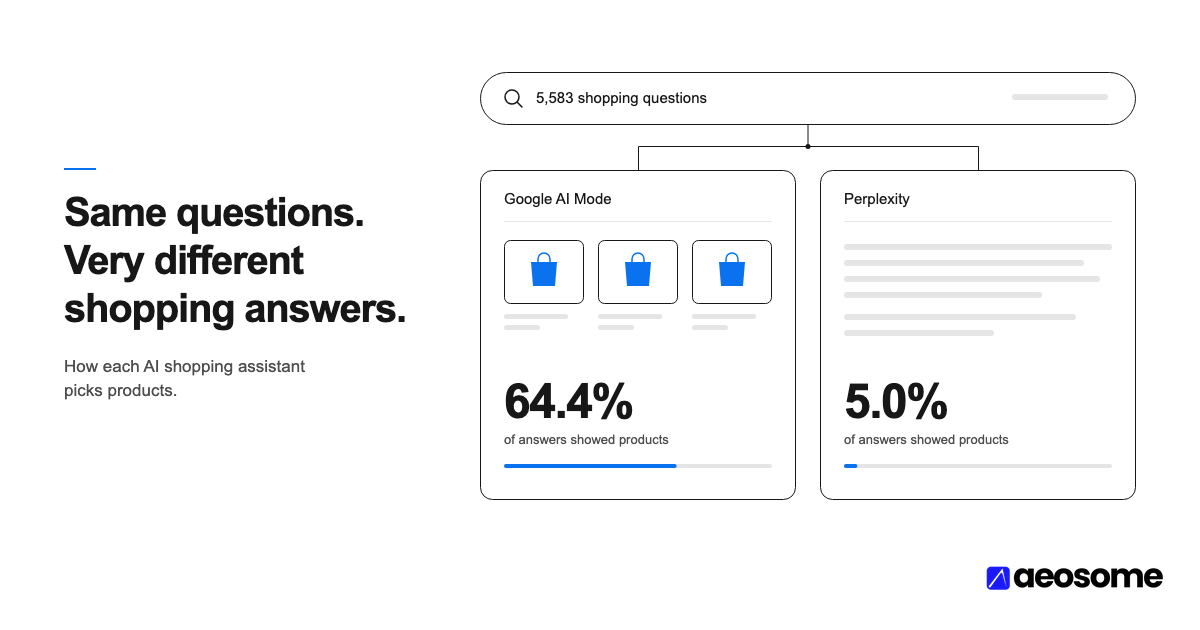
AI shopping assistants pick products in very different ways. We asked four of them the same 5,583 shopping questions. Google AI Mode showed product cards in 64.4% of answers, Copilot 44.5%, ChatGPT 28.5% and Perplexity 5.0% (AEOsome Research, 2026). Their cited sources barely overlap. Our reading: visibility on one engine is evidence for that engine only.
This post is not about adding a chatbot to your store. It's about the assistants your shoppers already use: ChatGPT, Google AI Mode, Microsoft Copilot and Perplexity. They are starting to act as AI shopping agents, not only answer engines. From a merchant's side, an AI shopping assistant is an answer engine that can show product cards (image, price, merchant link) inside its answer. Getting your products into those cards is the job of AEO (Answer Engine Optimization), and of its close cousin Generative Engine Optimization (GEO).
Below is what each engine does with your products, and what you change for each.
Key TakeawaysProduct-card rate on the same questions: Google AI Mode 64.4%, Copilot 44.5%, ChatGPT 28.5%, Perplexity 5.0% (AEOsome Research, 2026).1.6% of questions get a card on all four engines; 21.9% get one on none (AEOsome Research, 2026).ChatGPT's 28.5% is a mixture: gpt-5-3-mini showed a card 3.7% of the time, gpt-5-5 65.3% and gpt-5-3 72.2% (AEOsome Research, 2026).Copilot's card slots are 25.2% Amazon and 18.2% Walmart, while 99.3% of Perplexity's card links are Shopify-style store URLs (AEOsome Research, 2026).Re-asking the same question kept the card decision 89.8% of the time on Google AI Mode and 57.6% on ChatGPT (AEOsome Research, 2026).
In this article:
- How Often Does Each AI Shopping Assistant Show Products?
- Google AI Mode: The Widest Shelf, Built on Community Sources
- Microsoft Copilot: The Retail and Marketplace Web
- ChatGPT: Two Engines Behind One Name
- Perplexity: Rare Cards From a Different Merchant Network
- AI Shopping Assistants Side by Side
- What This Means for Your Store
- Frequently Asked Questions
- Four Engines, Four Shelves
How Often Does Each AI Shopping Assistant Show Products?
The engine decides more than the question does. On identical shopping questions, product-card rates ran from 64.4% down to 5.0% (AEOsome Research, 2026). See the full four-engine comparison in Chapter 2 of our study.
A product-card rate is the share of shopping answers that show at least one product card. That is not the same as being cited. A citation is a source link in the answer text. A card is a product offered for purchase. ChatGPT even shows cards in answers that cite no page at all. Our reading: the two outcomes have different inputs.
The engines also rarely agree. Only 1.6% of questions got a card on all four, and 21.9% got one on none (AEOsome Research, 2026). After "none", the most common pattern was Google AI Mode alone, at 21.0% of questions.
Low agreement: of 5,583 shopping questions asked on Google AI Mode, Copilot, ChatGPT and Perplexity, 1.6% got a product card on all four and 21.9% on none (AEOsome Research, 2026).
For you, that means one test on one engine tells you very little. A product that appears for a question in one assistant may be absent in the next.
Google AI Mode: The Widest Shelf, Built on Community Sources
Google AI Mode shows products most often, and it usually shows them when another engine does (76% to 95% of the time). Given a card on ChatGPT, Google AI Mode also showed one 80.2% of the time. Given Copilot, 75.8%. Given Perplexity, 95.3% (AEOsome Research, 2026).
Google describes the experience as combining "Gemini capabilities with our Shopping Graph" (Google, May 20, 2025). In the same announcement, Google said the Shopping Graph held more than 50 billion product listings, with more than 2 billion refreshed every hour.
The sources it cites lean on the community web. Reddit appears in 51.8% of its answers, and YouTube is its single most-cited domain at 13.0% of sources (AEOsome Research, 2026). It accounts for nearly all of the study's citations of Instagram, TikTok and Quora.
The shelf itself is moderate in size: a median of 4 cards, a mean of 5.4, with a tail to 16. Walmart leads with 11.2% of slots. Ratings show on 38% of its cards. It is also the only engine that showed ads, in 3.9% of answers (AEOsome Research, 2026).
What this means for your store: Google AI Mode draws on product data in the Shopping Graph. Your Merchant Center feed is how your listings reach it. Read what Google Shopping AI Mode is and how it uses your product data. Then look at the community conversations it cites. If Reddit threads and YouTube reviews in your category never mention you, the engine has little to quote.
Microsoft Copilot: The Retail and Marketplace Web
Copilot shops through big retailers, and it asks before it recommends. Microsoft calls it "your personal shopper: on your side, doing the research, building comparisons, offering advice" (Microsoft, April 4, 2025).
Its shelf belongs to the marketplaces. Amazon takes 25.2% of its card slots and Walmart 18.2%, and its top three merchants hold 47.5% (AEOsome Research, 2026). Its products carry a median of 2,189 reviews, the heaviest of any engine.
Its citations follow the same pattern. Amazon alone is 12.4% of Copilot's citations, and 77% of all amazon.com citations in the study came from Copilot. Community sources barely register: Reddit shows up in 2.9% of answers, and community pages are 1.8% of sources (AEOsome Research, 2026).
The answer shape is conversational. Copilot asks a clarifying question in 92.5% of shopping answers and ends 86.3% with a question. When it does show cards, it shows a median of 6.
What this means for your store: marketplace listings and review depth matter more on Copilot than your own site does. Its clarifying questions narrow the shopper by size, use case or budget. Complete attributes decide which follow-up your product fits. A listing with missing attributes can't answer the follow-up.
ChatGPT: Two Engines Behind One Name
ChatGPT's 28.5% hides a split. Which model answers the question decides whether products appear at all. A merchant who checks ChatGPT once and sees no products may simply have hit the small model.
The served model decides
In Study 2, 60.4% of ChatGPT's de-duplicated answers came from gpt-5-3-mini, 30.1% from gpt-5-5 and 9.1% from gpt-5-3 (AEOsome Research, 2026). Their product-card rates were far apart. gpt-5-3-mini showed a card in 3.7% of answers (95% CI 3.1 to 4.4). gpt-5-5 did in 65.3% (63.0 to 67.7), and gpt-5-3 in 72.2% (68.3 to 76.0).
The mix depended on the collection day. All gpt-5-3 answers came on May 5 with the electronics batch, so that model's figure is tied to one category. The gpt-5-3-mini versus gpt-5-5 contrast is clean: they shared collection days and categories. Our interpretation: the published 28.5% is a weighted average of a text engine and a shopping engine.
The ChatGPT split: in Study 2, gpt-5-3-mini answered 60.4% of ChatGPT's shopping questions and showed a product card in 3.7% of them. gpt-5-5 showed one in 65.3% and gpt-5-3 in 72.2% (AEOsome Research, 2026).
What it reads and how it answers
Pooled across served models, ChatGPT is the editorial engine. Publishers, review sites and listicles make up 49.9% of its sources (AEOsome Research, 2026). It cites nothing at all in 14.5% of answers.
Pooled, it names a single pick in 34.7% of answers and ends just 0.3% with a question. The model split shows here too. gpt-5-5 named a single pick in 51.9% of answers, gpt-5-3-mini in 23.7%. The mini model also asked a clarifying question in 51.5% of answers, against 9.2% for gpt-5-5.
Its shelf leads with Walmart at 11.0% of slots, and ratings show on 73% of its cards. Stability is the weak spot. Re-asked, the same question kept its card decision 57.6% of the time overall. That was 90.2% when the same model answered both times, and 25.5% when the model switched.
What this means for your store: editorial coverage (reviews, roundups, buying guides) feeds the text side. Product data feeds the shopping side. OpenAI's merchant docs ask for a structured product feed "so ChatGPT accurately indexes and displays your products" (OpenAI developer docs, retrieved October 18, 2026). See how feeds, retrieval and carousels decide what gets shown. Our recommendation: measure ChatGPT by served model, or you measure routing noise.
Perplexity: Rare Cards From a Different Merchant Network
Perplexity shows products in 5.0% of shopping answers, and its shelf comes from Shopify-style stores, not big-box retailers (AEOsome Research, 2026). Of its card URLs, 99.3% are Shopify-style store links. In all, 828 merchants fill 1,842 slots, and its top ten merchants hold 16% of them. Almost all of those cards sit on electronics questions, as how visibility differs by category shows.
That fits how Perplexity describes its own product. Its shopping launch said the experience is "powered by platform integrations including Shopify" and that its cards "aren't sponsored" (Perplexity, November 18, 2024).
The products are lightly reviewed: 83.0% of them show zero reviews (AEOsome Research, 2026). Separately, 8.6% of its slots sit on non-US domains. Its median card price is $169, inflated by those non-US stores.
Perplexity rewrites the shopper's question before it searches. It fires 1.35 searches per shopping answer, and only 15.4% of those searches repeat the shopper's words. The median search is 31.8% of the question's length. It adds "best" to 53.8% of budget-framed searches. It cites 8.7 distinct domains per answer, and almost never cites nothing (0.1%).
What this means for your store: this is the one engine where Shopify-style stores, not big-box retailers, fill the shelf. If you sell electronics, that is a real opening. Its searches are short. Your product page needs to answer the short "best X for Y" version of the shopper's question, not only the long one.
AI Shopping Assistants Side by Side
Google AI Mode has the widest shelf. Copilot is a marketplace engine. ChatGPT is two engines depending on the model. Perplexity is rare but independent-store heavy. The table puts the Chapter 2 numbers next to each other (AEOsome Research, 2026).
| Google AI Mode | Copilot | ChatGPT | Perplexity | |
|---|---|---|---|---|
| Product-card rate | 64.4% | 44.5% | 28.5% (3.7% to 72.2% by model) | 5.0% |
| Median cards when shown | 4 | 6 | 4 | 7 |
| Web it leans on | Community (Reddit in 51.8% of answers) | Retail and marketplace (Amazon 12.4% of citations) | Editorial (49.9% of sources, pooled) | Editorial (44.0%) and community (18.9%) |
| Top merchants on the shelf | Walmart 11.2% | Amazon 25.2%, Walmart 18.2% | Walmart 11.0% | Shopify-style store URLs (99.3%) |
| Median card price | $62 | $46 | $55 | $169 (non-US stores inflate it) |
| Cards showing a rating | 38% | 69% | 73% | 17% |
| Answer style | Hedges least; single pick in 8.5% | Clarifying question in 92.5% | Single pick in 34.7% (pooled) | Most domains cited (8.7) |
| Same card decision on re-ask | 89.8% | 75.4% | 57.6% | 86.4% |
ChatGPT figures pool all three served models unless the cell names a range. No column wins. Our reading: each engine draws on a different mix of the web, so each needs different work.
What This Means for Your Store
Presence on one engine is evidence of presence on that engine only. That is our interpretation, and the overlap numbers back it (AEOsome Research, 2026). Brand overlap between engines ranges from a Jaccard of 0.25 to 0.42 (a 0 to 1 overlap score, where 1 means identical sets). Between 18% and 41% of question pairs share no brand at all.
Cited domains overlap even less, at a Jaccard of 0.06 to 0.12. Brands do travel, just not question by question. Of 564 brands with at least ten card slots, only 10 appear on exactly one engine.
Single spot-checks are unreliable too. Ask the same question twice and the card decision can flip, most often on ChatGPT.
Each engine needs different work:
- Google AI Mode: keep your Merchant Center product data complete. Earn mentions in the Reddit threads and YouTube reviews it cites.
- Copilot: list on the marketplaces it shops and build review depth there. Fill every attribute its clarifying questions ask about.
- ChatGPT: win editorial coverage for the text model. Keep your product feed eligible for the shopping model. Our product feed eligibility checklist covers the basics.
- Perplexity: make each product page answer the short "best X" version of the question.
Shoppers also ask different things at different moments. The stages of the AI shopping customer journey show where each kind of question sits.
Measure per engine, and for ChatGPT per served model. Then fix, and measure again: Monitor → Audit → Optimize → Verify.
Frequently Asked Questions
Which AI shopping assistant shows products most often?
Google AI Mode. It showed product cards in 64.4% of shopping answers on the same 5,583 questions (AEOsome Research, 2026). Copilot followed at 44.5%, ChatGPT at 28.5% and Perplexity at 5.0%.
Why does ChatGPT sometimes show my products and sometimes not?
The served model. gpt-5-3-mini showed a product card in 3.7% of answers, against 65.3% for gpt-5-5 and 72.2% for gpt-5-3. When the model switched between two asks, the card decision matched only 25.5% of the time (AEOsome Research, 2026).
If my products show in Google AI Mode, will they show in ChatGPT or Copilot?
Not reliably. Given a card on Google AI Mode, ChatGPT showed one only 35.5% of the time and Copilot 52.4% (AEOsome Research, 2026). Google AI Mode is the widest door, but winning there does not carry over.
Do I need to sell on Amazon or Walmart to appear in AI shopping results?
Not everywhere. On Copilot, Amazon holds 25.2% of card slots and Walmart 18.2%. On Perplexity, 99.3% of card links are Shopify-style store URLs (AEOsome Research, 2026). Marketplaces matter most on Copilot.
Four Engines, Four Shelves
Shopping AI is not one shelf. The gap is the story. Google AI Mode showed products in 64.4% of shopping answers and Perplexity in 5.0%. Only 1.6% of questions got a card on all four engines. ChatGPT alone ranged from 3.7% to 72.2%, depending on which model answered.
Methodology: this post uses Study 2 of the AI Shopping Visibility Study 2026. We asked 5,583 shopping questions on Google AI Mode, Microsoft Copilot, ChatGPT and Perplexity. They spanned seven categories and nine intent stages, in the United States, in English, logged out. Answers were collected May 5 to 14, 2026.
We kept 22,335 de-duplicated answers (27,255 collected, 4,920 duplicate retries removed). A product card counts when the engine's structured response holds at least one product object. Full details: how the study was run.
Want to see which shelves your products are on? Run a free AEOsome AI shopping visibility check across all four engines.
Retrieval note: OpenAI's developer docs are undated and were retrieved October 18, 2026.
Vijaya Kumar Channalli is a serial SaaS founder and the founder of AEOsome (Tartu, Estonia), which helps eCommerce brands get their products recommended when shoppers ask AI what to buy. Read how we write, source and correct posts in our editorial policy.