How AI Product Discovery Actually Works: Feeds, Retrieval, and Carousels
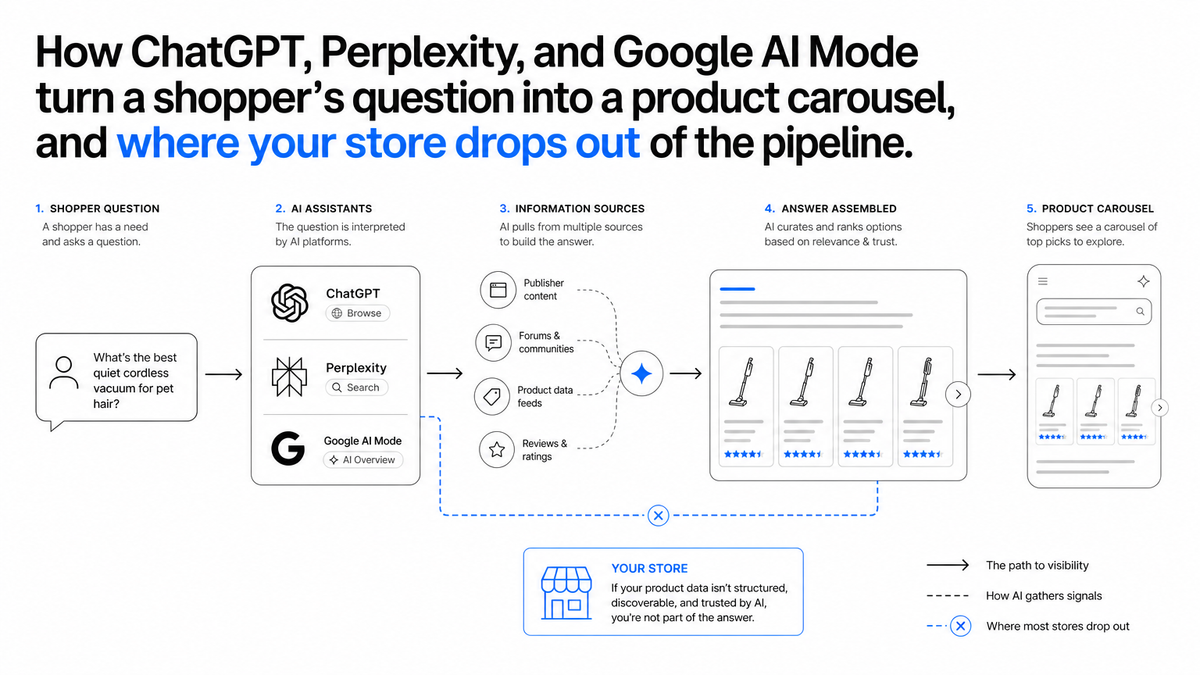
How ChatGPT, Perplexity, and Google AI Mode turn a shopper's question into a product carousel, and where your store drops out of the pipeline.

A shopper types "waterproof trail runners under $150 for wide feet" into ChatGPT. Four product cards appear in seconds. You stock three pairs that fit. None of them show up.
One clarification before anything else: "product discovery" here means shoppers finding products, not product teams finding ideas. This is about the pipeline that puts items in front of buyers, not a roadmap process.
AI product discovery runs as a pipeline, not a search. The assistant reads the shopper's intent, breaks the request into constraints, and retrieves candidates from product feeds, shopping indexes, and the web. It ranks what it finds on fit, price, availability, and reviews, then decides whether to show a carousel at all. Your store can drop out of that pipeline at every stage.
Key TakeawaysA structured product card appeared in 35.6% of 22,335 AI shopping responses across four platforms (AEOsome Research, 2026).Intent decides whether products appear at all: ChatGPT's carousel trigger rate ranged from 93.0% (Purchase Execution) to 2.8% (Post Purchase) across 8,520 queries (AEOsome Research, 2026).Platforms differ widely: Google AI Mode showed product cards in 64.4% of answers; Perplexity showed them in 5.0% (AEOsome Research, 2026).Retrieval leans on structured data. Google's Shopping Graph holds more than 50 billion listings, with more than 2 billion refreshed every hour (Google, 2025).Ads are rare: 1.0% of AI shopping answers carried an ad (AEOsome Research, 2026). Placement comes from data, not bids.
This post walks the pipeline one stage at a time: what it runs on, how it decides, and what you control at each step. If you're new to the term, we cover Answer Engine Optimization (AEO) in a companion post. The pipeline below is the same mechanism whether you call the discipline AEO, Generative Engine Optimization (GEO), or AIO (AI Optimization), and the distinctions matter less than the mechanism.
In this article:
- What Data Does AI Product Discovery Run On?
- Step 1: How Does AI Decide a Question Is a Shopping Question?
- Step 2: How Does AI Turn a Request Into Searchable Constraints?
- Step 3: Where Does AI Retrieve Products From?
- Step 4: How Does AI Rank the Products It Retrieved?
- Steps 5 and 6: When Does a Carousel Appear, and Does It Lead to Checkout?
- Where Does Your Store Drop Out of the Pipeline?
- Frequently Asked Questions
- The Pipeline Is Where You Win or Lose. Start at the Top.
What Data Does AI Product Discovery Run On?
Three pipes feed every AI shopping answer: merchant product feeds, platform shopping indexes, and the open web.
Feeds are structured files merchants submit directly. OpenAI's product feed spec requires 9 basic fields per variant: item_id, title, description, url, brand, seller_name, image_url, availability, and price. OpenAI's own key-concepts documentation adds that recommended attributes "like rich media, reviews, and performance signals" improve ranking, relevance, and user trust.
Shopping indexes are the platform's own product graphs, built from feeds plus crawled and licensed data. Google's Shopping Graph holds more than 50 billion listings, with more than 2 billion refreshed every hour (Google, May 2025). Perplexity has also described a merchant program for sharing product specs directly, positioned as separate from its advertising products (Modern Retail, 2024).
The web is everything else: product pages, JSON-LD schema, reviews, and third-party retailer listings that corroborate what the feed says.
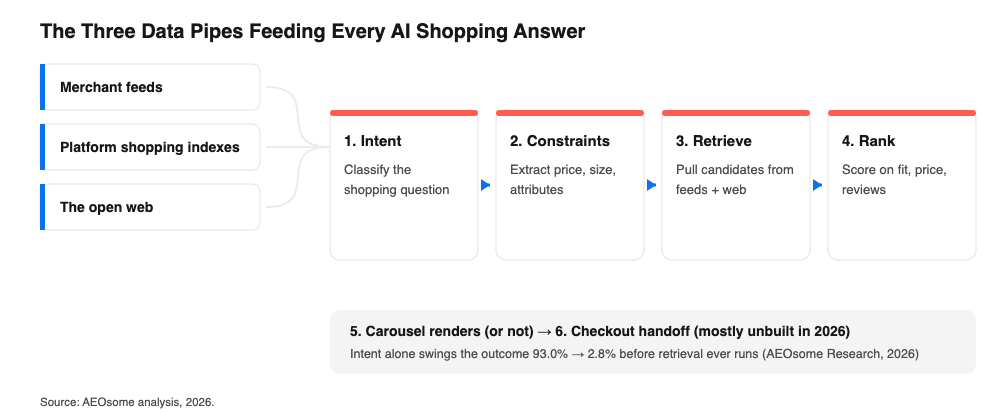
Citation Capsule: Every AI shopping answer draws on three data pipes: merchant product feeds, the platform's own shopping index, and the open web (product pages, schema, and reviews) (AEOsome analysis, 2026).
A compliant feed is table stakes before any of the later stages matter. For the field-by-field requirements, see the feed eligibility checklist and product schema and GTINs for AI.
Step 1: How Does AI Decide a Question Is a Shopping Question?
Before any retrieval happens, the model classifies intent. That single gate decides whether products appear at all, independent of how good your catalog is.
AEOsome sorted 8,520 ChatGPT queries about women's dresses into a 9-stage shopping-intent framework. The carousel trigger rate swung from 93.0% at Purchase Execution down to 2.8% at Post Purchase (AEOsome Research, 2026). Across all four platforms and 22,335 responses, the pattern holds at a smaller scale: Budget Framing queries triggered products 54.8% of the time, versus 14.7% for Post Purchase (AEOsome Research, 2026).
The exact wording of a query moves that rate before retrieval ever starts. Deal-seeking language raised the trigger rate by 35 percentage points; urgency added 33; a stated price constraint added 30 (AEOsome Research, 8,520 queries, 2026). Naming a specific brand cut it by 46 points, and comparison language cut it by 49. The assistant reads a comparison or validation question as a request for an answer, not a shelf.
What you control here is intent coverage: which questions your content and catalog are built to answer. Budget- and attribute-framed pages win product slots; comparison and "is X worth it" pages win cited answers instead. Our 22,335-response study covers that gap in more depth. Being cited is not the same as being recommended for purchase, and that distinction shapes which intent stages are worth building for first.
Step 2: How Does AI Turn a Request Into Searchable Constraints?
Once the intent gate opens, the assistant breaks a natural-language request into attributes: price ceiling, size, material, use case. Google describes this as "query fan-out": AI Mode "runs several simultaneous searches" to work out what makes a product suitable (Google, May 2025).
This step only works if your data states the attribute explicitly. "Wide fit" sitting inside an image alt tag or a buried review paragraph doesn't count as a structured attribute the assistant can match against. In the 8,520-query study, the carousel trigger rate rose roughly 29 points once a query carried five or more stated attributes (AEOsome Research, 2026). More specific requests are easier for the pipeline to act on, not harder.
What you control: attribute completeness, in the feed and on the page. Size, material, use case, price, and variant options (via variant_dict or group_id) all need to exist as structured fields, not just prose. A companion post on structuring product descriptions for AI walks through the format that 8,520 queries actually rewarded.
Step 3: Where Does AI Retrieve Products From?
Retrieval pulls offers, not brands. Whoever has the cleanest, most complete offer data in the feeds and indexes gets into the candidate set first; the open web fills gaps second.
OpenAI's own commerce documentation describes ChatGPT drawing on structured metadata (price, descriptions, reviews, and performance signals) from first- and third-party providers to rank shopping results. AEOsome's electronics deep-dive backs this up with volume: ChatGPT payloads drew on three distinct product-provider tiers with very different rating coverage (9%, 99%, and 26% of listings rated). Best Buy alone held 32.1% of the 3,142 product slots (AEOsome Research, 2026).
In the dresses dataset, retail sites took 89% to 99% of citations at every single intent stage. Brand-owned sites barely registered.
Citation Capsule: AI retrieves offers, not brands. Retail sites took 89% to 99% of product citations at every intent stage in an 8,520-query ChatGPT study (AEOsome Research, 2026).
What you control: getting into the feed programs that matter (direct OpenAI feeds, Google Merchant Center, the Perplexity merchant program). Also keep your offers on third-party retailers consistent on title, GTIN, and price. A retailer carrying your SKU with a stale price can cost you the slot even when your own site is correct. What blocking GPTBot actually does covers the access side of this stage.
Step 4: How Does AI Rank the Products It Retrieved?
Ranking weighs fit to the stated constraints first, then price, availability, ratings, and data trustworthiness. Ad spend plays no part in organic slots.
OpenAI's feed documentation states that rich media, reviews, and performance signals improve ranking. The data matches: ads appeared in only 1.0% of AI shopping answers overall, rising to 3.9% on Google AI Mode, the one platform that runs them at scale (AEOsome Research, 2026).
Brand concentration in electronics was moderate, not winner-take-all; the top 10 brands held 55% of branded slots. A separate 8,520-query fashion study shows what happens when a query names a brand. The carousel shrank from 7.18 to 2.81 unique brands, and the named brand captured 68% of the slots (AEOsome Research, 8,520 queries, 2026).
Citation Capsule: Ads appeared in just 0.9% of AI shopping answers in AEOsome's 22,335-response dataset. Organic product placement is still decided by data, not bids (AEOsome Research, 2026).
What you control: review coverage, price and availability accuracy, and consistent entity data across every channel that mentions your product. Whether reviews function as an AI shopping ranking signal goes deeper on one of those levers.
Steps 5 and 6: When Does a Carousel Appear, and Does It Lead to Checkout?
The carousel is the pipeline's visible output, usually four to eight products, shaped heavily by platform and intent. Checkout inside the AI assistant is the newest stage, and it's still mostly unbuilt.
| Platform | Product-card rate (22,335 responses) |
|---|---|
| Google AI Mode | 64.4% |
| Microsoft Copilot | 44.5% |
| ChatGPT | 28.5% |
| Perplexity | 5.0% |
(AEOsome Research, 2026)
Carousel size follows the same platform-and-category pattern: the ChatGPT electronics dataset showed a median of 4 products per carousel when one appeared, while the dresses dataset averaged 7.99 products from 6.94 unique brands. Checkout is the clear gap: 0 of 3,142 product slots in the electronics payload were checkout-enabled (AEOsome Research; dataset collected before 2026-05-05).
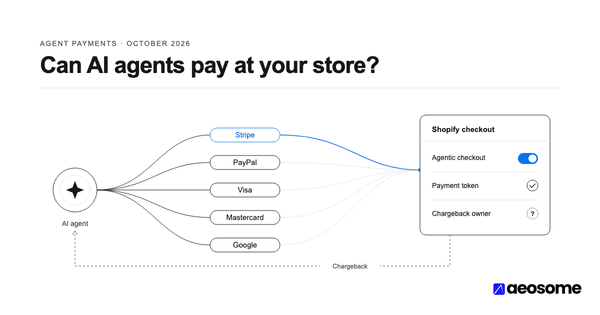
OpenAI's Agentic Commerce Protocol (ACP, built with Stripe) and Google's Universal Commerce Protocol (UCP, built with Shopify) now define in-chat checkout, even though neither showed up in that snapshot. Under ACP, "OpenAI is not the merchant of record." Google has described Merchant Center as the integration path for UCP going forward (Google, Merchant Center UCP guide).
Read that zero as a snapshot, not a verdict; checkout plumbing moves fast, and the dataset predates the most recent rollout. A companion glossary post on agentic commerce covers ACP and UCP in more depth, and a companion post on zero-click search covers what happens to store revenue once a carousel can trigger without a click.
Where Does Your Store Drop Out of the Pipeline?
Diagnose from the top of the pipeline down. A store missing at Step 3 (retrieval) can't be fixed with a Step 5 tactic (carousel copy); the product never got that far.
| Stage | Symptom | Check | Fix |
|---|---|---|---|
| Intent gate | Carousels never trigger for your category's queries | Are your target queries budget- or attribute-framed, or comparison-framed? | Build content and feed coverage around the intent stages that actually open the gate |
| Constraints | Products drop out once a shopper adds detail (size, material) | Are those attributes structured fields, or only prose? | Add them as explicit feed and schema attributes, not just description text |
| Retrieval | You never appear, even for exact-match queries | Are you in OpenAI / Google Merchant Center / Perplexity feeds? Do third-party retailer listings match your site? | Submit a compliant feed; fix GTIN and title parity across every retailer that lists you |
| Ranking | You appear sometimes, but rarely in the top slots | Is your review coverage thin? Does your price ever drift from your feed? | Close review gaps; audit feed-to-page price and availability sync |
| Carousel rendering | Carousels appear for competitors but not for you, same intent | Is your product data richer or thinner than what's winning the slot? | Match the data completeness of the retailers currently holding the slots |
| Checkout | You're visible but get no attributed sales from AI traffic | Is checkout inside the assistant even live for your category yet? | Treat this stage as infrastructure to prepare for, not a current ranking lever |
The full diagnostic guide walks through each row with a step-by-step audit. Feeds and retrieval tend to sit with operations; intent coverage and content tend to sit with marketing.
Frequently Asked Questions
How does ChatGPT decide which products to show?
It runs the same gate every query hits: classify intent, extract constraints, retrieve candidates from feeds and third-party data, then rank on fit, price, availability, and reviews. ChatGPT showed a product card in 28.5% of the queries in AEOsome's 22,335-response study (AEOsome Research, 2026).
Can I pay to get my products into ChatGPT or Perplexity shopping results?
Not for organic product slots. Ads appeared in just 0.9% of AI shopping answers in AEOsome's dataset, and OpenAI's own commerce documentation frames product ranking as driven by structured data signals, not ad spend. Perplexity also offers a merchant program for sharing product specs directly, positioned as separate from its advertising products (Modern Retail, 2024).
Does my product feed matter more than my product page for AI?
For retrieval, yes: feeds and structured indexes are checked first. Your page and its reviews still feed the ranking stage and the web pipe, so neither one on its own is sufficient. The feed eligibility checklist covers what a compliant feed needs.
Why does AI show a product carousel for some questions and not others?
Intent. In the 8,520-query study, the carousel trigger rate ranged from 93.0% for Purchase Execution queries down to 2.8% for Post Purchase queries. Our 22,335-response study breaks that gap down by platform and category.
The Pipeline Is Where You Win or Lose. Start at the Top.
Three numbers to carry out of this: 35.6% of AI shopping queries already return a structured product card, and the trigger rate swings from 93.0% down to 2.8% purely on intent. Only 1.0% of answers carry an ad. The pipeline is open, mechanical, and mostly unpaid. It's also easy to fail at any single stage without knowing which one cost you.
Methodology: Figures in this post draw on three AEOsome datasets, all collected in 2026. The first is a four-platform study (27,255 responses collected, 4,920 duplicate retries removed, 22,335 analyzed) (ChatGPT, Google AI Mode, Microsoft Copilot, Perplexity) across seven categories. The second is an 8,520-query ChatGPT study (model gpt-5-mini, US market, Women's Fashion > Dresses). The third is a 2,129-response ChatGPT electronics deep-dive, collected before 2026-05-05. Exact collection windows are documented alongside the underlying datasets.
About the author. Vijaya Kumar Channalli is a serial SaaS founder and the founder of AEOsome (Tartu, Estonia), which helps eCommerce brands get their products recommended when shoppers ask AI what to buy. Read how we write, source and correct posts in our editorial policy.
If you want to see which stage your own SKUs are dropping out at, AEOsome runs a free citation check against your catalog. For the hub view of everything in this series, see our complete AEO for eCommerce guide.