Why Your Products Don't Show Up in AI Shopping Results: A Diagnostic Guide
Your products aren't showing up in ChatGPT, Google AI Mode, or Perplexity shopping results. Run this 7-point diagnostic to find the exact cause and fix it.

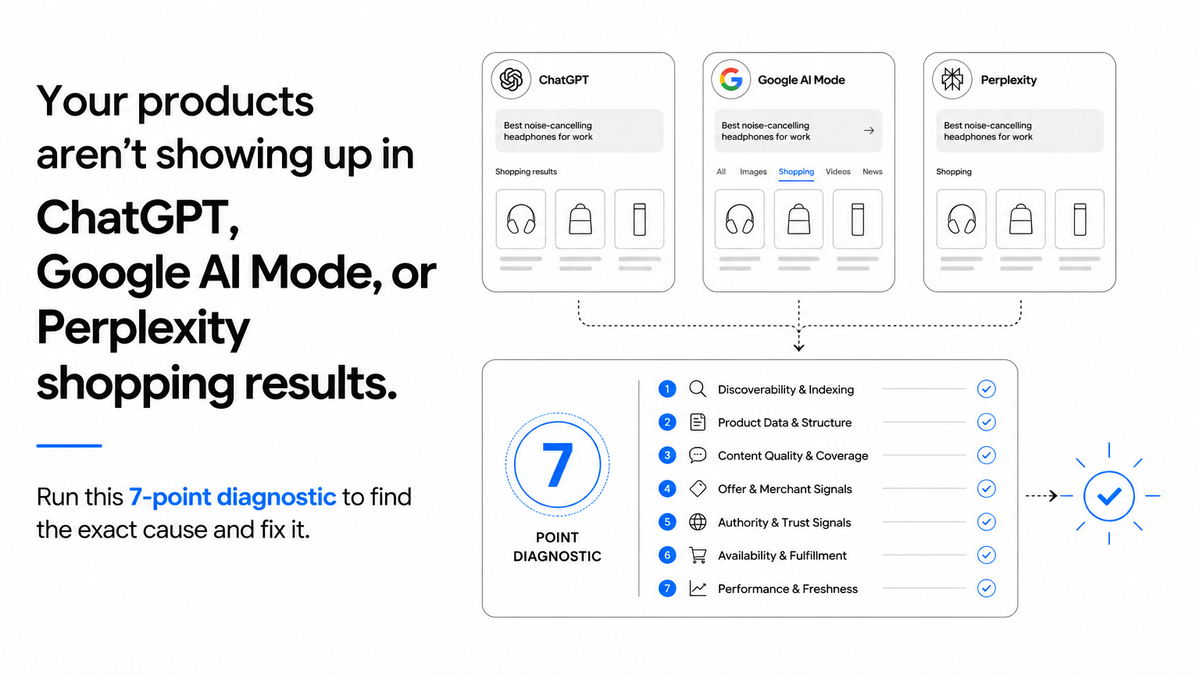
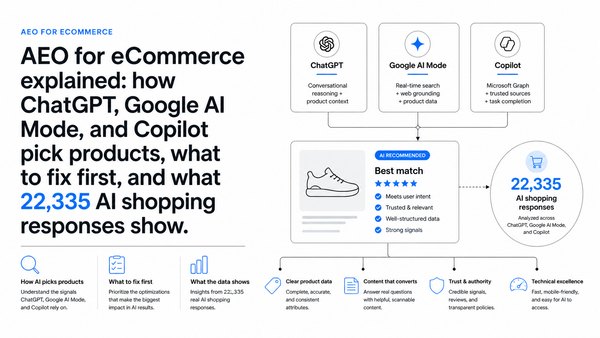
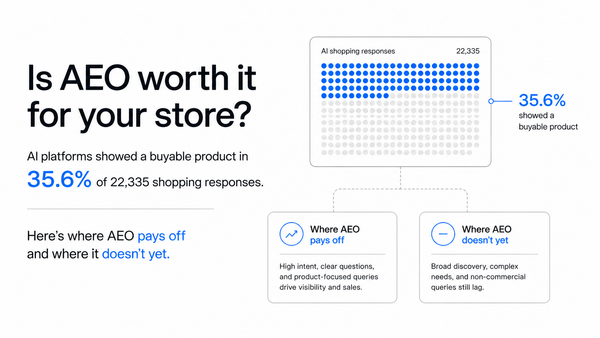
A merchant ranks #3 on Google for "best running shoes under $100." The same shopper asks ChatGPT or Google AI Mode the identical question, and that merchant's product never appears. AEOsome's 22,335-response study found AI shopping surfaces return a structured product in just 35.6% of queries overall — and which 35.6% depends on seven specific, checkable root causes, worked in order (AEOsome Research, 2026).
Key Takeaways
- AI shopping surfaces return a structured product in only 35.6% of queries across 22,335 query-platform responses, four platforms, seven categories (AEOsome Research, 2026).
- Google AI Mode returns products in 64.4% of queries versus 5.0% for Perplexity — the same product can be invisible on one platform and highly visible on another (AEOsome Research, 2026).
- Carousel trigger rate climbs from 58.1% with zero stated attributes to 87.3% with five — description structure is measurable, not stylistic (AEOsome Research, 2026).
- Brands rated 4.70+ stars consistently outranked globally recognized names near 4.20, regardless of brand awareness (AEOsome Research, 2026).
- Blocking GPTBot has no effect on ChatGPT Shopping visibility; only blocking OAI-SearchBot does (OpenAI, 2026).
Most diagnostic advice treats these seven causes as a flat checklist. They aren't. Each one is a gate: a product that fails Step 2 never gets a fair read on Step 5, no matter how good its description is. This guide walks the causes in the order to check them — crawler access, feed eligibility, structured data, entity consistency, description structure, review data, then platform and query-intent match — and points you to the deeper fix for each one. This is Answer Engine Optimization (AEO) applied to commerce: getting your product data recommended, not just your brand mentioned. The diagnostic below is built from AEOsome's 5,584-query, four-platform AI shopping study and the audit patterns behind AEOsome's Monitor → Audit → Optimize → Verify loop for keeping product data recommendation-ready.
In this article:
- Why a #1 Google Ranking Doesn't Explain This
- Step 1 — Rule Out the Crawler Myth (5-Minute Check)
- Step 2 — Check Feed Eligibility
- Step 3 — Check On-Page Structured Data
- Step 4 — Check Entity Consistency
- Step 5 — Check Description Structure and Attribute Density
- Step 6 — Check Review Data Presence and Consistency
- Step 7 — Check Platform and Query-Intent Match
- The Full Diagnostic Checklist
- What to Do Next
- Frequently Asked Questions
- The Order Is the Fix
Why a #1 Google Ranking Doesn't Explain This
A Google ranking signal has no direct route into an AI product pick. The two surfaces run on different inputs entirely.
Think of it as two shelves. The web shelf is ranked — Google orders pages using backlinks, keyword-matched copy, Core Web Vitals, click-through, internal links, and freshness, and a merchant's job is to earn position on that ranked list. The AI shelf is assembled — an AI shopping surface builds a short list of purchasable SKUs from the merchant's product feed and structured data, then justifies each pick. None of the six Google ranking inputs above has a direct path into that assembly process. A page can rank #1 and still supply a feed with a missing GTIN, and the AI shelf never sees it.
Entity and authority signals are the one genuine bridge between the two surfaces: a well-linked, consistently described brand is easier for a model to trust as a corroborating source, which indirectly helps it get cited. That's an indirect path through trust, not a direct transfer of ranking position (AEOsome Research, 2026).
Read the full mechanism and transfer table: why Google ranking signals don't transfer to AI shopping.
Step 1 — Rule Out the Crawler Myth (5-Minute Check)
Blocking GPTBot does not remove products from ChatGPT Shopping. Blocking OAI-SearchBot does. Most merchants check the wrong bot first.
OpenAI runs at least three distinct crawler classes, each with its own robots.txt control. GPTBot collects pages that may train OpenAI's foundation models — blocking it opts a store out of training only, with no effect on ChatGPT search or Shopping. OAI-SearchBot surfaces sites inside ChatGPT's search features — blocking it removes the site from ChatGPT search answers outright. ChatGPT-User fetches a page when a person or an agent acting on their behalf asks ChatGPT to open it; robots.txt rules may not even apply, since the fetch is person-triggered rather than an automated crawl.
The real accidental-block pattern rarely starts with a deliberate GPTBot decision. It's a staging robots.txt with a blanket Disallow that gets promoted to production, or an over-broad CDN bot rule that catches OAI-SearchBot along with everything else. Pull your live robots.txt, confirm every User-agent block is intentional, and test a product URL against each answer-engine bot's user-agent string before assuming crawler policy is your problem.
Opting out of OAI-SearchBot removes a site from ChatGPT search and shopping answers; opting out of GPTBot has no effect on that surface (OpenAI, 2026).
Step 2 — Check Feed Eligibility
Eligibility is pass/fail, not a gradient. A malformed GTIN in 3% of rows is 3% of the catalog invisible — not "97% fine."
This is where feed work stops behaving like SEO. A weak SEO signal costs a few ranking positions on a gradient. Feed eligibility has no gradient: required-field validation runs row by row, and a failing row is held back silently, with nothing flagged in your store admin. Check the fastest-failing fields first: identity (a stable item_id per variant, a real gtin or mpn), price and availability format, and — the signature failure pattern — variant-level rows. A feed can pass validation because the product-level row is complete while every variant shares one image and one availability value, and the surface never sees a distinct in-stock variant to return.
OpenAI's Agentic Commerce Protocol product feed spec lists nine required fields — item_id, title, description, url, brand, seller_name, image_url, availability, price. A row missing any single one is rejected outright (OpenAI ACP product feed spec, 2026).
Run the full eligibility checklist for AI shopping product feeds.
Step 3 — Check On-Page Structured Data
There is no separate "AI product schema." AI engines read the same schema.org Product/Offer markup that powers Google's rich results, and that markup has to be server-rendered to matter.
Four requirements decide whether an engine can actually use it:
- Server-rendered JSON-LD. Most non-Google AI crawlers don't execute JavaScript, so client-injected markup is invisible to them.
- Complete core fields — name, image, price, currency, and availability at minimum.
- A GTIN present as the match key engines use to reconcile a product across sources.
- Every purchasable variant modeled as its own
Offer, with its own price and stock.
The common failure is client-side: a variant selector updates price and availability in the browser without updating the underlying JSON-LD, so the crawler only ever sees the default variant.
Without a GTIN, a listing is capped at basic snippets and "accurate matching to products can't be assured" (Google Merchant Center Help).
See how to structure Product and Offer schema for AI recommendations, including GTIN requirements.
Step 4 — Check Entity Consistency
If AI describes your brand's category or price tier wrong, it drops your products from the carousels tied to the correct description — before per-SKU selection even starts.
AI assembles a brand profile from many indexed sources and repeats whichever version is most consistent across the ones it trusts. Six things typically cause a wrong description:
- Sources that disagree on category
- Outdated content left over from a rebrand
- A name collision with a similarly named company
- Thin owned content with no clear "this is what we are" statement to lift
- Third-party pages that out-rank your own
- Missing
Organization/Brandschema
Fix these in order of control, authority, and speed-to-update: your own site and product feed first, then Wikipedia/Wikidata, then your Google Business Profile — each layer down is slower to move and carries less weight.
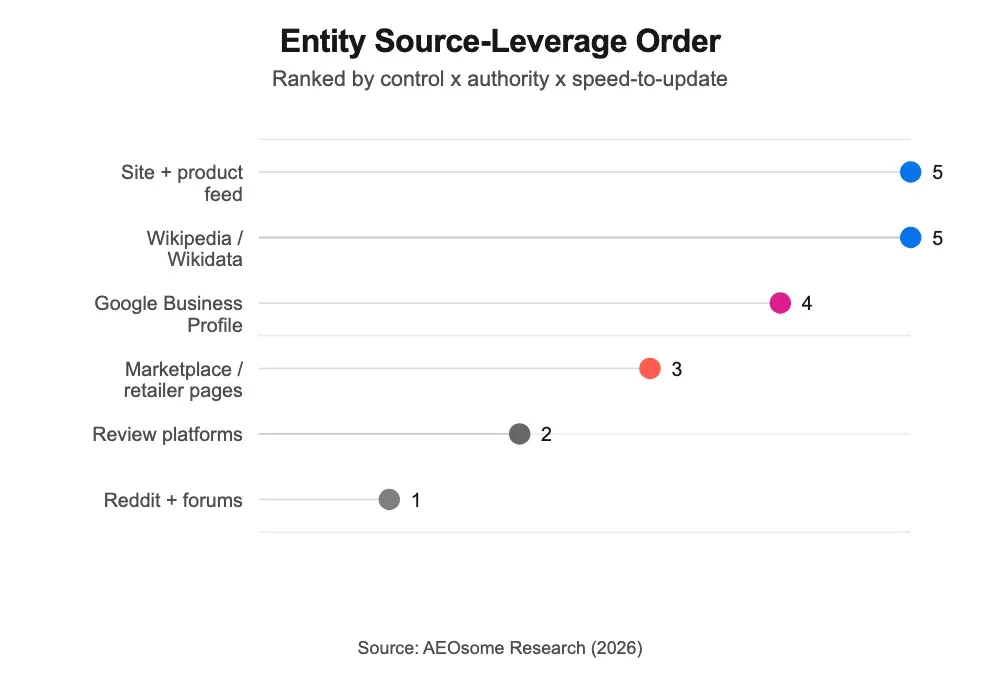
Entity source-leverage order: fix the sources you control first, then work down. Source: AEOsome Research, 2026.
In the 22,335-response study, AI returned a product in 35.6% of queries overall — a wrong category or price tier changes which of those queries a brand is even eligible to win (AEOsome Research, 2026).
Fix entity consistency across the sources AI reads.
Step 5 — Check Description Structure and Attribute Density
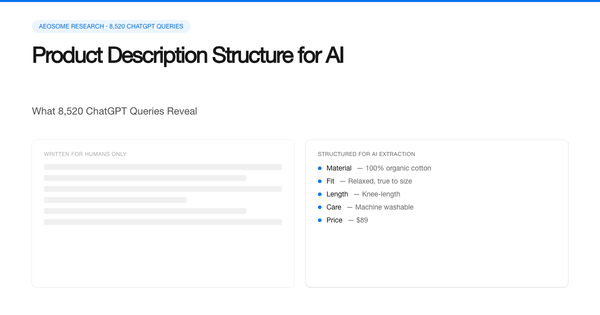
AI extraction favors content it can parse into discrete attributes over content it has to interpret from flowing prose. A well-written description can still give an AI system nothing to extract.
The fix is a four-layer template: an identity sentence stating product type and category up front, a structured attribute block (material, dimensions, price, compatibility), a grounded-claims paragraph using checkable specifics instead of vague superlatives, and a use-case statement naming who the product is for. AEOsome's 8,520-query ChatGPT study shows exactly why this matters: carousel-trigger rate climbs from 58.1% at zero stated attributes to 87.3% at five (AEOsome Research, 2026).
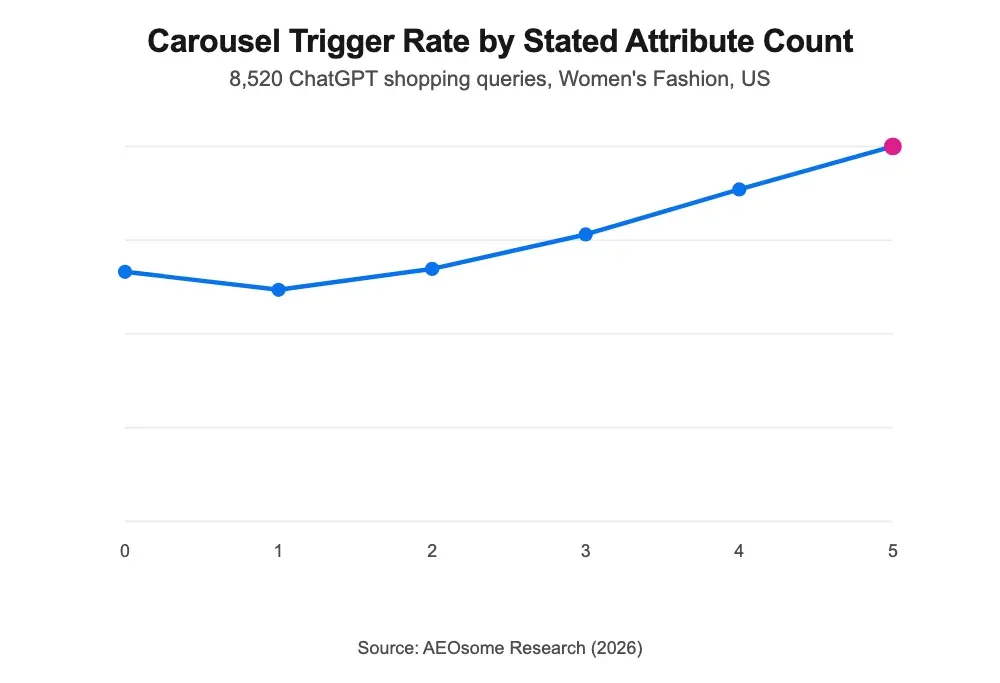
The five-attribute cell is thin (N=63); treat 87.3% as directionally strong, not a precise ceiling. Source: AEOsome Research, 2026.
Retail listings, structured around attributes, price, and availability by default, account for 89–99% of AI citations across every shopping intent stage (AEOsome Research, 2026). A description written primarily as narrative marketing copy is competing against that structural bar and starting behind.
See what 8,520 ChatGPT queries reveal about product description structure.
Step 6 — Check Review Data Presence and Consistency
Reviews aren't a ranking dial in AI shopping. They're corroboration, and they only help a product that has already cleared eligibility.
Review data travels through three channels that different teams usually own: the product feed's star_rating and review_count fields, on-page AggregateRating JSON-LD, and off-site sources like marketplace ratings. Each can be missing on its own — a feed shipping a blank rating because reviews live only in an on-page widget is a common gap. When those three channels disagree, the model gets conflicting evidence and tends to hedge, add a caveat, or pick a competitor whose sources agree with each other.
In the 5,072-carousel ChatGPT analysis, average product rating predicted carousel rank better than brand recognition. Brands rated above 4.70 stars — Quince at 4.73, Express at 4.73 — consistently outranked globally recognized names near 4.20, including H&M at 4.21 and ASOS at 4.20 (AEOsome Research, 2026).
See whether reviews are an AI shopping ranking signal.
Step 7 — Check Platform and Query-Intent Match
The same product can be highly visible on one AI platform and invisible on another, because citation rate varies more by platform and query intent than by anything a single merchant controls per SKU.
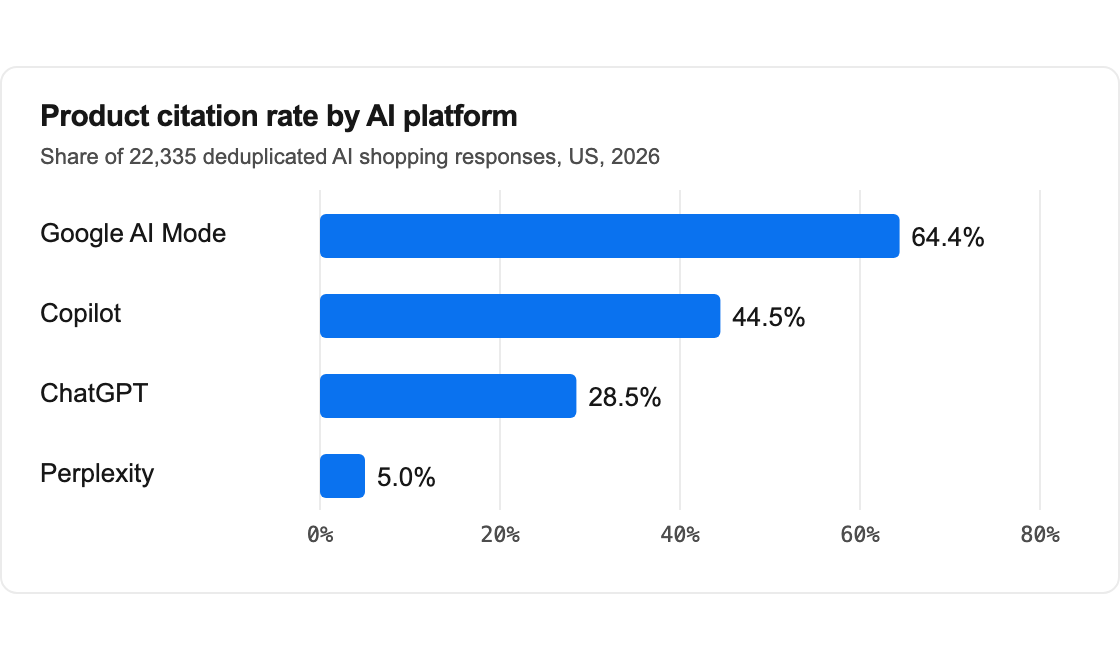
Product citation rate by platform, 22,335 responses. Source: AEOsome Research, 2026.
Platform spread runs from Google AI Mode at 64.4% down to Perplexity at 5.0% (AEOsome Research, 2026). Intent spread is just as wide: Budget Framing queries like "best X under $Y" trigger products in 54.8% of cases, the single strongest predictor in the dataset — more predictive than platform choice — while Post Purchase queries trigger products in only 14.7% of cases. Category spread runs from Electronics at 50.3% down to Auto at 28.7%, with no category below that floor.
The strategic implication is straightforward: under-investing in Google AI Mode is the most common allocation mistake in this dataset. Most eCommerce teams treat ChatGPT as the whole opportunity and Google AI Mode as an afterthought, when AEOsome's data shows the reverse citation gap.
Why ChatGPT Recommends Your Competitor Products and Why Your Products Don't Appear in ChatGPT Shopping dig into platform-specific selection patterns; The Fashion Brands ChatGPT Recommends Most: 5,072 Carousels Analyzed breaks down which brands actually win the carousel once eligibility is cleared.
The Full Diagnostic Checklist
Run these seven checks in order. Stop at the first one that fails, fix it, then continue — don't skip ahead to Step 5 if Step 2 hasn't passed. Later fixes don't help until earlier gates pass.
| Step | Check | Fix |
|---|---|---|
| 1. Crawler | Is OAI-SearchBot (not GPTBot) allowed in robots.txt and at the CDN layer? |
Remove any accidental block; leave GPTBot policy as a separate, non-blocking decision |
| 2. Feed | Do all required fields pass, row by row, including every variant? | Validate a sample batch before the full push; check variant-level rows specifically |
| 3. Schema | Is Product/Offer JSON-LD server-rendered, complete, and GTIN-carrying? |
Bind schema to the selected variant; add a GTIN wherever one exists |
| 4. Entity | Does AI describe your category and price tier correctly? | Publish one canonical description verbatim across every owned channel |
| 5. Description | Does the description have a structured attribute layer? | Add the four-layer template: identity, attributes, grounded claims, use case |
| 6. Reviews | Do the feed, schema, and off-site ratings agree? | Reconcile rating and review count across all three channels |
| 7. Platform/intent | Is your investment matched to where citation rate is actually highest? | Prioritize Google AI Mode and Budget Framing-style content |
What to Do Next
This is a maintenance loop, not a one-time fix. Product data drifts as catalogs, prices, and stock change, so a diagnostic pass that's clean today can fail again after the next feed migration or theme update.
AEOsome's Monitor → Audit → Optimize → Verify loop applies the seven checks above on a recurring basis instead of once: Monitor tracks feed and schema health continuously, Audit re-runs the brand-fact and eligibility checks, Optimize fixes what's failing (this is where identifiers, prices, and variant rows get reconciled between your store and every feed so the record doesn't drift again), and Verify confirms products re-enter the right carousels. Run the free AEOsome audit to see which of the seven gates is failing for your catalog right now.
Frequently Asked Questions
Why doesn't my product show up on ChatGPT Shopping?
Most often because it hasn't cleared eligibility, not because it lost a selection fight. Eligibility is decided by feed compliance and structured data — a missing required field or a bad GTIN holds a SKU out of consideration entirely, before description quality or reviews ever get evaluated. Walk through every required feed field.
Why isn't my product showing up in Google AI Mode or AI Overviews?
Check platform allocation before anything else. Google AI Mode returns a structured product in 64.4% of queries in AEOsome's dataset — more than double ChatGPT's 28.5% — so if your feed and schema are clean, the gap is likely where your content and product data investment is going, not a technical block (AEOsome Research, 2026).
Does blocking GPTBot affect ChatGPT Shopping visibility?
No. GPTBot controls whether your pages may train OpenAI's models, and has no effect on ChatGPT search or Shopping answers. Only blocking OAI-SearchBot removes a site from those surfaces (OpenAI, 2026). Check your robots.txt against all three OpenAI bot classes.
Does my Google ranking affect my AI shopping visibility?
Not directly. A Google ranking signal has no route into an AI product pick — the two surfaces read different inputs. Entity and authority signals are the one indirect bridge, because a well-linked, consistently described brand is easier for a model to trust as a source. Compare all six ranking inputs against what AI actually reads.
How long does it take to show up in AI shopping results after fixing feed or schema issues?
Feed and schema fixes typically show up in AEOsome's re-check window within 48 to 72 hours, once the platform re-crawls or re-ingests the updated feed. Entity corrections take longer — expect weeks, not days, since engines re-crawl third-party sources on their own schedule and cached answers lag behind.
Do I need to fix everything on this list, or just one thing?
Work in order, and stop at the first failing gate. A perfect product description doesn't help a SKU that's failing feed eligibility, and reconciled review data doesn't help a brand AI is describing under the wrong category. Fix causes in the sequence above, not by whichever seems easiest.
The Order Is the Fix
Products go missing from AI shopping results for one of seven root causes, and the merchant's first guess — crawler blocking or a weak Google ranking — is almost never the real one. The boring, checkable causes are: feed eligibility, structured data, entity consistency, description structure, review-data consistency, and platform/intent match. AI shopping surfaces returned a structured product in just 35.6% of the 22,335 responses AEOsome tested, and Google AI Mode alone returned products in 64.4% of cases versus 5.0% for Perplexity (AEOsome Research, 2026). Work the seven causes in order, and each one you clear widens the set of queries your catalog can actually win.
Run the free AEOsome audit to find out which of the seven gates is failing for your catalog. Get in touch through AEOsome to have your products checked against every step in this diagnostic.
About the author. Vijaya Kumar Channalli is a serial SaaS founder and the founder of AEOsome (Tartu, Estonia), which helps eCommerce brands get their products recommended when shoppers ask AI what to buy. He built the query-fanout system behind AEOsome's 5,584-query, four-platform AI shopping study and writes about AI shopping visibility, product feeds, and how Answer Engine Optimization (AEO) differs from SEO. More at vijay.cc. Read how we write, source and correct posts in our editorial policy.
Sources: AEOsome Research, 2026 (5,584-query, four-platform, seven-category AI shopping study, US market; 8,520-query ChatGPT shopping-intent study; 5,072-carousel ChatGPT analysis); OpenAI crawler documentation; Google Merchant Center Help.