Is AEO Worth It for eCommerce in 2026? What 22,335 AI Shopping Responses Say
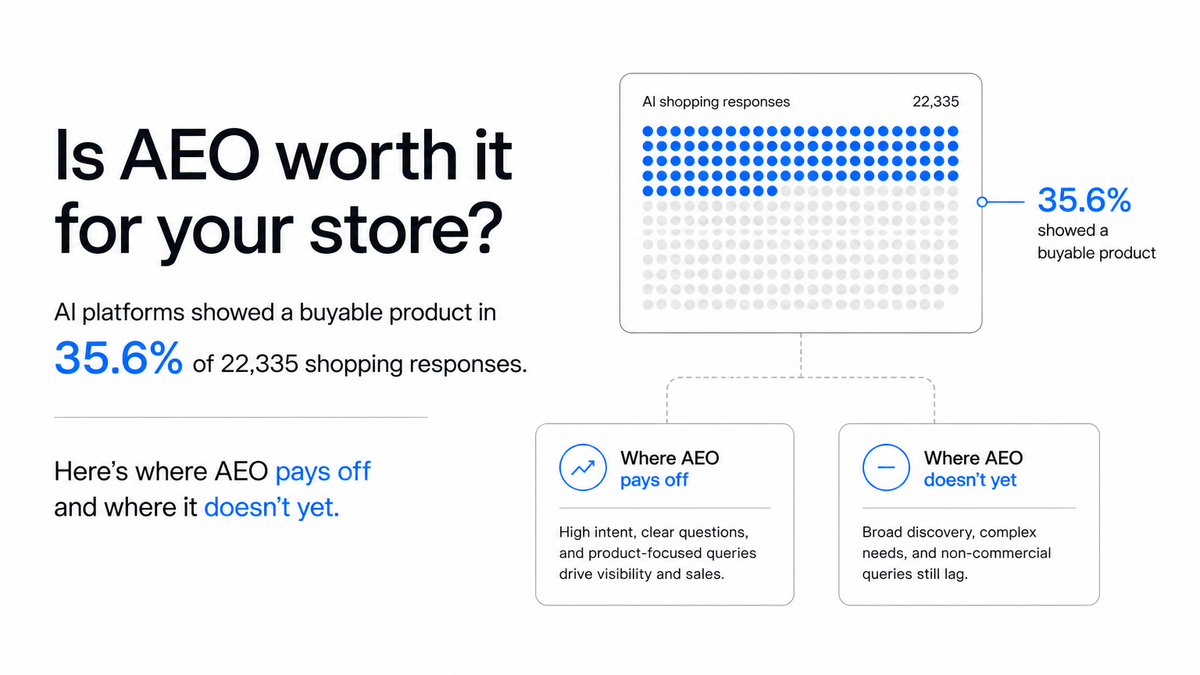
Is AEO worth it for your store? AI platforms showed a buyable product in 35.6% of 22,335 shopping responses. Here's where AEO pays off and where it doesn't yet.

Everyone agrees AI search is growing. Almost nobody has shown whether it actually puts products in front of shoppers.
Our read: yes, for most online stores. Across 22,335 AI shopping responses on ChatGPT, Google AI Mode, Microsoft Copilot, and Perplexity, the platforms showed a specific, purchasable product 35.6% of the time (AEOsome Research, 2026). AEO pays off most on Google AI Mode and in budget-framed queries. It pays off least on Perplexity.
A note on the count: we collected 27,255 query-response attempts and removed 4,920 duplicate retries. Every rate on this page uses the 22,335 deduplicated responses (5,584 distinct queries across four platforms).
Key TakeawaysOur read: AEO is worth it for most eCommerce stores in 2026. AI platforms returned a structured product card (name, price, merchant link) in 35.6% of 22,335 shopping responses (AEOsome Research, 2026). The study measures whether a slot exists, not whether optimizing for it changes your rate.Platform sets the ceiling. Google AI Mode showed products in 64.4% of queries and Perplexity in 5.0% (AEOsome Research, 2026).Query intent is the lever you can build for: budget-framed "best X under $Y" queries surfaced products 54.8% of the time, versus 14.7% for post-purchase queries (AEOsome Research, 2026).The traffic converts. In March 2026, AI-referred visits to US retail sites converted 42% better than non-AI traffic (Adobe Digital Insights, via TechCrunch, 2026).The organic window is open: 1.0% of AI shopping answers contained ads, though Google AI Mode already shows them in 3.9% (AEOsome Research, 2026).
Answer Engine Optimization (AEO) is the work of structuring your product data and content so AI answer engines cite and recommend your products. Our companion post What Is AEO? Why eCommerce Brands Can't Ignore It in 2026 covers the basics. If Generative Engine Optimization (GEO) and AI Overviews (AIO) are also in your vocabulary, AEO, GEO, and AIO describe the same shift.
This post doesn't repeat the full study. It uses the same dataset to answer one commercial question: where does the investment pay off, and where doesn't it yet? Our data measures whether AI platforms put a specific product in front of a shopper. It doesn't measure ROI, cost, or how much a store's own AEO work moves that rate — we're honest about that limit throughout. For the complete findings, read the full study findings.
In this article:
- AI Platforms Put a Buyable Product in 35.6% of Shopping Answers
- Platform Sets the Ceiling: Google AI Mode Returns Products 7.8× More Often Than Perplexity
- Your Category Sets the Floor, Not the Verdict
- Query Intent Is the Lever You Can Build For: 54.8% vs. 14.7%
- AI-Referred Traffic Now Converts Better Than Non-AI Traffic
- When AEO Isn't Worth It Yet
- What a Worth-It AEO Program Looks Like
- Frequently Asked Questions
- Methodology
- The Shelf Exists. The Question Is Whether You're On It.
AI Platforms Put a Buyable Product in 35.6% of Shopping Answers
More than one in three AI shopping answers contains a structured product card, not just a text mention. That product shelf is what AEO competes for.
We define a product citation strictly: a structured card with a product name, a price, and a merchant or purchase link. A response that only mentions your brand in a sentence doesn't count. That distinction matters: a mention isn't a recommendation, a point we cover in a companion post on brand mentions versus product recommendations.
Citation Capsule: AI platforms returned a structured product card, with name, price, and merchant link, in 35.6% of 22,335 shopping responses across ChatGPT, Google AI Mode, Microsoft Copilot, and Perplexity (AEOsome Research, 2026).
What this means for you: if 38% of answers contain a product slot and your products aren't eligible for it, the slot goes to someone else's. The deduplicated reading of the same data is roughly 35–36%, a gap we explain in the methodology below.
Platform Sets the Ceiling: Google AI Mode Returns Products 7.8× More Often Than Perplexity
Whether AEO pays off depends heavily on which AI surface your shoppers use. Google AI Mode showed a product card in 64.4% of queries. Perplexity did it in 5.0%.
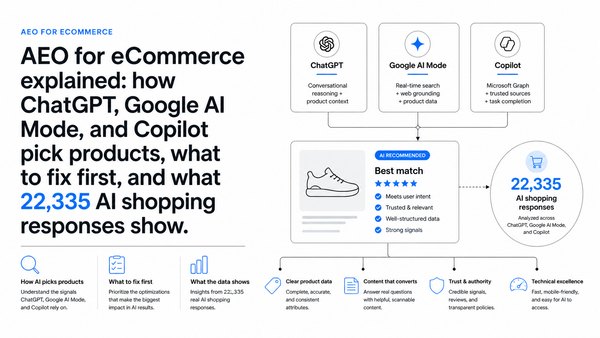
Perplexity behaves like an information engine, not a shopping engine. It answers the question and rarely builds a shelf. A one-platform strategy that optimizes only for ChatGPT misses the most commerce-forward surface in the study: ChatGPT's 28.5% citation rate trails both Google AI Mode (64.4%) and Microsoft Copilot (44.5%).
The ad numbers matter too. Just 221 of 22,305 completed responses (1.0%) contained ads. Google AI Mode already runs sponsored placements in 3.9% of queries, and it has the highest organic product rate. Eligibility is cheaper to build before paid competition fills the slots.
We cover why platforms differ in a companion post on how AI product discovery actually works: feeds, retrieval, and carousels.
Your Category Sets the Floor, Not the Verdict
No category in the study fell below a 28.7% product citation rate, so a live AI shelf exists in every vertical we measured. The payoff is steeper in some than in others.
| Category | Product citation rate | Our read on AEO priority |
|---|---|---|
| Electronics | 50.3% | Highest shelf. Start here. |
| Sports | 37.8% | Strong. Worth prioritizing. |
| Beauty | 35.9% | Strong. Worth prioritizing. |
| Toys | 31.9% | Moderate. Intent mix decides. |
| Home | 31.4% | Moderate. Intent mix decides. |
| Health | 30.1% | Moderate. Intent mix decides. |
| Auto | 28.7% | Lowest shelf. Fix attribute data first. |
The rates are deduplicated category figures from AEOsome Research (2026). The priority column is our interpretation, not a study output.
Auto likely lags because purchases hinge on fitment and compatibility, which generic answers handle poorly. If you sell in Auto, complete variant-level attribute data before anything else.
Citation Capsule: Across seven categories, AI product citation rates ranged from 28.7% (Auto) to 50.3% (Electronics), so every vertical AEOsome studied has a live AI shelf (AEOsome Research, 2026).
Query Intent Is the Lever You Can Build For: 54.8% vs. 14.7%
You can't choose how shoppers phrase their questions. You can make sure your product data answers the phrasings that trigger a shelf. Budget-framed queries returned products 54.8% of the time. Post-purchase queries did it 14.7% of the time, a 40-point spread.
The chart uses AEOsome's 9-stage eCommerce shopping-intent framework, which maps how shoppers move from recognizing a problem to buying and using a product. The top four stages all sit above 42%. They're the stages where the shopper already knows roughly what they want.
Our read, not a tested causal finding: attribute-constrained queries likely reward complete variant-level attributes (size, color, material, compatibility), and budget-framed queries likely reward accurate, current prices, since both query types ask for exactly that information. A companion post goes deeper on why budget-framed queries win product slots.
Citation Capsule: Budget-framed shopping queries returned a product card 54.8% of the time, against 14.7% for post-purchase queries, a 40-point spread across AEOsome's 9-stage intent framework (AEOsome Research, 2026).
AI-Referred Traffic Now Converts Better Than Non-AI Traffic
Our study measures the step before the click: is there a product on the AI shelf? The largest independent dataset on the step after the click comes from Adobe Digital Insights, drawn from over 1 trillion visits to US retail sites, and it points the same way.
In March 2026, AI-referred traffic to US retail sites converted 42% better than non-AI traffic (Adobe Digital Insights, via TechCrunch, April 16, 2026). A year earlier, in March 2025, it converted 38% worse. By May 2026 the gap had widened to 54% better (Adobe Analytics, via Digital Commerce 360, June 17, 2026).
The growth figures follow the same shape, per the same sources. AI traffic to US retailers rose 393% year over year in the first three months of 2026 (Adobe Digital Insights, via TechCrunch, 2026). Revenue per visit was 37% higher than non-AI traffic in March, and AI-referred shoppers spent 48% longer on site (same source). In May 2026, AI-referred traffic was up 138% year over year (Adobe Analytics, via Digital Commerce 360, 2026).
Be careful with what this proves. Neither Adobe report states AI referrals as a share of total retail traffic, so we can't tell you how large the channel is today. Adobe measures visits that already happened. Our data measures whether your products get a slot at all. The two together make the case: a growing channel with a conversion premium, and a shelf you can't stand on without eligible product data.
For the revenue side of this, see our companion post on zero-click search and what AI answers mean for store revenue.
When AEO Isn't Worth It Yet
AEO is a lower priority if most of your demand sits in low-shelf intent stages, if your buyers mostly research on Perplexity, or if your catalog can't pass basic feed eligibility. All three are our reading of what the numbers, and how eligibility works, imply. None is a tested outcome; the study measures shelf presence, not what happens to a specific store that changes its data.
- Your query mix skews to post-purchase and problem-recognition intent. These stages returned products only 14.7% and 20.4% of the time. If most of your demand looks like "how do I fix X" or "where is my order," your shelf is thinner than the 35.6% headline suggests.
- Your audience lives on Perplexity. At 5.0%, it's the weakest shopping surface in the study. Optimizing for it first means optimizing for the smallest shelf we measured.
- Your product data isn't eligible. This isn't a study finding; it's how AI shopping eligibility works in general. Missing GTINs, incomplete attributes, and absent policy URLs keep a product out of consideration before content can help. Fix eligibility first.
None of this argues for dropping SEO. AEO layers on top of it; see what actually changes when you add AEO to SEO for the specifics.
What a Worth-It AEO Program Looks Like
Stores that see a return measure SKU-level visibility first, fix eligibility second, and create content third. SKU-level visibility means tracking each product, not just your brand, on the AI shelf. It's one of several terms we define in our AEO glossary for eCommerce teams, alongside agentic commerce, ACP, UCP, and llms.txt.
The loop has four stages, and we run it as Monitor → Audit → Optimize → Verify:
- Monitor: measure citation rate by platform and intent stage, not brand-mention counts.
- Audit: find the SKUs missing identifiers, attributes, or policy data.
- Optimize: fix feeds and structured data first, keeping identifiers, prices, and variant rows consistent across feeds.
- Verify: re-measure after platforms recrawl, and keep only what moved the rate.
Start with the feed eligibility checklist. Then settle who should own AEO on your team, which we cover separately. The full playbook lives in our complete AEO for eCommerce guide.
Frequently Asked Questions
Is AEO worth it for a small Shopify store?
Usually yes, if your catalog sits in high-intent categories and your product data is complete. Our study didn't measure store size directly, but eligibility runs on structured data, not revenue or headcount, so a small store with complete product data has the same shot as a large one. AI platforms showed a product in 35.6% of shopping queries overall (AEOsome Research, 2026).
How long does AEO take to show results?
We don't have outcome data that supports a timeline, so we won't give you one. Eligibility fixes to your feed and schema can be verified as soon as platforms recrawl. Content effects compound more slowly.
Does traffic from ChatGPT and other AI tools actually convert?
Yes, per the largest independent retail dataset available. AI-referred visits converted 42% better than non-AI traffic in March 2026 (Adobe Digital Insights, via TechCrunch, 2026).
Should I do AEO instead of SEO?
No. Layer AEO on top of SEO. Crawlability, structured data, and page experience serve both. See what actually changes when you add AEO to SEO.
Which AI platform should my store optimize for first?
Start with Google AI Mode (64.4% product citation rate), then Microsoft Copilot (44.5%) and ChatGPT (28.5%) (AEOsome Research, 2026). Perplexity comes last at 5.0%.
Methodology
We collected 27,255 query-response attempts across ChatGPT, Google AI Mode, Microsoft Copilot, and Perplexity, in the US market, with collection completed by May 2026. We removed 4,920 duplicate retries, leaving 22,335 query-platform responses: 5,584 distinct queries across four platforms. 22,305 of the 22,335 returned a completed response, a 99.9% completion rate. Queries covered seven categories (Electronics, Sports, Beauty, Toys, Home, Health, Auto), nine intent stages, and four query styles (short, medium, long, conversational).
A product citation is a structured card with name, price, and merchant link. An ad is an explicitly labeled sponsored placement.
One limitation: duplicate retries skewed toward Electronics, so we removed them before computing any rate. Adobe's figures measure traffic after the click, on a different basis from ours.
The Shelf Exists. The Question Is Whether You're On It.
AI platforms put a buyable product in 35.6% of shopping answers. The platform spread runs from 64.4% to 5.0%. The intent spread runs from 54.8% to 14.7%. Add a conversion premium that Adobe measured at 42% in March 2026, and the case is clear for most stores with eligible product data.
See which of your SKUs appear on the AI shelf today. Run a free AI shopping visibility check.
About the author. Vijaya Kumar Channalli is a serial SaaS founder and the founder of AEOsome (Tartu, Estonia), which helps eCommerce brands get their products recommended when shoppers ask AI what to buy. Read how we write, source and correct posts in our editorial policy.
Sources: AEOsome Research, 2026; TechCrunch, AI traffic to US retailers rose 393% in Q1, and it's boosting their revenue too, April 16, 2026 (reporting Adobe Digital Insights data); Digital Commerce 360, Adobe: AI-referred traffic to retail sites doubles in a year, June 17, 2026 (reporting Adobe Analytics data).