AEO vs GEO vs AIO: Do the Distinctions Matter for an eCommerce Store?
AEO, GEO, and AIO get used interchangeably. Here's what separates them — and why the difference matters less than what your store fixes next.

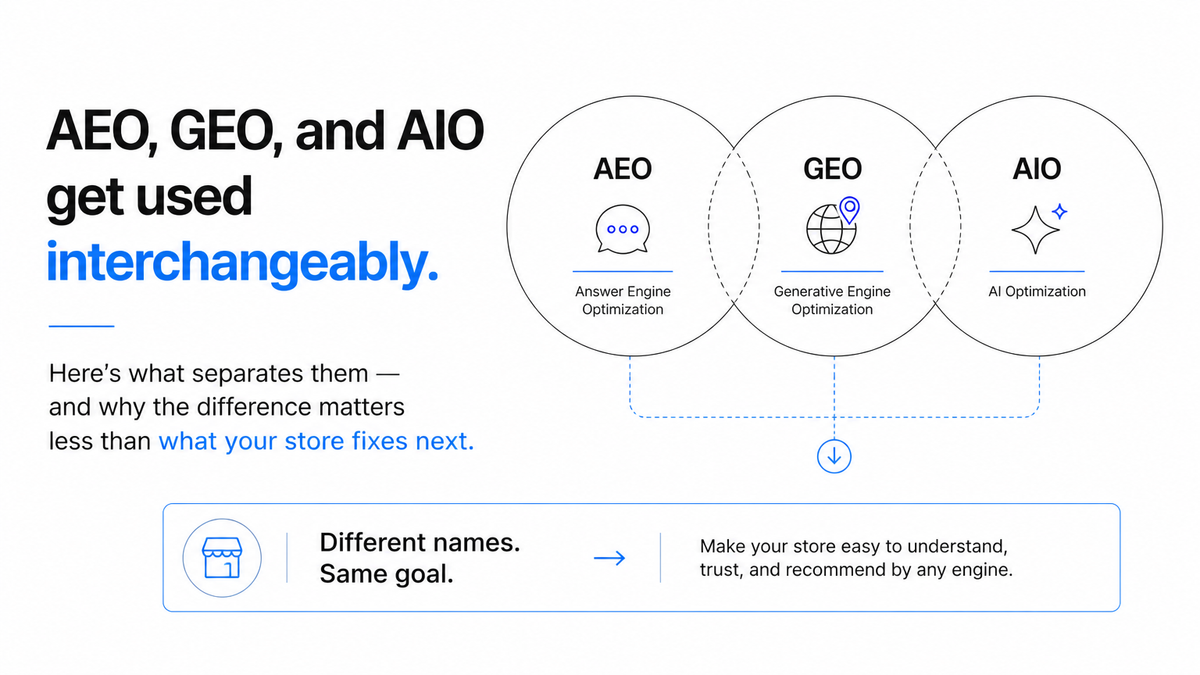
AEO (Answer Engine Optimization), GEO (Generative Engine Optimization), and AIO (AI Optimization) all describe the same underlying shift — getting cited inside AI-generated answers instead of ranked on a results page — from three different origins. For an eCommerce store, the distinction is not operationally load-bearing: the fixes that drive AI citations are identical no matter which acronym your team standardizes on.
Key TakeawaysAEO, GEO, and AIO describe one shift with three different origin stories — practitioner, research, and vendor-marketing — not three separate disciplines.AI platforms recommended a specific product in 22,335 shopping responses AEOsome analyzed across four platforms, with recommendation rate varying sharply by platform (AEOsome Research, 2026).Recommendation rate varies by platform — Google AI Mode 64.4%, Microsoft Copilot 44.5%, ChatGPT 28.5%, Perplexity 5.0% (AEOsome Research, 2026) — regardless of which acronym describes the work.No product category AEOsome studied fell below a 28.7% citation rate, so the opportunity exists across every vertical, whatever your team calls the discipline.AEOsome standardizes on AEO for eCommerce work. Pick one term for internal consistency and spend the argument-time on product data instead.
By late 2026, AEO, GEO, and AIO show up interchangeably across vendor blogs, agency decks, and LinkedIn posts — sometimes in the same paragraph, describing the same tactic. That's a real problem for a team trying to plan a budget line or write a job description: three names can look like three disciplines, three headcounts, three tool stacks.
This post defines each term precisely, shows where a genuine (if narrow) distinction exists, and gives a clear verdict on whether an eCommerce team should spend any time on the naming debate at all.
In this article:
- Quick Comparison — AEO vs GEO vs AIO at a Glance
- What Is AEO (Answer Engine Optimization)?
- What Is GEO (Generative Engine Optimization)?
- What Does AIO (AI Optimization) Mean — and Should You Use the Term?
- Does the Distinction Actually Matter for an eCommerce Store?
- Which Term Should Your Team Actually Use?
- Frequently Asked Questions
- The Label Doesn't Move the Citation Rate. Your Product Data Does.
Quick Comparison — AEO vs GEO vs AIO at a Glance
All three terms point at the same practical convergence: structuring product and content data so an AI system can extract or synthesize it into a direct answer. Where they differ is origin and connotation, not method.
| Term | Full Name | Origin | Primary Surfaces | eCommerce Relevance | AEOsome's Recommended Usage |
|---|---|---|---|---|---|
| AEO | Answer Engine Optimization | Practitioner and product-marketing term | ChatGPT Shopping, Google AI Mode, Copilot product answers | High — the term aligned with SKU/variant-level citation work | Use this term for all internal and external eCommerce communication |
| GEO | Generative Engine Optimization | AI-search research and technical literature | Long-form synthesized answers, multi-source summaries | Moderate — matters more for editorial content than product citation | Use only when referencing academic or technical sources directly |
| AIO | AI Optimization | Loose vendor-marketing umbrella | Varies — sometimes citation, sometimes personalization or ad targeting | Low — ambiguous enough to dilute a team's vocabulary | Avoid for internal use; recognize it as a synonym when reading vendor content |
For the complete breakdown of what AEO means for eCommerce, see the full definition and history behind the term that's replacing "SEO" in eCommerce AI-search conversations.
What Is AEO (Answer Engine Optimization)?
AEO is the practitioner and product-marketing term for structuring product data and content so AI platforms cite specific products directly in shopping answers — and it's the term that has taken hold across eCommerce tooling, agencies, and this site.
AEO won the naming war in commerce contexts specifically because it maps cleanly to SKU- and variant-level work: a shopper asks an AI what to buy, and the "answer" is a specific product with a specific price and specific attributes, not a ranked list of ten blue links. That framing lines up with how eCommerce teams already think about product data, feeds, and merchandising — it's a closer conceptual fit than a term borrowed from academic AI-search research.
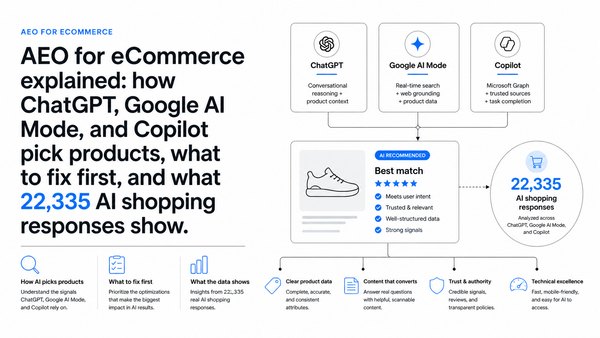
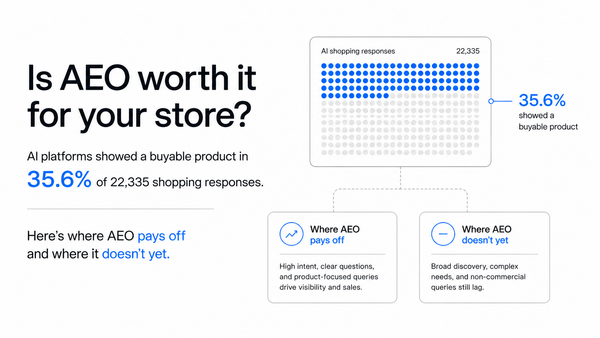
AI platforms recommended a specific product across 22,335 shopping responses AEOsome analyzed across four platforms, at rates ranging from 5.0% to 64.4% depending on the platform (AEOsome Research, 2026). That's the number AEO practitioners are optimizing toward: not a ranking position, but a direct product recommendation inside the AI's answer.
AEO vs SEO for Online Stores: What Actually Changes breaks down exactly which SEO fundamentals still apply under AEO and which ones stop mattering.
What Is GEO (Generative Engine Optimization)?
GEO is the term that originated in AI-search research and technical literature, describing optimization for generative synthesis — an AI model composing an answer from multiple sources — rather than extraction of a single direct answer. In practice, the two overlap heavily for eCommerce.
The narrow technical distinction is real: synthesis and extraction are different retrieval behaviors. When an AI platform synthesizes a "best running shoes for flat feet" answer from five review sites and a forum thread, that's the generative behavior GEO research was originally built to describe. When an AI platform extracts one specific product's price and availability to answer "buy X under $50," that's closer to the extraction behavior AEO practitioners describe.
Long-form informational content leans on synthesis more than product-citation queries do, which is why GEO's distinction matters more for editorial and comparison content than for a single-SKU shopping answer.
For a store's day-to-day work — feed compliance, schema completeness, third-party credibility — the two framings point at the same fixes. GEO is worth knowing as a term because it shows up in research citations and technical vendor documentation, not because it changes what a merchandising team does on Monday morning.
How AI Product Discovery Actually Works: Feeds, Retrieval, and Carousels covers the retrieval mechanics both terms are ultimately describing.
What Does AIO (AI Optimization) Mean — and Should You Use the Term?
AIO is the least standardized of the three terms — a broad umbrella some vendors use for "optimizing for AI" generally, sometimes overlapping with AEO or GEO and sometimes stretched to cover AI-driven personalization or ad targeting that has nothing to do with citation.
That looseness is the problem. A term flexible enough to describe both "get your product cited in ChatGPT Shopping" and "run AI-optimized ad bidding" isn't precise enough to build a workflow, a job description, or a budget line around. AEOsome recommends AEO as the standard internal term for eCommerce teams specifically — it's more precise, and it aligns with how the rest of this site and this content cluster refer to the discipline.
When a vendor uses "AIO" in their marketing, treat it as a synonym for AEO or GEO until their content proves otherwise, and don't let it fragment your team's vocabulary into a fourth workstream that doesn't need to exist.
The AEO Glossary for eCommerce Teams: Agentic Commerce, ACP, UCP, SKU Visibility, and llms.txt has the full standardized vocabulary this site uses, including where AIO fits (or doesn't).
Does the Distinction Actually Matter for an eCommerce Store?
No — not operationally. The signals that drive citation — structured product data completeness, third-party credibility, intent alignment — are identical no matter which acronym a team uses. The fixes live at the feed and schema level, not the terminology level.
That variance is real and worth planning around — but it's a platform-prioritization question, not a terminology question. A team that calls this work "AEO" and a team that calls it "GEO" both need the same answer to "why is Perplexity's citation rate so much lower than Google AI Mode's," and both find it in feed and schema completeness, not in which acronym is on the slide deck.
Gartner's widely cited prediction that traditional search engine volume would fall 25% by 2026 due to AI chatbots and virtual agents (Gartner, February 19, 2024) motivated a large share of the "AEO vs GEO" content published this cycle — including most of the explainers competing for this exact search query. That prediction drew methodological skepticism from search-industry trade press almost immediately: both Search Engine Land and Search Engine Journal published pieces questioning Gartner's assumptions within weeks of the release (Search Engine Land, February 2024; Search Engine Journal, March 2024).
Most of the content citing the 25% figure in 2026 repeats it without mentioning that the number was contested from day one.
The lesson isn't that AI search doesn't matter — AEOsome's own 22,335-query dataset shows real, measurable recommendation activity across every platform tested. The lesson is narrower: don't let a single dramatic, unresolved prediction, or a debate over what to call the discipline, substitute for looking at your own product data.
Reconciling that product data across every channel a store publishes to — the site, the marketplace feeds, the AI shopping surfaces — is exactly where the actual fix lives regardless of terminology. The fix is reconciling identifiers, prices, and variant rows between the store and every feed so the AI has one consistent, complete record to cite from, whatever your team calls the strategy behind it.
Is AEO Worth It for eCommerce in 2026? What 22,335 AI Shopping Responses Say goes deeper into the ROI case using the same dataset.
Which Term Should Your Team Actually Use?
Standardize on AEO for eCommerce-specific work. It's the term this content cluster, most eCommerce tooling, and most of your stakeholders will already recognize — and it keeps a naming debate from turning into a budget or ownership debate.
That standardization decision matters more than it sounds. Teams that let "AEO vs GEO vs AIO" stay unresolved often end up debating vocabulary in the same meeting where they should be assigning ownership of feed audits or deciding which platform to prioritize first. Pick a term, write it into your team's shared documentation, and move the conversation to execution.
Who Owns AEO — SEO, Content, or Operations? Building the Workflow tackles the ownership question directly — arguably the higher-leverage decision once the terminology question is settled. AEO for eCommerce: The Complete Guide to Getting Products Recommended by AI is the complete guide this post's cluster builds toward.
Frequently Asked Questions
Is AEO the same as GEO?
Functionally, for eCommerce citation use cases, yes. The difference is origin and connotation — AEO is the practitioner term, GEO the research term — not a different set of fixes. Both point back to the same structured-data and credibility work.
What does AIO stand for in AI marketing?
AI Optimization — the least standardized of the three terms. Vendors use it inconsistently, sometimes as a synonym for AEO or GEO and sometimes stretched to cover unrelated AI-driven marketing tactics like personalization or ad bidding.
Do I need separate strategies for AEO, GEO, and AIO?
No. One structured-data-and-credibility strategy serves all three framings. Teams that build three separate workstreams around three names for the same underlying shift waste effort that should go into product data.
Which term will AEOsome use going forward?
AEO, consistently, across this site and its research. The AEO Glossary for eCommerce Teams: Agentic Commerce, ACP, UCP, SKU Visibility, and llms.txt has the full standardized vocabulary this cluster uses.
The Label Doesn't Move the Citation Rate. Your Product Data Does.
AEO, GEO, and AIO are one shift wearing three names — a practitioner term, a research term, and a loose vendor umbrella. For an eCommerce store, the fixes underneath all three are identical: structured product data, feed compliance, and third-party credibility.
The numbers that matter aren't which acronym you pick. They're the recommendation activity across 22,335 shopping responses, the platform-by-platform spread from 5.0% up to 64.4%, and the reminder that even a widely cited industry prediction is worth double-checking before it anchors your strategy. Standardize on one term internally, then spend the rest of the argument-time where it actually pays off: your product feed.
See which of your products are eligible to be cited today — regardless of what you call the discipline. Check your AI citation rate
About the author. Vijaya Kumar Channalli is a serial SaaS founder and the founder of AEOsome (Tartu, Estonia), which helps eCommerce brands get their products recommended when shoppers ask AI what to buy. Read how we write, source and correct posts in our editorial policy.
Sources: AEOsome Research, 2026; Gartner, Gartner Predicts Search Engine Volume Will Drop 25% by 2026 Due To AI Chatbots and Other Virtual Agents, February 19, 2024; Search Engine Land, Will traffic from search engines fall 25% by 2026?, February 2024; Search Engine Journal, 7 Reasons To Be Skeptical of 25% Search Drop by 2026, March 2024.