The AEO Glossary for eCommerce Teams: Agentic Commerce, ACP, UCP, SKU Visibility, and llms.txt
A plain-English glossary of agentic commerce terms for 2026: what ACP and UCP do, what SKU-level visibility means, and whether llms.txt matters.

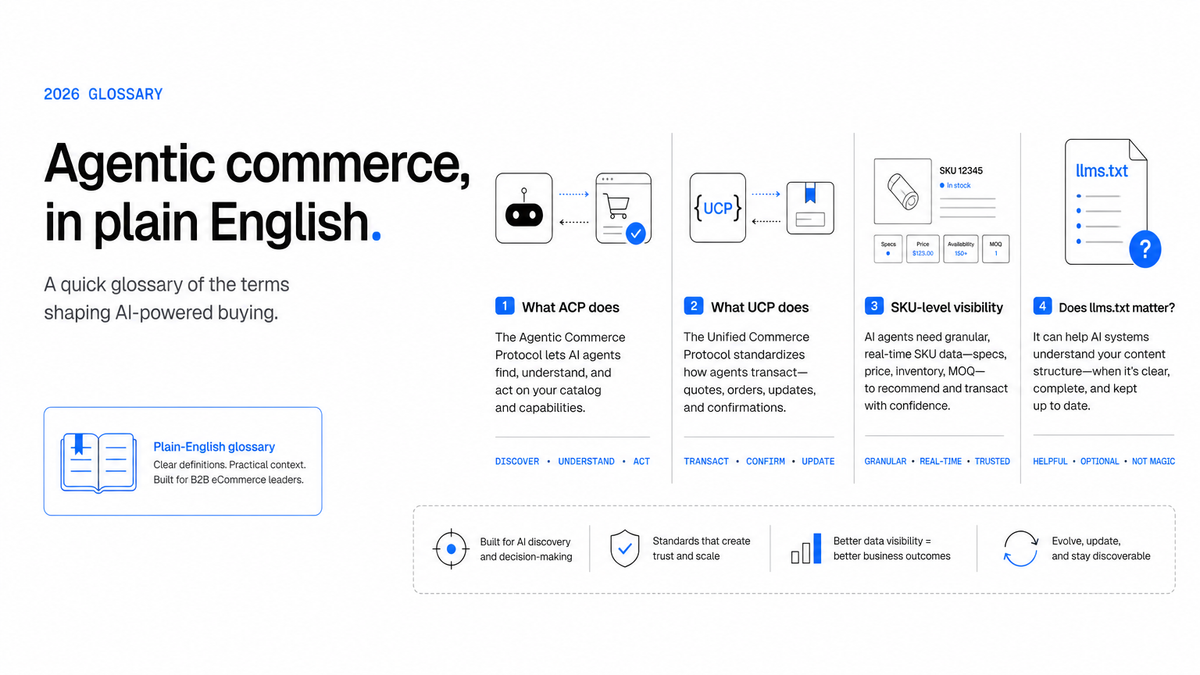
Agentic commerce brought a new vocabulary with it: ACP, UCP, SKU-level visibility, and llms.txt. Most of it showed up in eCommerce teams' inboxes within the same few weeks. This glossary defines each term precisely and states plainly how they relate, and don't. It also flags which ones carry a confirmed ranking effect versus which are still unproven.
Key TakeawaysAgentic commerce is a transaction shift, not a marketing trend. An AI agent browses, compares, and increasingly checks out on a shopper's behalf.ACP (OpenAI and Stripe) and UCP (Google and Shopify) are two separately governed standards. They are not the same protocol under two names.AI platforms cited a specific product, not merely a brand, in 35.6% of 22,335 shopping responses analyzed across four platforms (AEOsome Research, 2026). That's the SKU-level visibility standard in practice.what is llms.txt carries measurable search interest: 480/mo in the US, at a $5.54 CPC (DataForSEO, 2026). No major AI platform has committed to honoring it, and it has no confirmed Google ranking effect.None of these four concepts work alone. A store can implement ACP or UCP checkout and still be invisible to AI shopping assistants if its product data lacks SKU-level completeness.These terms show up in vendor pitches, AI-search headlines, and dev tickets within weeks of each other, often used loosely or interchangeably. Google reports too little search volume to assign a number to agentic commerce glossary, acp ucp ecommerce, or sku visibility ai (DataForSEO, United States, 2026). That's a sign of how new this vocabulary still is, even as the concepts behind it move fast. This page is the one you bookmark and return to when the next acronym shows up in a Slack thread. If your team is separately untangling what to call the discipline itself, see the AEO vs GEO vs AIO breakdown. This glossary covers the transaction-layer vocabulary underneath that question instead.
In this article:
- What Is Agentic Commerce?
- What Is the Agentic Commerce Protocol (ACP)?
- What Is the Universal Commerce Protocol (UCP)?
- ACP vs UCP: Are They the Same Thing?
- What Does SKU-Level Visibility Mean?
- What Is llms.txt?
- How These Four Concepts Fit Together
- Frequently Asked Questions
- The Vocabulary Is New. The Priority Order Isn't.
What Is Agentic Commerce?
Agentic commerce is shopping where an AI agent, not a human clicking through pages, does the browsing and comparing. It increasingly handles the checkout too, on the shopper's explicit instruction. Instead of a human reading product pages and clicking "buy," the shopper tells an AI agent what they want. The agent then handles discovery, comparison, and the transaction itself.
That's a bigger shift than it sounds. "AI recommends, human clicks and buys" is a marketing problem: get mentioned, get clicked. "AI agent completes the transaction directly" is a data problem. The agent needs machine-readable product data it can trust enough to complete a purchase without a human double-checking the listing first. A store's product feed, not its marketing copy, decides whether that transaction can happen at all.
For the complete breakdown of what this means for a store's roadmap, see the full guide to getting recommended before a transaction happens.
What Is the Agentic Commerce Protocol (ACP)?
ACP is a technical standard, built by OpenAI and Stripe. It defines how an AI agent like ChatGPT can read a merchant's product data and complete a purchase without the shopper leaving the chat interface.
ACP standardizes three things. The product feed format tells an agent what's for sale and whether it's eligible to be bought. The checkout handoff creates and completes a purchase session inside the chat. Payment delegation routes the transaction to a processor while the merchant stays merchant of record. Operationally, a store either meets the protocol's data requirements or it doesn't get the agentic checkout flow. There's no partial credit for a feed that's "mostly" compliant.
OpenAI and Stripe are the named backers. Stripe's Agentic Commerce Suite shipped December 11, 2025, and ChatGPT is the primary surface where ACP-based checkout currently runs. For what changes at the point of sale once a store supports it, see what ACP-based checkout actually changes at the buy button. For a merchant view of how these protocols turn into real payments, see how Stripe's agentic commerce suite compares with what PayPal, Visa and Mastercard offer.
What Is the Universal Commerce Protocol (UCP)?
UCP is a separate technical standard, built by Google and Shopify. It serves the same general goal as ACP, letting an AI agent transact on a shopper's behalf, through Google's AI Mode and Shopify's merchant infrastructure.
UCP standardizes how product data flows from a merchant's commerce platform into Google's AI shopping surfaces. It also governs how an agent-initiated transaction completes against that same infrastructure. Shopify Catalog verifies pricing and inventory in real time and syndicates that data to connected AI platforms (Shopify, June 2026).
A Shopify-first merchant is likely to encounter UCP before ACP simply because it's closer to native. Shopify already owns the catalog and checkout, and the protocol extends that existing relationship rather than requiring a separate integration. That proximity is also the trap: supporting UCP through Shopify's native tooling doesn't automatically satisfy ACP's separate data and checkout requirements. A team that assumes otherwise finds out at the worst possible moment, mid-launch.
For the catalog-readiness work both protocols ultimately depend on, see getting a Shopify catalog checkout-ready for either protocol.
ACP vs UCP: Are They the Same Thing?
No. ACP and UCP are two separately governed, differently backed standards solving the same category of problem. They are not interoperable by default, and a merchant should not assume integrating one covers the other.
| ACP (Agentic Commerce Protocol) | UCP (Universal Commerce Protocol) | |
|---|---|---|
| Backers | OpenAI and Stripe | Google and Shopify |
| Primary AI surface | ChatGPT (Instant Checkout) | Google AI Mode and Google Shopping |
| What it standardizes | Product feed eligibility, checkout session handoff, payment delegation | Product data syndication into Google's AI surfaces, agent-initiated transaction flow |
| Merchant integration path | Feed compliance plus a supported payment processor (Stripe or PayPal) | Native through Shopify's existing commerce and Google integration |
| Covers the other protocol? | No | No |
Convergence between the two is not confirmed, and a Q1 or Q2 planning cycle shouldn't assume it's coming. Budget for both as separate integration efforts until one is formally announced to subsume the other. How this fits into the broader AEO vs SEO budget question covers where this kind of protocol spend sits. That's relative to a team's existing SEO budget line.
What Does SKU-Level Visibility Mean?
SKU-level visibility means an AI platform's shopping surface can see, evaluate, and recommend a specific product variant, a size, color, or configuration. It's not just recognizing that a brand exists. Brand visibility and SKU-level visibility are measurably different outcomes. Treating them as the same thing is one of the most common mistakes in agentic-commerce planning.
An AI mentioning your company's name is brand visibility. An AI surfacing your specific 9-ounce, size-10, forest-green running shoe as a buyable option is SKU-level visibility. The second one is what actually drives a sale. It depends entirely on feed completeness and structured data at the variant level, not at the brand level. A perfectly written brand story doesn't make a specific SKU eligible to be cited; a complete GTIN, price, and attribute record does.
AI platforms cited a specific product, not merely a brand, in 35.6% of 22,335 shopping responses AEOsome analyzed across four platforms (AEOsome Research, 2026). That distinction, a named product versus a named company, is the practical gap between "my brand gets mentioned" and "my product gets sold." What SKU-level visibility actually means in that data breaks down the same dataset platform by platform and category by category.
For the schema work that closes that gap, see the schema work that makes a SKU visible to an AI agent. A companion post, Brand Mentions vs Product Recommendations, goes deeper into why these two outcomes get conflated so often. It also covers what separates them in practice, and why AI citing you isn't the same as selling you.
What Is llms.txt?
llms.txt is a proposed plain-text file, placed at a site's root. It's intended to give AI crawlers and language models a curated list of a site's most useful pages. It is not a Google Search or Google AI Mode ranking signal. No major AI shopping platform has publicly committed to reading or honoring it.
The format proposes a markdown-formatted index of key URLs. It's similar in spirit to robots.txt, but for giving an LLM context about what matters on a site, not for controlling crawl permission. That similarity to a familiar, load-bearing file is probably why it gets discussed constantly in agentic-commerce content. There's a gap, though, between what it promises and what's actually confirmed.
what is llms.txt is the only one of this glossary's four target terms with measurable reported search volume. It gets 480 searches a month in the US, at a $5.54 CPC (DataForSEO, 2026). That volume signals real curiosity, not a confirmed effect. Publishing an llms.txt file is low-cost, and there's no harm in doing it. The mistake is treating it as a substitute for the structured-data and feed-compliance work that actually drives SKU-level visibility. It isn't one, and it was never designed to be.
For the related, more commonly confused question of whether to block AI crawlers outright, see the crawler-access question llms.txt gets confused with.
How These Four Concepts Fit Together
Agentic commerce is the shift. ACP and UCP are the two competing protocols that make the transaction step possible. SKU-level visibility is the data condition that determines whether a specific product gets offered inside that transaction. llms.txt is a narrow, unconfirmed crawl-guidance tool that sits outside all three and shouldn't be mistaken for solving any of them.
If a team is planning Q1 or Q2 work and can only fix one thing first, fix feed and schema completeness. SKU-level visibility is the prerequisite that makes ACP or UCP integration worth doing at all. A checkout protocol can't sell a product the agent can never see clearly. A companion post on who on your team should actually own this glossary's worth of work covers that sequencing question directly. A separate piece on what this means for revenue that never shows up as a click covers the business case for prioritizing it. That holds even without a trackable click.
Frequently Asked Questions
Is ACP the same as UCP?
No. They're separately governed standards, OpenAI and Stripe behind ACP, Google and Shopify behind UCP, and they are not interoperable by default.
Do I need to support both ACP and UCP?
It depends on where your traffic and AI-shopping surfaces concentrate today. Shopify merchants typically encounter UCP first, through Shopify's own integration, and ACP through ChatGPT's checkout flow. Both merit evaluation, and neither is optional long-term if agentic checkout volume grows as expected.
Does adding an llms.txt file improve my Google rankings?
No. It has no confirmed effect on Google Search or Google AI Mode rankings, and it is not a recognized ranking signal.
What's the difference between brand visibility and SKU-level visibility in AI shopping?
Brand visibility means an AI mentions that your company exists. SKU-level visibility means it can recommend a specific product variant a shopper can actually buy. The first doesn't guarantee the second: AI platforms cited a specific product, not merely a brand, in 35.6% of 22,335 analyzed responses (AEOsome Research, 2026).
Where should an eCommerce team start if none of this is implemented yet?
Start with product feed and schema completeness at the SKU and variant level. It's the prerequisite both protocols, and any future crawl-guidance tool, depend on.
The Vocabulary Is New. The Priority Order Isn't.
Agentic commerce is a transaction shift, not a marketing trend. ACP and UCP are two real, non-interchangeable protocols, each backed by different companies and solving the same problem in parallel rather than together. SKU-level visibility is the data layer that determines whether either protocol can actually surface a specific product. llms.txt is a narrow tool with no confirmed ranking effect, and it shouldn't be prioritized over the feed and schema work that does.
None of these four concepts work in isolation. A store can implement ACP or UCP checkout and still be invisible to AI shopping assistants if its product data lacks SKU-level completeness. An llms.txt file can't substitute for that underlying work.
The first number worth remembering: a 35.6% product-citation rate across 22,335 AI shopping responses (AEOsome Research, 2026). The second: just 480 monthly US searches for what is llms.txt, the only one of this glossary's four target terms with measurable volume (DataForSEO, 2026).
Methodology: the 22,335-response figure is AEOsome's own deduplicated count (27,255 collected, 4,920 duplicate retries removed). It covers ChatGPT, Microsoft Copilot, Google AI Mode, and Perplexity across 7 product categories in the US market, published May 2026 (AEOsome Research, 2026).
See which of these concepts already apply to your own catalog. Run a free AEOsome product-visibility check
Vijaya Kumar Channalli is a serial SaaS founder and the founder of AEOsome (Tartu, Estonia), which helps eCommerce brands get their products recommended when shoppers ask AI what to buy. Read how we write, source and correct posts in our editorial policy.