The Agentic Commerce Protocol (ACP) for Shopify Merchants: A Plain-English Guide
What the Agentic Commerce Protocol (ACP) is, how it differs from UCP, what changed in 2026, and how to check your Shopify store's agentic settings today.

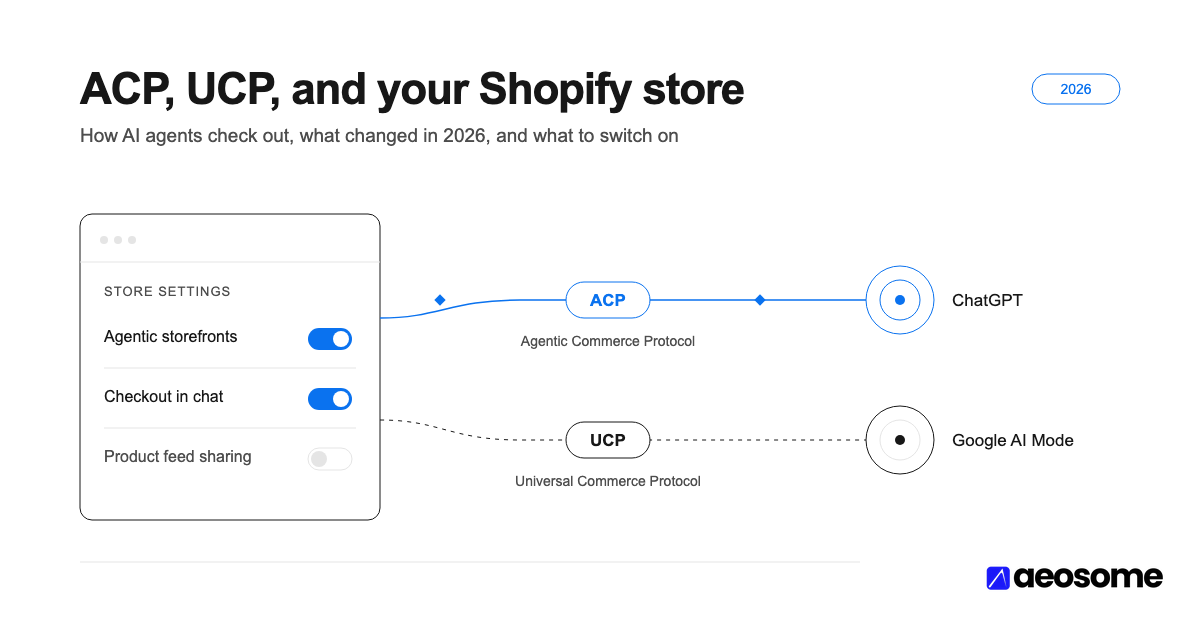
The Agentic Commerce Protocol (ACP) is an open standard from OpenAI and Stripe. It lets an AI assistant read a merchant's product feed, build a cart and hand off payment. On Shopify, Shopify runs ACP for you through Agentic Storefronts. Your job is eligibility: complete product data, published policies and the right channel settings.
Key TakeawaysOpenAI and Stripe released ACP on September 29, 2025 under the Apache 2.0 license. The current stable spec is dated April 17, 2026 (Stripe Newsroom, 2025; ACP GitHub, 2026).In March 2026, OpenAI refocused ChatGPT shopping on product discovery and let merchants use their own checkouts. ACP now carries merchant product data (OpenAI, 2026).Shopify's ChatGPT channel charges no selling fee. Checkout finishes on your own store, in an in-app browser or a new tab (Shopify Help Center, 2026).AI-driven traffic to Shopify stores grew 8 times year over year in Q1 2026. Orders from AI-powered searches grew nearly 13 times (Shopify, 2026).When shoppers are ready to buy, ChatGPT names a retailer in 82.6% of answers in our Study 2 (AEOsome Research, 2026). Your store has to be a buyable option then.
You open Shopify Admin and see a sales channel called "Agentic," with ChatGPT listed inside it. A payments email in the same week mentions "ACP." Did you set this up? Does it take payments? Do you need a developer?
Most explainers of the protocol are written for payments engineers. Many also predate March 2026, when OpenAI changed how checkout works in ChatGPT. This guide covers what ACP is, how it differs from UCP, what changed this year, and a five-step check of your own store.
In this article:
- What Is the Agentic Commerce Protocol, in Plain English?
- How Does an ACP Purchase Actually Flow?
- ACP vs. UCP: Which One Touches Your Shopify Store?
- What Changed With In-Chat Checkout in 2026?
- How to Check What Your Shopify Store Is Doing With ACP Today
- What Do You Still Have to Fix Yourself?
- Which ACP Misunderstandings Cost Shopify Merchants Sales?
- Is ACP Worth Your Attention Over the Next 12 Months?
- Frequently Asked Questions
- The Protocol Is Handled. The Product Data Isn't.
What Is the Agentic Commerce Protocol, in Plain English?
ACP is a shared set of rules for how an AI assistant talks to a store. It covers reading the store's products, opening a checkout, passing a payment token and receiving order updates. That is the core of agentic commerce: an AI agent shopping on a person's behalf, inside a conversation.
OpenAI and Stripe announced ACP on September 29, 2025, describing it as "an open standard co-developed by Stripe and OpenAI" (Stripe Newsroom, 2025). It is published under the Apache 2.0 license. Any business can adopt it, including those that don't process payments with Stripe.
The latest stable version of the spec is dated April 17, 2026, and the project still labels itself beta (ACP GitHub, retrieved 2026-10-26). It covers seven areas:
- Checkout: how an agent opens and updates a purchase session with the merchant.
- Delegate Payment: how a payment credential passes to the merchant without exposing card details.
- Cart: how an agent holds items before checkout.
- Feed: how a merchant describes products, prices and stock to the agent.
- Orders: how the merchant reports confirmation, shipping and changes.
- Authentication: how the agent and merchant prove who they are.
- MCP integration: how the protocol plugs into the Model Context Protocol, a common way AI tools call outside services.
Who controls it matters too. A Technical Steering Committee holds up to seven seats, and three are filled: OpenAI, Stripe and Meta. OpenAI and Stripe keep a founding veto. It "can only be used to block a change, never to override the TSC" (ACP governance doc, retrieved 2026-10-26). The stated plan is to move to a neutral foundation once adoption is broad.
ACP is a standard, not a ChatGPT feature. The Agentic Commerce Protocol is an Apache 2.0 open standard released by OpenAI and Stripe on September 29, 2025. Its governing committee now includes Meta, and OpenAI and Stripe can veto changes but cannot force them through (ACP GitHub, 2026).
How Does an ACP Purchase Actually Flow?
An ACP purchase runs in five steps. A shopper asks an AI assistant. The merchant's feed tells the agent what exists. The agent opens a checkout session with the merchant. A payment provider passes a secure token. The merchant confirms the order.
The payment step uses delegated payment. Stripe's Shared Payment Token lets an app like ChatGPT start a payment "without exposing the buyer's payment credentials" (Stripe Newsroom, 2025). Each token is limited to one merchant and one basket total. PayPal said it would adopt ACP on October 28, 2025 (PayPal Newsroom, 2025). On December 11, 2025, Stripe launched an Agentic Commerce Suite that handles these tokens across several AI agents (Stripe Newsroom, 2025).
The merchant stays the merchant of record. You accept or decline the order, charge the payment, remit sales tax, and handle fulfillment and returns (Stripe Newsroom, 2025). Refunds and disputes stay with you as well. Because your checkout calculates the final total, keep feed prices and stock in sync with your store. For where live sessions break, see our guide to making your SKUs checkout-ready.
ACP vs. UCP: Which One Touches Your Shopify Store?
Both do. ACP is what ChatGPT speaks. UCP, the Universal Commerce Protocol, is what Google AI Mode and Gemini speak. Shopify translates for you, so you manage one set of settings instead of two integrations.
Shopify and Google announced UCP on January 11, 2026. Shopify called it "co-developed by Shopify and Google" and "already endorsed by 20+ retailers and platforms" (Shopify News, 2026). On October 15, 2026, Google launched Universal Cart in US Search and the Gemini app. Its checkout is "powered by the Universal Commerce Protocol (UCP)," and "many Shopify merchants" take part (Google, 2026).
| ACP | UCP | |
|---|---|---|
| Who built it | OpenAI and Stripe (September 2025); Meta now sits on its steering committee | Shopify and Google (January 2026) |
| Where shoppers meet it | ChatGPT | Google Search, including AI Mode, and the Gemini app |
| Checkout model today | Merchant's own checkout; on Shopify, your store opens in an in-app browser or new tab | Google Pay inside Universal Cart for many stores, or a transfer to the merchant's cart |
| What a Shopify merchant configures | The ChatGPT channel under Sales channels > Agentic | The Google AI Mode and Gemini channel under Sales channels > Agentic |
The practical point: you don't pick a protocol. You pick which agentic channels get your catalog. For the Google side in more depth, read how Google AI Mode shopping works.
What Changed With In-Chat Checkout in 2026?
In-chat checkout was scaled back. ACP was not. In March 2026, OpenAI refocused ChatGPT shopping on product discovery and let merchants handle checkout on their own sites or in their own ChatGPT apps.
On March 24, 2026, OpenAI said its first Instant Checkout "did not offer the level of flexibility that we aspire to provide" (OpenAI, 2026). It launched a more visual shopping experience in ChatGPT, built on ACP and fed by merchant-provided data. Large retailers had already integrated ACP for discovery, according to Digital Commerce 360 (2026).
The money followed discovery. In September 2026, OpenAI integrated ChatGPT Ads with Shopify. BetaKit reported that Shopify is OpenAI's first commerce partner (BetaKit, 2026).
For your store, this is mostly good news. The Buy button in ChatGPT now sends shoppers to a checkout you already run and already measure. Your payment methods and checkout customizations still apply (Shopify Help Center, 2026). The new work sits upstream, in the product data ChatGPT reads before it picks a store.
ACP did not fail. Native in-chat checkout did. The protocol moved from a payments rail to a product-data and handoff rail. For the full timeline, read the full story of ChatGPT Instant Checkout.
How to Check What Your Shopify Store Is Doing With ACP Today
You don't install ACP. You review five settings under Sales channels > Agentic. You need store owner access, or staff permissions for Products and Agentic (Shopify Help Center, retrieved 2026-10-26).
- Open Sales channels > Agentic. You should see the AI channels Shopify supports: ChatGPT, Microsoft Copilot, Meta (including Muse), Google AI Mode, Gemini and Shop. It worked if your store's status shows for each one.
- Check "Allow Shopify to manage for me." When it's on, agentic storefronts reach your products through Shopify Catalog. Direct checkout turns on where supported, and you're auto-enrolled in new channels. Turn it off only if you want to control each channel by hand.
- Confirm ChatGPT eligibility. Shopify lists four requirements (Shopify Help Center, retrieved 2026-10-26). You sell to US customers, and your products are eligible for Shopify Catalog. You accepted the Agentic Storefronts Supplemental Terms. Your Terms of service, Privacy policy and Return and refund policy are complete. It worked if the ChatGPT channel shows no open requirement.
- Check checkout behavior per channel. On ChatGPT, shoppers finish on your online store checkout, in an in-app browser or a new tab on ChatGPT web. Your checkout customizations and payment methods still apply. Shopify states there are no fees for selling in ChatGPT beyond standard payment processing.
- Review the Catalog eligibility report. The Agentic section shows how many products are in Shopify Catalog, or why your store isn't eligible. Fix flagged products first, then recheck.
Run this check again after any change to your markets, policies or catalog structure. The four ChatGPT requirements depend on exactly those settings, so a routine edit can change your eligibility.
Opting out is slower and leakier than it looks. If you switch off Shopify Catalog access for ChatGPT, it can take up to 7 days to stop sharing product data. Products might still appear through web crawling and indexing (Shopify Help Center, 2026).
For a Shopify merchant, "ACP compliance" mostly means Catalog eligibility plus those four ChatGPT requirements. The protocol work is Shopify's. The data and policy work is yours. Use our product feed eligibility checklist to work through the product side.
What Do You Still Have to Fix Yourself?
Shopify handles the protocol. Whether your SKU gets named in the answer still depends on product data, reviews and policies. ACP decides how a sale completes. Visibility decides whether your store is the one named.
Our Study 2 covers 22,335 de-duplicated AI shopping answers. We isolated the ready-to-buy questions, the Purchase Execution stage, with 668 answers per engine. ChatGPT named a retailer in 82.6% of them (AEOsome Research, 2026). The rate is 83.8% on Google AI Mode, 78.9% on Copilot and 69.0% on Perplexity.
The named retailer is often not you. ChatGPT leads with Walmart, which holds about 11% of its Study 2 product card slots (AEOsome Research, 2026). In Study 2's ChatGPT answers, only 15.5% of card slots sat on the brand's own store (AEOsome Research, 2026).
Buyable is not the same as named. In AEOsome's Study 2, ChatGPT named a retailer in 82.6% of ready-to-buy answers. Across all its product cards, only 15.5% of slots pointed to the brand's own store (AEOsome Research, 2026).
This is where agentic commerce stops being a settings task. It becomes an infrastructure problem, won or lost at the SKU level. Start with product schema and metafields for ChatGPT Shopping: GTINs, complete attributes and clean variant data.
Which ACP Misunderstandings Cost Shopify Merchants Sales?
Four beliefs are common, and each one leads to a wrong decision.
"ACP means customers pay inside ChatGPT." Not on Shopify's ChatGPT channel today. The shopper finishes on your store checkout, which opens inside ChatGPT's in-app browser or a new tab.
"I need a developer to integrate ACP." Not on Shopify. Agentic Storefronts and Shopify Catalog handle the protocol. Custom builds outside Shopify are the exception.
"Turning off the channel hides me from ChatGPT." It doesn't. Shopify says products may still show up through crawling and indexing. The same logic explains why blocking crawlers doesn't remove you.
"Enrolled means visible." Eligibility is the floor, not the ranking. If products are enrolled but never named, start with diagnosing missing products.
Is ACP Worth Your Attention Over the Next 12 Months?
Yes, as a data project rather than a payments project. Volume is growing fast from a small base, and the forecasts are large.
Shopify reported that in Q1 2026, AI-driven traffic to its stores grew 8 times year over year. Orders from AI-powered searches grew nearly 13 times (Shopify, June 18, 2026). New buyers placed orders through AI channels at nearly twice the rate of other channels.
The analyst forecasts are larger still, and they measure different things. Morgan Stanley estimates agentic shoppers could reach $190 billion to $385 billion of US eCommerce spending by 2030. That would be about 10% to 20% of the market (Morgan Stanley, 2025). McKinsey puts US B2C revenue orchestrated by agents at $900 billion to $1 trillion by 2030, and $3 trillion to $5 trillion globally (McKinsey, 2025).
Treat these as forecasts, not measurements. The useful signal for you is the Shopify data: real orders, already growing. Measure your own AI referral traffic in your analytics before you invest further.
Frequently Asked Questions
Is the Agentic Commerce Protocol the same as UCP?
No. ACP comes from OpenAI and Stripe and powers ChatGPT. UCP comes from Shopify and Google and powers Google AI Mode, Gemini and Universal Cart. Shopify supports both through Agentic Storefronts, so you manage them in one admin section.
Do I need a developer to set up ACP on Shopify?
No. It runs through Sales channels > Agentic, with Shopify Catalog sharing your products. Custom or headless builds outside Shopify's checkout are the exception and may need integration work.
Can customers still buy inside ChatGPT?
On Shopify's ChatGPT channel, customers tap through to your own online store checkout. It opens in ChatGPT's in-app browser, or in a new tab on ChatGPT web (Shopify Help Center, 2026).
Does ChatGPT charge Shopify merchants a fee per sale?
Shopify states there are no fees for selling in ChatGPT. You pay only your standard payment processing fees (Shopify Help Center, 2026).
If I turn off the ChatGPT channel, will my products disappear from ChatGPT?
Not necessarily. Sharing through Shopify Catalog can take up to 7 days to stop. Your products might still appear through web crawling and indexing, which the channel setting doesn't control.
The Protocol Is Handled. The Product Data Isn't.
Shopify runs ACP and UCP for you. Your work is the five-step check, then the product data behind it. ChatGPT names a retailer in 82.6% of ready-to-buy answers. Only 15.5% of its product card slots sit on the brand's own store. AI-driven traffic to Shopify stores grew 8 times in a year.
If you want to know whether ChatGPT names your products or a reseller's, run a free AI visibility audit with AEOsome. For the wider strategy, read the complete guide to AEO for eCommerce.
Vijaya Kumar Channalli is a serial SaaS founder and the founder of AEOsome (Tartu, Estonia), which helps eCommerce brands get their products recommended when shoppers ask AI what to buy. Read how we write, source and correct posts in our editorial policy.