Product Description Structure for AI: What 8,520 ChatGPT Queries Reveal
AEOsome's 8,520-query ChatGPT study shows carousel odds climb 50% with attribute count (58.1% to 87.3%) — the product description structure that follows.

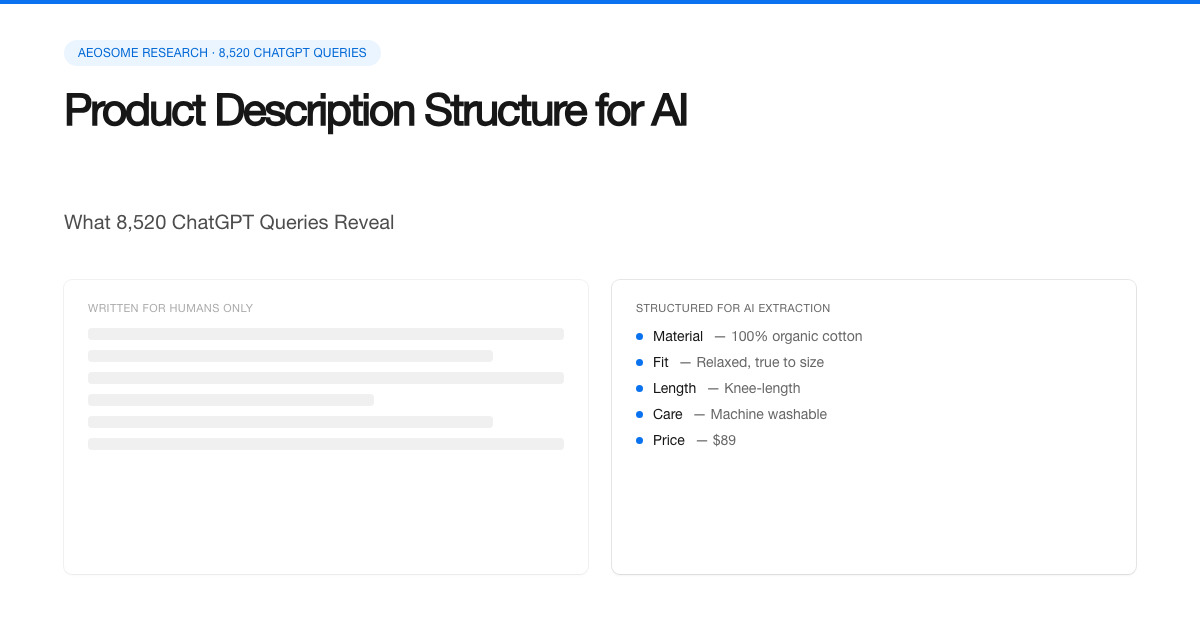
Product descriptions now do two jobs at once: persuading a human shopper, and supplying the structured signal an AI assistant uses to decide whether to recommend the product at all. AEOsome's 8,520-query ChatGPT study shows carousel-trigger rate climbing from 58.1% at zero stated attributes to 87.3% at five (AEOsome Research, 2026). The same specificity logic applies to how a description is written, not just how a feed is filled in.
Key Takeaways
- Carousel-trigger rate rises from 58.1% to 87.3% as attribute count in a query goes from 0 to 5 (AEOsome Research, 2026).
- Highly specific queries trigger carousels 65.5% of the time versus 41.7% for highly ambiguous ones — a 24-point gap driven by clarity, not word count.
- Switching from Short to Conversational phrasing collapsed the Attribute Constrained intent stage from 100% to 25.8% trigger rate — the single worst cell in the entire 8,520-query dataset.
- Retail listings account for 89–99% of AI citations across every shopping intent stage; brand-owned sites peak at just 6.1% (Comparison queries).
- The practical implication: a product description built for AI shopping needs a structured, attribute-forward layer — narrative prose alone works against you, even when the underlying product data is complete.
These are query-side findings from a proprietary study, translated into description-writing guidance. The sections below walk through the evidence, then a four-layer structure template you can apply today.
In this article:
- Why Product Description Structure Is Now an AI-Visibility Signal, Not Just a Conversion Signal
- What 8,520 ChatGPT Queries Show About Attribute Density
- Specificity Beats Length: What the Ambiguity-Score Data Shows
- Why Conversational-Only Product Copy Can Backfire
- Your Description Is Competing Against Retail Listings, Not Just Other Brands
- A Structure Template for AI-Ready Product Descriptions
- Common Product Description Mistakes That Suppress AI Visibility
- Methodology
- Frequently Asked Questions
- The Data Points to Structure, Not Just Content
Why Product Description Structure Is Now an AI-Visibility Signal, Not Just a Conversion Signal
Product descriptions used to have one job: convince a human to click "add to cart." That job hasn't gone away. But it now has a second audience — the AI system deciding whether your product belongs in the handful it shows a shopper.
Traditional SEO ranks pages using backlinks, keyword density, and domain authority — none of which apply here. AI shopping assistants evaluate structured product data instead: attributes, pricing, availability, and how precisely your content matches the intent behind a natural-language question. Ranking signals don't transfer to AI shopping. Ranking well on Google doesn't guarantee AI recommends you — the two systems read completely different signals from the same page.
That distinction matters for anyone who assumes "well-written" copy is enough. A description that reads beautifully to a human but buries its material, fit, and use case in flowing prose gives an AI system little to extract and match against. The data below shows exactly how much that costs.
What 8,520 ChatGPT Queries Show About Attribute Density
Carousel-trigger rate rises with the number of attributes stated in a query, from 58.1% at zero attributes to 87.3% at five (AEOsome Research, 2026). The relationship isn't perfectly linear — it dips slightly at one attribute before climbing — but the direction above two attributes is consistent and substantial.
| Attributes in Query | N | Carousel Trigger Rate | Avg. Unique Brands Shown |
|---|---|---|---|
| 0 | 1,665 | 58.1% | 6.74 |
| 1 | 2,725 | 53.9% | 6.83 |
| 2 | 2,285 | 58.8% | 6.99 |
| 3 | 1,341 | 66.8% | 7.12 |
| 4 | 441 | 77.3% | 7.28 |
| 5 | 63 | 87.3% | 7.36 |
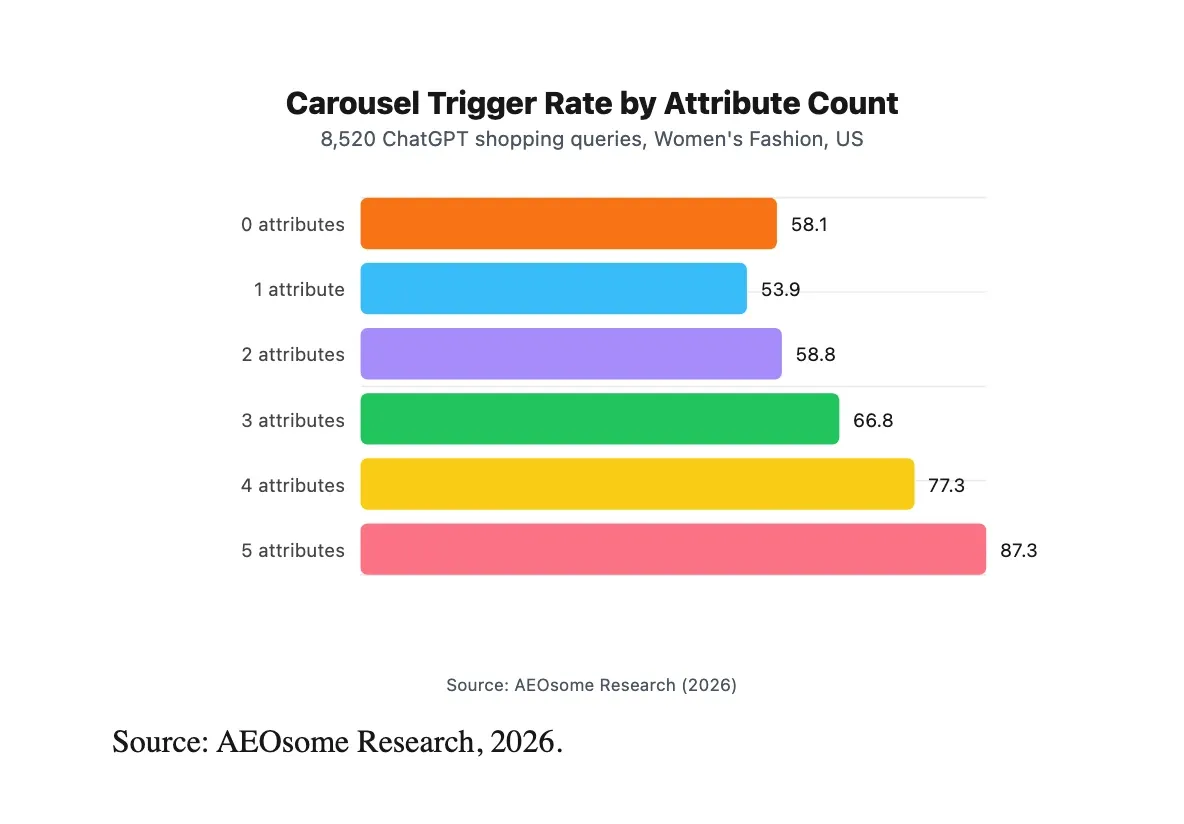
Carousel trigger rate by attribute count. Source: AEOsome Research, 2026.
For a product description, this translates directly: each additional structured, specific attribute you state — material, fit, dimensions, compatibility — increases the chance AI can match a specific shopper query to your product. Note the second column, too. Average unique brands per carousel also rises as attribute count rises, from 6.74 to 7.36. Adding specificity doesn't shrink the competitive set; it expands the pool of products that qualify as a match. More attributes earn you more chances to be considered, not an automatic win.
One caveat worth stating plainly: the five-attribute row is built from only 63 queries, the smallest sample in this breakdown. Treat 87.3% as directionally strong rather than a precise ceiling.
Specificity Beats Length: What the Ambiguity-Score Data Shows
Highly specific queries triggered carousels 65.5% of the time versus 41.7% for highly ambiguous ones (AEOsome Research, 2026) — a 24-point gap driven by clarity, not by how many words the query used.
| Ambiguity Score | Description | N | Carousel Trigger Rate |
|---|---|---|---|
| 1 | Highly specific | 2,013 | 65.5% |
| 2 | Specific | 2,136 | 66.6% |
| 3 | Neutral | 2,268 | 55.9% |
| 4 | Vague | 1,611 | 53.3% |
| 5 | Highly ambiguous | 492 | 41.7% |
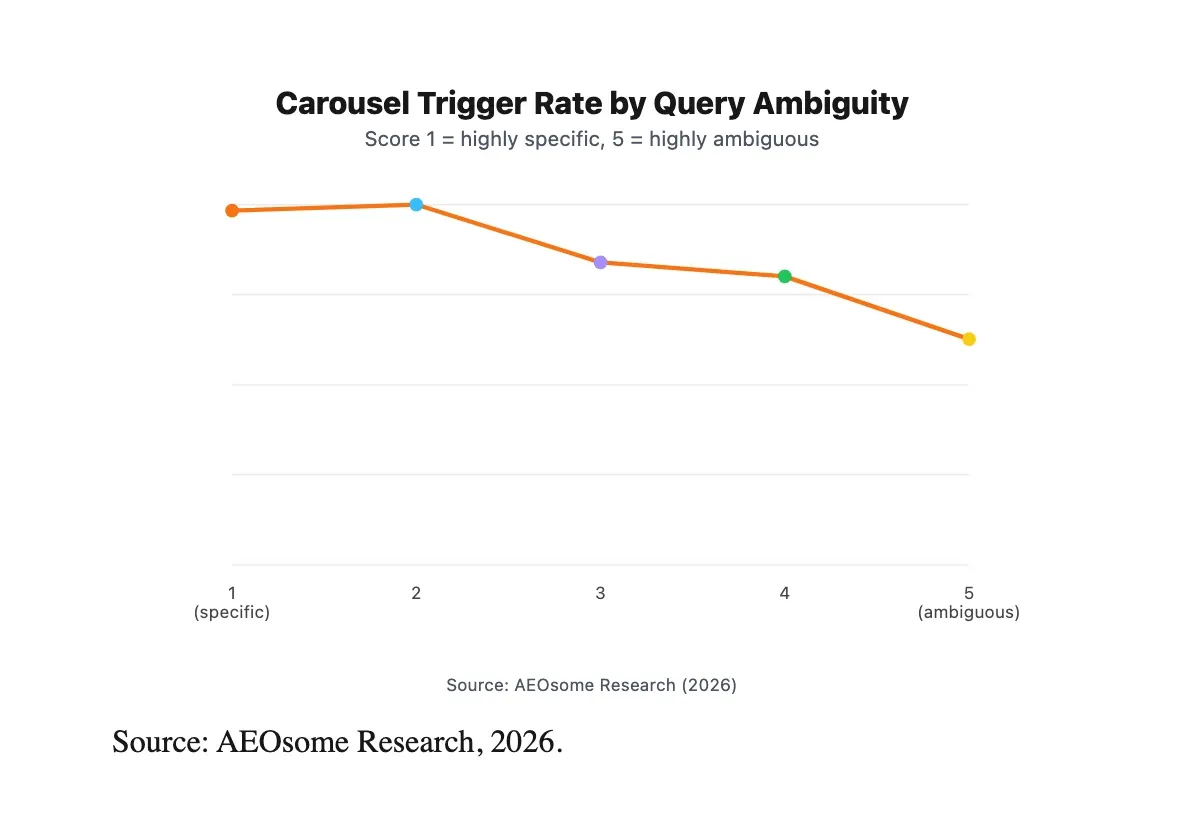
Carousel trigger rate by query ambiguity score. Source: AEOsome Research, 2026.
The description-writing rule that follows: replace vague superlative claims — "great quality," "amazing fit," "you'll love it" — with grounded, checkable specifics. Exact material composition. Precise dimensions. Named fit type. Actual care instructions. A specific query needs something specific to match against, and a vague description gives it nothing to lock onto. This is the same mechanism as the attribute-count finding above, just measured from the other direction: it's not only how many attributes you state, it's whether the language around them is concrete or hedged.
Why Conversational-Only Product Copy Can Backfire
In our data, switching from Short to Conversational phrasing collapsed the Attribute Constrained intent stage from a 100% carousel-trigger rate to 25.8% — the single worst cell in the entire 8,520-query dataset (AEOsome Research, 2026).
| Query Style | Attribute Constrained Trigger Rate |
|---|---|
| Short | 100.0% |
| Medium | 98.7% |
| Long | 99.0% |
| Messy | 98.7% |
| Conversational | 25.8% |
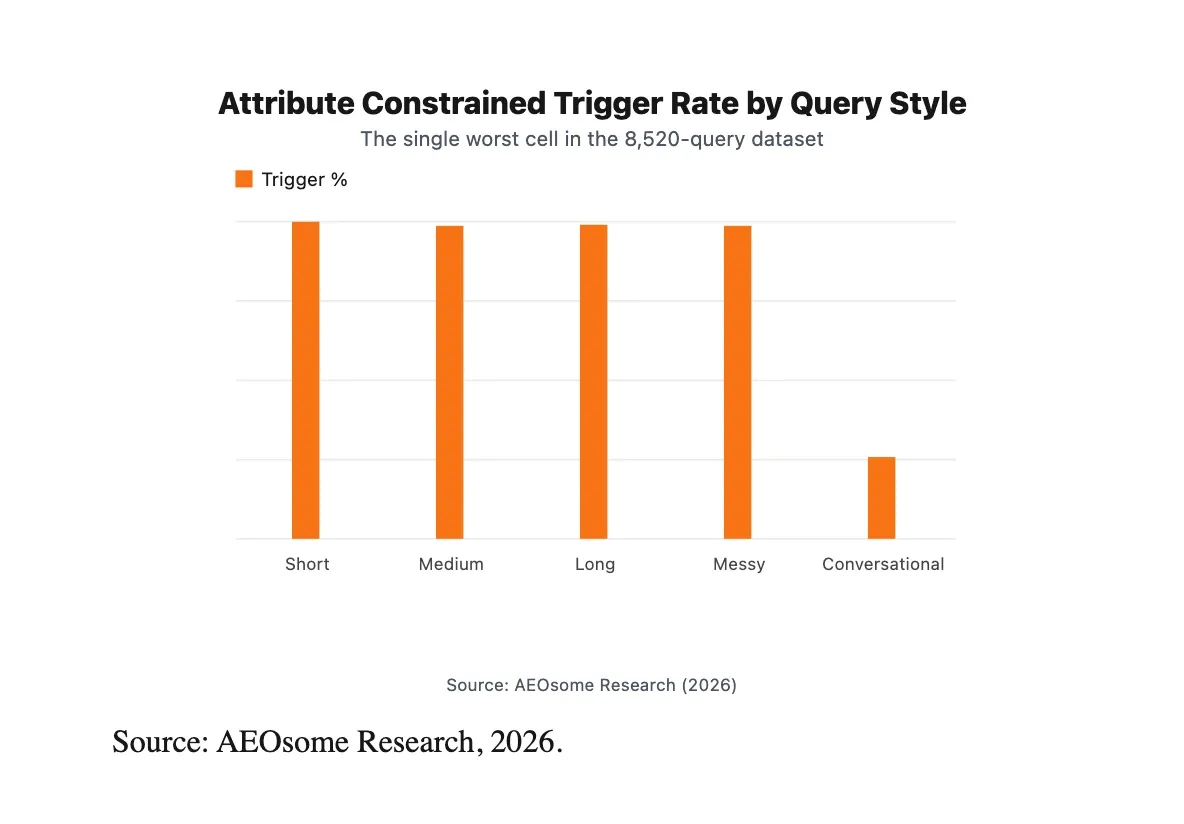
Attribute Constrained trigger rate by query style. Source: AEOsome Research, 2026.
Short, Medium, Long, and Messy phrasing all held between 98.7% and 100% trigger rate on this intent stage. Only Conversational phrasing — soft, narrative wording like "I'm kind of looking for something that might work for..." — collapsed the signal. The mechanism: conversational, narrative phrasing buries the structured constraint an AI system needs to match products, even when the underlying intent (a shopper who wants specific attributes) hasn't changed at all.
The translation to product descriptions is direct. Narrative-only copy — all flowing prose, no structured block — risks the same failure mode, because AI extraction favors content it can parse into discrete attributes over content it has to interpret. A product description doesn't need to abandon narrative voice; it needs to pair one with a structured attribute block the AI can read independently of the prose. A JSON-LD structured data layer reinforces this at the markup level, but the on-page, human-readable text needs the same discipline.
Your Description Is Competing Against Retail Listings, Not Just Other Brands
Retail websites account for 89–99% of all AI citations across every shopping intent stage in our data; brand-owned sites appear only in Comparison (6.1%), Validation (4.4%), and Purchase Execution (3.7%) queries (AEOsome Research, 2026).
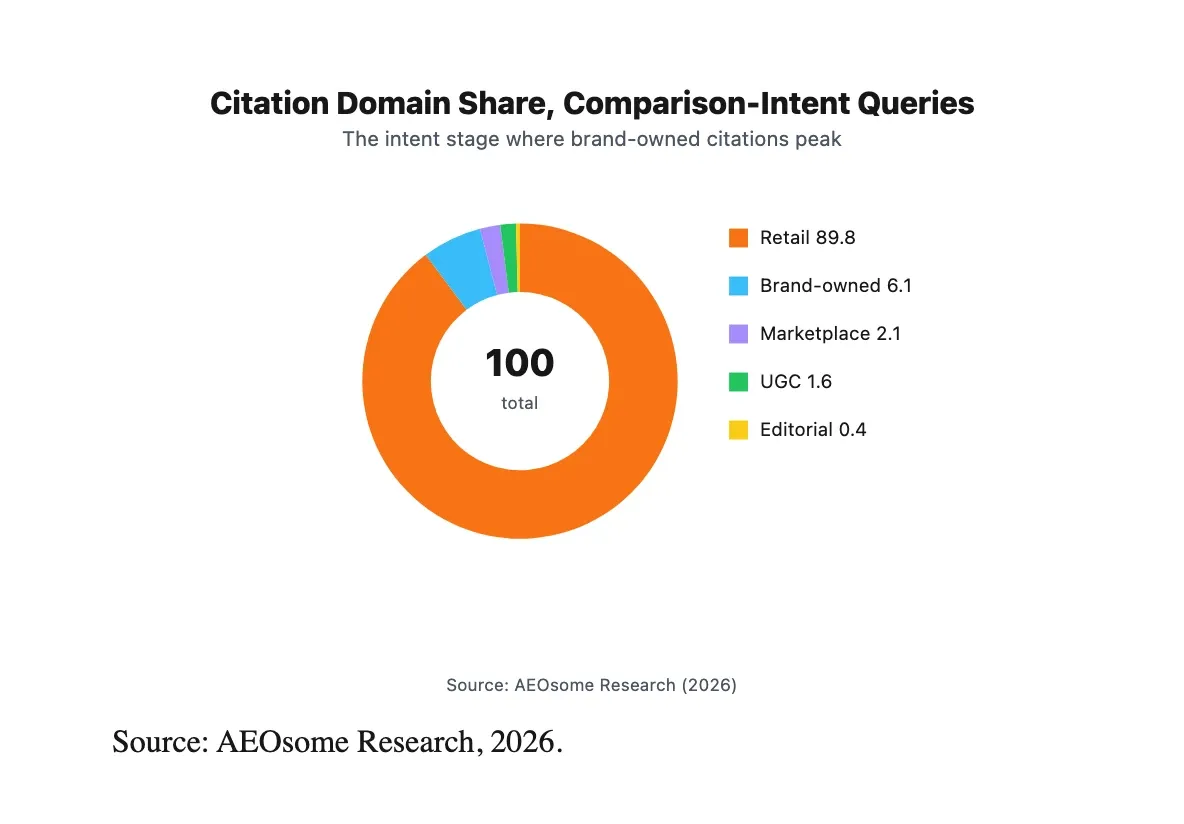
Citation domain share, Comparison-intent queries — the stage where brand-owned citations peak. Source: AEOsome Research, 2026.
| Intent Stage | Retail | Brand-Owned | Marketplace | Editorial | UGC |
|---|---|---|---|---|---|
| Problem Recognition | 98.7% | 0.0% | 0.2% | 0.3% | 0.7% |
| Category Exploration | 98.0% | 0.0% | 0.4% | 1.1% | 0.5% |
| Budget Framing | 96.4% | 0.0% | 2.9% | 0.2% | 0.4% |
| Attribute Constrained | 93.5% | 0.0% | 5.0% | 0.4% | 1.1% |
| Comparison | 89.8% | 6.1% | 2.1% | 0.4% | 1.6% |
| Validation / Risk Reduction | 93.0% | 4.4% | 0.3% | 0.6% | 1.8% |
| Scenario Confirmation | 96.8% | 0.0% | 1.1% | 0.7% | 1.4% |
| Purchase Execution | 91.4% | 3.7% | 4.0% | 0.3% | 0.6% |
| Post Purchase | 96.9% | 0.0% | 1.1% | 0.3% | 1.6% |
Full citation-domain breakdown across all 9 intent stages, among queries that triggered a carousel and had citations. Source: AEOsome Research, 2026.
Even Comparison queries, the intent stage where brand-owned citations peak in our dataset, still show retail sites capturing nearly 90% of citations. The practical read: your own product page's description is being evaluated against the structural bar a retailer or marketplace feed already clears, not against a competitor's marketing copy. Retailers structure listings around attributes, price, and availability by default. A DTC brand page written primarily as narrative marketing copy is competing against that structural bar and starting behind. Feed-level eligibility compliance is the other half of clearing it — description structure and feed structure need to move together.
A Structure Template for AI-Ready Product Descriptions
Based on the findings above, a product description built for AI shopping surfaces needs four layers in a fixed order: a one-sentence identity statement, a structured attribute block, a grounded-claims paragraph, and a use-case/fit statement.
- Identity sentence. Product type, category, and one or two defining attributes stated up front — this mirrors how Short-style queries that state their attributes directly succeed in the data above. Example: "A relaxed-fit, knee-length cotton midi dress for warm-weather occasions."
- Structured attribute block. Bullets or a mini spec table covering the discrete, matchable fields the attribute-count data rewards: material, dimensions or size range, price, compatibility, and care instructions. This is the layer narrative-only copy is missing.
- Grounded-claims paragraph. Specific, checkable statements rather than vague superlatives — per the ambiguity-score finding. "Machine washable, pre-shrunk cotton" beats "premium quality fabric."
- Use-case/fit statement. Who the product is for and when they'd use it, giving AI a scenario match without requiring a separate buying guide.
This structure is a synthesis derived from the query-side data above — what makes a query easy for AI to match — applied to the product description side. It's AEOsome's own analytical translation of that data, not a separate description-level experiment. If you want to audit your existing descriptions against this template, start with the products getting the least AI traffic and check each one against all four layers before moving to the next — see Why Your Products Don't Show Up in AI Shopping Results: A Diagnostic Guide for a fuller walkthrough.
Common Product Description Mistakes That Suppress AI Visibility
Three recurring mistakes in existing product copy work against every finding above:
No structured attribute layer. All-prose descriptions with zero bullets or spec block give AI nothing discrete to extract, regardless of how complete the underlying product data is. This is the direct cause of the conversational-copy collapse shown earlier.
Vague marketing language instead of grounded specifics. Generic superlatives — "premium," "best-in-class," "you'll love it" — have nothing checkable behind them. The ambiguity-score data shows specificity, not adjective density, drives carousel inclusion.
Inconsistency between the description and the feed, reviews, or FAQ. When a description claims one thing and the feed or reviews say another, that's a trust and consistency issue AI systems weigh against a product. Entity consistency across your description and feed matters as much as what either one says on its own — and review consistency is part of the same pattern.
Methodology
This analysis draws on 8,520 shopping-intent queries run against ChatGPT (gpt-5-mini), covering 9 intent stages and 5 query styles in the Women's Fashion category, US market, collected in February 2026 (AEOsome Research, 2026).
The dataset measures query-side structure — how shoppers phrase what they want — not a direct audit of product description text from surfaced listings. The structural recommendations in this post are AEOsome's analytical translation of those query-side findings into description-writing guidance, not a separate description-level controlled test. No controlled A/B test yet exists on rewritten product descriptions and resulting carousel inclusion; that's a stated open question for future research. AEOsome's raw captured responses include some inline product-card text, and a follow-up study could code a sample of actually-surfaced product cards for length and format, testing the structure template above directly against real outcomes.
Frequently Asked Questions
Does ChatGPT read my full product description or just my product feed?
Both structured feed data and on-page description content factor into how AI systems extract and evaluate a product. OpenAI's own Agentic Commerce Protocol documentation confirms merchants can supply a structured product feed via API or file upload, and ChatGPT Shopping is built to work with that feed alongside a merchant's page. Retail sites account for 89–99% of citations across every intent stage in our data, which points to structure mattering across both the feed and the page — but we can't make a more specific claim about ChatGPT's exact indexing weighting between the two without further primary detail from OpenAI.
How long should a product description be for AI shopping visibility?
Our data doesn't measure description length directly. Based on the specificity and attribute-density findings, length matters less than including a structured attribute block and grounded, checkable specifics. A short description with five clear attributes likely outperforms a long one with none.
Do bullet points help more than paragraph descriptions for AI search?
The conversational-collapse finding — a 100% to 25.8% drop on the Attribute Constrained intent stage — is evidence that a structured, scannable layer outperforms prose-only phrasing when the AI needs to match specific constraints. A bulleted attribute block gives it exactly that.
What's the single biggest structural mistake in most product descriptions?
A missing structured attribute block. This ties directly to the attribute-count finding: carousel-trigger rate rises from 58.1% to 87.3% as stated attributes go from zero to five, and a description with no attribute layer at all forfeits that entire range.
The Data Points to Structure, Not Just Content
Three numbers carry this study: attribute count and specificity both drive carousel-trigger rate upward, conversational-only prose can suppress even a well-attributed product, and retail listings set the structural bar your own description has to clear. None of this replaces good writing — it adds a second, machine-readable job to it.
If you want a structured look at how your own product descriptions and feed measure up against this data, AEOsome runs a free product-description and feed audit. Get in touch through AEOsome to have your catalog checked.
About the author. Vijaya Kumar Channalli is a serial SaaS founder and the founder of AEOsome (Tartu, Estonia), which helps eCommerce brands get their products recommended when shoppers ask AI what to buy. He designed the 8,520-query ChatGPT shopping-intent research methodology behind this study and writes about AI shopping visibility, product feeds, and how Answer Engine Optimization differs from SEO. More at vijay.cc. Read how we write, source and correct posts in our editorial policy.
Sources: AEOsome Research, 2026 (8,520-query ChatGPT shopping-intent study, Women's Fashion category, US, gpt-5-mini, February 2026); OpenAI, Agentic Commerce Protocol documentation.