When AI Describes Your Brand Wrong: Fixing Entity Consistency
AI describes your brand wrong when its sources disagree. A five-step fix: audit every answer engine, reconcile the properties you control, correct the sources AI trusts.

You asked ChatGPT what your brand sells, and the answer was wrong. It named the wrong category, quoted a price tier you dropped after a repositioning, or called a two-year-old product your flagship. Or it blended you with a different company that has a similar name.
AI describes your brand wrong when its sources disagree. It assembles a brand profile from your site, your feed, directories, marketplaces, and review sites, then repeats whichever version is most consistent across the sources it trusts. You fix it by publishing one identical description everywhere you control, then correcting the highest-authority sources that still carry the old one.
TL;DR: AI builds a brand profile from many indexed sources and repeats the version that is most consistent across the ones it trusts. You do not own that narrative. You out-repeat the wrong one. Fix it in five steps: audit what each engine says with a fixed prompt set, identify which sources it is reading, publish one verbatim entity description across every property you control including the brand field on every SKU, correct the highest-authority third-party sources, then re-prompt monthly until the record is clean. For eCommerce the cost is concrete: a wrong category or price tier changes which product recommendations you are eligible for.Key Takeaways
- AI assembles a brand's identity from indexed third-party sources, not from brand equity, ad spend, or recognition. An established brand can still be described wrong (general knowledge; AEOsome Research, 2026).
- A wrong brand category or price tier changes which questions your products can be recommended for. In AEOsome's 27,255-query study, AI returned a structured product in 38.1% of shopping queries, and how often varied sharply by category and by buying intent (AEOsome Research, 2026).
- Three signals correct an entity most reliably:
OrganizationorBrandschema with a fullsameAslist, a sourced Wikidata item, and one verbatim-identical description repeated across every property you own (Google structured-data documentation; Wikidata:Notability). - Google AI Overviews take feedback in-product: thumbs-down, then Report a problem, then the correct facts. Your Google Business Profile category and description feed the same Knowledge Panel the model reads (Google Search Help, 2026; Google Business Profile Help).
- Entity corrections propagate over weeks, not days. You confirm the fix by re-running one fixed prompt set across ChatGPT, Perplexity, Google AI Mode, and Gemini and scoring the change (general knowledge; AEOsome Research, 2026).
On this page
- Why does AI describe my brand wrong?
- How do I audit what every AI engine says about my brand?
- Which sources is the AI actually reading?
- How do I fix entity consistency on the properties I control?
- How do I correct the third-party sources AI trusts?
- How do I verify the fix worked?
- Frequently asked questions
- One Description, Everywhere
Why does AI describe my brand wrong?
Because it builds your brand profile from many indexed sources and repeats the version that is most consistent across the ones it trusts. When those sources disagree, or when your own properties disagree with each other, it picks wrong, hedges, or blends two companies into one.
An entity is the thing AI thinks your brand is: a company, with a category, a positioning, a set of products, a founding story. A knowledge graph is the structured map of those entities and how they connect. Answer engines read that map, plus the open web, to decide what to say about you.
Six causes produce almost every wrong description:
- Source disagreement. Your site says one thing, a marketplace listing says another, a directory carries a stale category.
- Outdated rebrand content. The old name, old positioning, or old flagship is still indexed and still ranking.
- Name collision. A similarly named company, a former parent, or a discontinued sub-brand shares your entity space.
- Thin owned content. You have no clear, extractable "this is what we are" statement for a model to lift.
- Third-party pages outranking yours. Marketplace and retailer product pages get crawled heavily and often carry old descriptions and pricing.
- Missing structured data. No
OrganizationorBrandschema, nosameAs, and inconsistent brand strings across your own catalog.
AI models do not retrieve a brand's identity from brand equity or ad spend. They assemble it from indexed third-party sources and repeat the most consistent version. Disagreement across those sources is what produces a wrong description (AEOsome Research, 2026).
This is a recommendation problem, not only a reputation problem. A product carousel is the row of product cards an answer engine shows for a shopping question. If the model files your brand under the wrong category or the wrong price tier, your products stop being eligible for the carousels where your buyers are actually looking. For how a model ends up recommending a rival's catalog instead of yours, see why ChatGPT recommends your competitor products.
How do I audit what every AI engine says about my brand?
Run one fixed set of prompts across ChatGPT, Perplexity, Google AI Mode, and Gemini, and log every answer against a brand-fact scorecard. Test the same facts every time so you can measure change instead of guessing at it.
Use seven prompts, phrased the way a shopper or a researcher would type them:
- "What does [brand] sell?" (category)
- "Is [brand] a budget or a premium brand?" (price tier)
- "What is [brand]'s most popular product?" (flagship and catalog freshness)
- "Who owns [brand], and where is it based?" (corporate facts)
- "What brands are similar to [brand]?" (which set the model files you in)
- "Is [brand] the same as [similar name]?" (collision check)
- "What do people say about [brand]?" (review and forum drift)
Score each answer correct, partially correct, wrong, or hedged. Note which sources the engine cites when it shows them. Then check the Google Knowledge Panel, the Wikidata entry if one exists, and the top ten organic results for your brand name. Those are the model's most likely inputs.
The scorecard is the point. You cannot fix what you have not measured, and a one-time check tells you nothing about whether a correction landed. If the audit shows your products missing rather than mis-described, work through why your products don't appear in ChatGPT Shopping; a wrong entity profile is only one of the reasons a catalog stays invisible.
Which sources is the AI actually reading?
For most eCommerce brands, in rough order: your own site and product feed, then Wikipedia and Wikidata, then Google Business Profile, then marketplaces and retailer product pages, then review platforms, then Reddit and forum threads. Fix them in that order of leverage.
Two tiers do the work. Properties you control are your website, your entity or About page, your blog, your Organization and Brand schema, your product feed, your marketplace brand stores, and your social profiles. Third-party sources AI weights heavily are Wikipedia and Wikidata, Google Business Profile, business-data aggregators, major marketplace listings, review platforms, and high-engagement forum threads.
AI weights sources by authority and by corroboration. One About page rarely overrides a marketplace listing and several directory entries that all agree with each other. Volume of agreement, weighted by authority, is what wins (AEOsome Research, 2026).
How do I fix entity consistency on the properties I control?
Write one canonical entity description, one or two sentences that state your category, your positioning, and what you are best for, then publish it verbatim everywhere you control it. The same string on the About page, in schema, in marketplace brand stores, in social bios, and in the feed.
Work through this checklist:
- Canonical description. Draft it as an extractable statement: "[Brand] is a [category] brand that makes [what] for [who], known for [distinctive attribute]." Reuse the exact wording. Do not paraphrase it per channel.
OrganizationorBrandschema. Includename,description,url,logo, and a fullsameAsarray pointing to every official profile. Keep the@idstable so the entity does not fork.- Product feed
brandvalue. Use one identical brand string on every SKU and variant. A variant, or SKU, is one buyable configuration: this color, this size, this pack count. "Acme", "Acme Inc.", and "ACME Co." across your catalog fragment the entity before any directory does. A feed tool such as SubFex can enforce one string across the catalog; the rule matters more than the tool. - Retire outdated rebrand pages. Redirect old-name, old-positioning, and discontinued-flagship pages that still rank.
- An entity-first About page. State founding year, headquarters, parent company, and category. Add an explicit "not affiliated with [similar name]" line if a collision exists.
- Consistent corporate facts. Match founding year, headquarters city, and legal entity across your site footer, Google Business Profile, and every directory.
Two of these are structured-data work: the Organization, Brand, and Product schema all have to state the same category and name, and the brand and identifier fields have to be right on every SKU in the feed. Product schema and structured data for AI recommendations covers the JSON-LD and GTIN details, and the product feed eligibility checklist lists the feed fields that have to be correct.
How do I correct the third-party sources AI trusts?
Update the high-authority sources in leverage order, and add fresh corroboration so the correct version outweighs the stale one. You are not issuing a correction. You are changing the source consensus the model reads.
| Source | What to fix | Why it matters |
|---|---|---|
| Wikidata | instance of, industry, official website, parent organization, and identifiers, each with a citation |
Openly editable with sourced statements, and more inclusive than Wikipedia (Wikidata:Notability) |
| Google Business Profile | Category, description, and attributes | Feeds the Knowledge Panel that answer engines read (Google Business Profile Help) |
| Google AI Overviews | Thumbs-down, then Report a problem, then the correct facts | Google's in-product route for a wrong AI description (Google Search Help, 2026) |
| Business-data aggregators | Category, headquarters, founding year, description | Cross-referenced by models as corroboration |
| Marketplace brand stores and retailer pages | Request description and category corrections | Stale retailer copy is a common source of wrong price-tier signals |
| Fresh mentions | Earned coverage and updated directory and review profiles | New, accurate content outweighs old content over time |
Do not force a Wikipedia page. Wikipedia requires significant coverage in independent secondary sources, and a page that gets deleted does nothing (Wikipedia:Notability for organizations and companies). A well-sourced Wikidata item plus Organization schema plus a clean Google Business Profile covers most of the signal.
You do not own how AI describes your brand. You change the source consensus it reads. The correct description has to out-number and out-rank the wrong one where the model looks (AEOsome Research, 2026).
If a similarly named company shares your entity space, consistency alone will not break the blend. Disambiguate actively: a stable schema @id, a full sameAs fan-out to your official profiles, an explicit "not to be confused with" line, and a Wikidata item with distinct identifiers.
How do I verify the fix worked?
Re-run the same prompt set on the same cadence, monthly for most brands, and track the brand-fact scorecard until every fact reads correct on every platform. Watch for product-carousel recovery as the downstream signal that the entity fix reached your catalog.
Expect weeks, not days. Engines re-crawl and re-index on their own schedule, and cached answers lag behind source changes. Track three things each cycle: the share of facts correct per platform, which sources the engine now cites, and whether your products re-enter the right carousels.
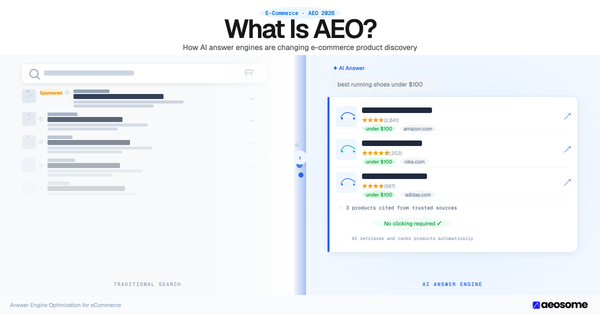
When a wrong fact survives two cycles and the source consensus is already correct, look for one stubborn high-authority page still carrying the old version. It is usually a marketplace listing or a directory entry. Run the whole procedure as a loop, Monitor → Audit → Optimize → Verify, not a one-time cleanup. This is entity-level AI search optimization: Answer Engine Optimization (AEO) pointed at your own brand record instead of a product page.
The fix does not depend on your Google rankings, which is why strong search positions can sit next to a wrong AI description. For how brand recognition and entity clarity play out in real recommendations, see the brands ChatGPT recommends most, from 5,072 analyzed carousels.
Frequently asked questions
ChatGPT says my brand sells the wrong thing. How do I change that?
Fix your own signals first: the Organization or Brand schema description, the About page, and the brand field on every SKU, all carrying one identical category statement. Then correct the third-party sources: Wikidata, Google Business Profile, and your marketplace brand stores. Re-prompt in about four weeks (general knowledge; AEOsome Research, 2026).
AI confuses my brand with another company that has a similar name. What do I do?
Disambiguate actively. Use a stable schema @id, a full sameAs array to your official profiles, an explicit "not affiliated with [name]" line on your About page, and a Wikidata item with distinct identifiers. Consistency plus explicit separation is what breaks the blend (general knowledge).
Do I need a Wikipedia page for AI to describe my brand correctly?
No. A well-sourced Wikidata item, Organization schema with sameAs, a Google Business Profile, and consistent directory entries cover most of the signal. Wikipedia helps if the brand clears its notability bar, but a forced page that gets deleted does nothing (Wikidata:Notability; Wikipedia:Notability for organizations and companies).
How long does it take for AI to stop repeating wrong information?
Usually weeks. Engines re-crawl and re-index on their own schedule, and cached answers lag behind source changes. Re-prompt monthly and score the change rather than checking daily (general knowledge; AEOsome Research, 2026).
AI still lists a product we discontinued two years ago. How do I get it removed?
Redirect the product page, pull the item from the feed, update marketplace and retailer listings, and refresh your "most popular products" content so the current flagship is the most consistent signal. The old product persists as long as stale pages outnumber current ones (general knowledge; AEOsome Research, 2026).
One Description, Everywhere
Three things hold this together. AI builds your brand from sources, not from recognition, so an established brand can still be described wrong. A wrong category or price tier costs you product recommendations, not just reputation: AI returned a product in 38.1% of shopping queries in our 27,255-query study, and a wrong entity profile changes which of those queries you can win (AEOsome Research, 2026). The fix is one verbatim description across every property you touch, weighted toward the sources with the most authority.
You do not own the narrative. You reconcile the sources until the correct version is the one that repeats.
AEOsome runs a free citation check that shows exactly what ChatGPT, Perplexity, Google AI Mode, and Gemini say about your brand right now, and which sources each one is reading.
About the author. Vijaya Kumar Channalli is the founder of AEOsome (Tartu, Estonia), which helps eCommerce brands get their products recommended when shoppers ask AI what to buy. He writes about AI shopping visibility, entity consistency, and how Answer Engine Optimization differs from SEO. More at vijay.cc.
Sources: Google Search Central, AI features and your website (developers.google.com); Google structured data documentation for Organization (developers.google.com); schema.org Organization (schema.org); Wikidata:Notability (wikidata.org); Wikipedia:Notability (organizations and companies) (en.wikipedia.org); Google Business Profile Help and the in-product AI Overviews feedback flow (thumbs-down, then Report a problem); AEOsome Research, 2026 (27,255-query, four-platform AI shopping study).