AEO for eCommerce: The Complete Guide to Getting Products Recommended by AI
AEO for eCommerce explained: how ChatGPT, Google AI Mode, and Copilot pick products, what to fix first, and what 22,335 AI shopping responses show.

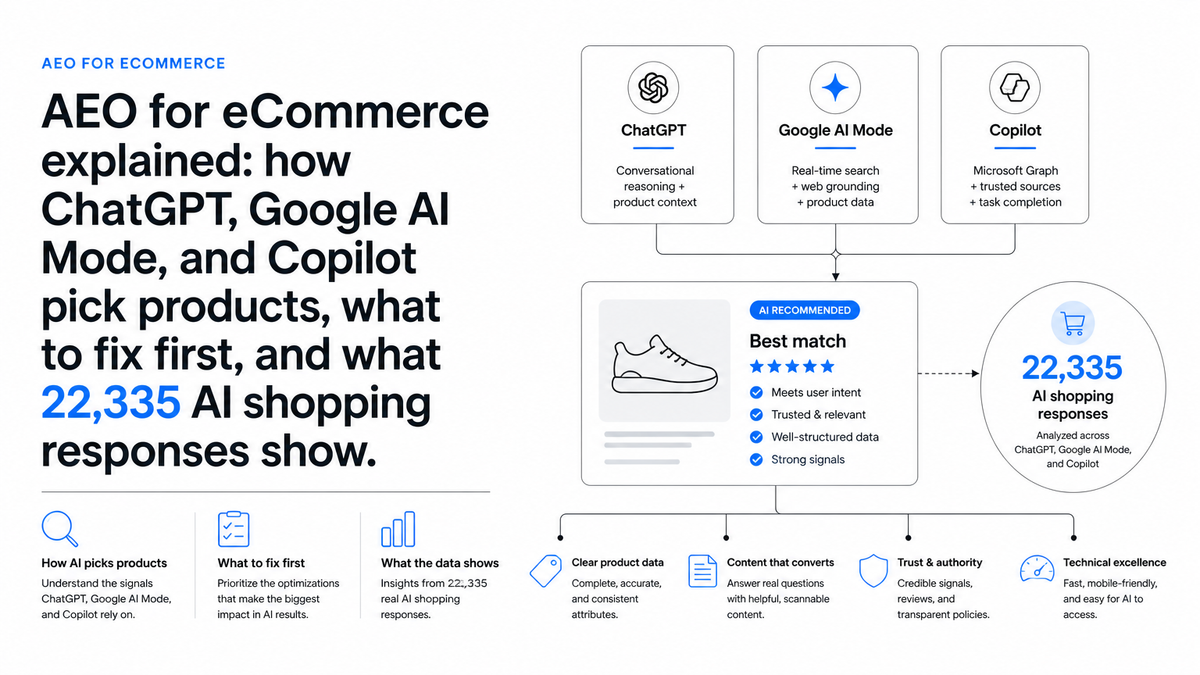
Most AEO advice is written for publishers who want to be quoted. Stores don't need to be quoted. They need a product, with a price, sitting inside the answer.
AEO for eCommerce (Answer Engine Optimization) is the work of making your products eligible, legible, and credible to AI assistants, so they get recommended when shoppers ask ChatGPT or Google AI Mode what to buy. It runs at the SKU level: clean feeds, complete structured data, corroborating reviews, and content that matches real shopping queries.
A counting note before anything else: we collected 27,255 query-response attempts, and 4,920 of them were duplicate retries of a query already asked on the same platform. We removed those. Every rate in this guide uses the 22,335 deduplicated responses (5,584 distinct queries across four platforms).
Key Takeaways - AI answers are already a shopping shelf. Across 22,335 shopping responses on 4 platforms, AI showed a buyable product card (name, price, merchant link) 35.6% of the time (AEOsome Research, 2026). - Platform matters. Google AI Mode showed products in 64.4% of queries, Copilot in 44.5%, ChatGPT in 28.5%, and Perplexity in 5.0% (AEOsome Research, 2026). - Intent matters more. Budget queries ("best X under $Y") surfaced products 54.8% of the time, versus 14.7% for post-purchase questions (AEOsome Research, 2026). - A recommendation is decided per SKU, not per brand. Missing GTINs, variant gaps, and feed-to-page price drift remove individual products from the shortlist before ranking starts. - The organic window is open: only 1.0% of AI shopping answers carried ads, though Google AI Mode already runs them in 3.9% (AEOsome Research, 2026).
Here's the roadmap: what AEO means for a store, how often AI actually shows products, how engines pick them, and the four layers of work that decide eligibility. Then: where to prioritize first, where agentic checkout fits, and how to measure the whole thing.
In this article:
- What Does AEO Mean for an eCommerce Store?
- How Often Do AI Assistants Actually Recommend Products?
- How Do AI Engines Decide Which Products to Recommend?
- How Is AEO Different From the SEO Your Store Already Does?
- What Does an eCommerce AEO Program Actually Involve?
- Which Platforms and Queries Should You Prioritize First?
- Where Do Agentic Commerce, ACP, and UCP Fit In?
- How Do You Measure AEO, and Who Should Own It?
- Frequently Asked Questions
- Methodology
- The AI Shelf Is Already Stocked. Make Sure Your SKUs Are On It.
What Does AEO Mean for an eCommerce Store?
For a store, AEO means getting specific products chosen, not getting the brand quoted. The unit of work is the purchasable SKU or variant, not the page.
Answer Engine Optimization (AEO) is the practice of structuring product data and content so AI answer engines can retrieve, verify, and recommend it. Some writers use GEO (Generative Engine Optimization) or AIO instead; the labels differ, the mechanics don't. We cover whether AEO, GEO, and AIO are different in a companion post, and a dedicated companion post goes deeper on what AEO covers for an eCommerce store.
The distinction that matters most: a brand mention isn't a product recommendation. Our study only counted structured product cards with a name, price, and merchant link. A response that says "brands like yours" in a sentence doesn't count, and it shouldn't. A companion post on brand mentions versus product recommendations covers why that gap trips up most AEO advice written for publishers.
How Often Do AI Assistants Actually Recommend Products?
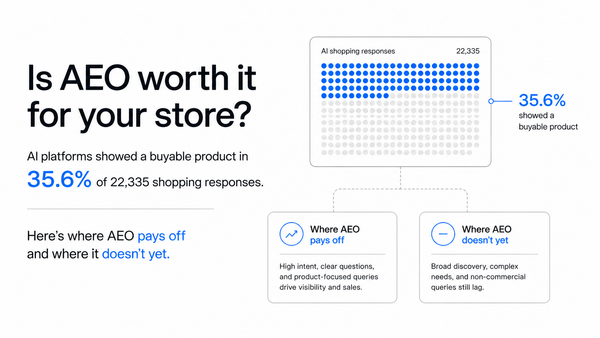
Often enough to be a real shelf. Across 22,335 shopping responses on ChatGPT, Google AI Mode, Copilot, and Perplexity, 35.6% returned a structured product card (AEOsome Research, 2026).
That average hides a wide platform spread: Google AI Mode returned a product card in 64.4% of queries, Copilot in 44.5%, ChatGPT in 28.5%, and Perplexity in 5.0%. No category fell below 28.7%; Electronics led at 50.3%.
A second dataset shows what the shelf looks like once it appears. In 8,520 ChatGPT queries about women's dresses, a shopping carousel triggered 59.5% of the time, averaging 7.99 products from 6.94 unique brands per carousel (AEOsome Research, 2026).
Citation Capsule: Across 22,335 AI shopping responses on ChatGPT, Google AI Mode, Microsoft Copilot, and Perplexity, 35.6% returned a structured product card with name, price, and merchant link (AEOsome Research, 2026).
What this means for you: the shelf exists in every category we measured, so the live question is whether you're on it, not whether it exists. If you're weighing whether the investment is worthwhile for your catalog, our companion post on whether AEO is worth the investment for your store walks through the platform-by-platform and intent-by-intent math.
How Do AI Engines Decide Which Products to Recommend?
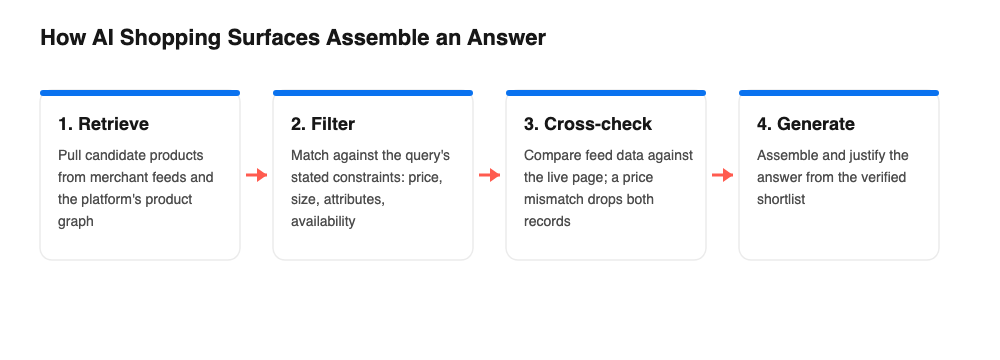
An AI engine doesn't rank your page. It assembles a shortlist of products it can verify, then justifies the pick. Structured product data decides who makes the shortlist. Corroboration decides who gets chosen from it.
The process runs in four stages. Retrieve candidate products from merchant feeds and the platform's own product graph. Filter by the query's stated constraints: price, size, availability. Cross-check the feed against the live page, then generate the answer. A price mismatch between feed and page means neither record gets trusted.
Scale backs this up. Google's Shopping Graph holds more than 50 billion product listings, with more than 2 billion refreshed every hour (Sundar Pichai, Google, remarks at NRF 2026). That's not a search index you rank in. It's a live inventory system you either feed correctly or don't appear in.
That's the core contrast: the web shelf is ranked, and you influence position. The AI shelf is assembled, and you influence eligibility and corroboration. Two different games, two different levers.
Citation Capsule: The web shelf is ranked, and a store influences its position. The AI shelf is assembled, and a store influences only its eligibility and corroboration (AEOsome analysis, 2026).
A companion post on how AI product discovery actually works covers the retrieval and carousel mechanics in more depth. And Strong Google Rankings, Invisible in AI: Why Ranking Signals Don't Transfer explains why a #1 Google position doesn't carry over.
How Is AEO Different From the SEO Your Store Already Does?
SEO earns a page a position in a ranked list. AEO earns a product a slot in an assembled answer. The two share crawlability and content quality, but AEO's decisive inputs are product data, not links and pages.
| SEO | AEO | |
|---|---|---|
| Unit | The page | The SKU or variant |
| Decisive input | Content and backlinks | Feed, schema, and corroboration |
| Output | A ranked link | A product card |
| Failure mode | A lower position | Silent exclusion from the shortlist |
| What you measure | Rank and CTR | SKU visibility rate |
The two disciplines overlap on crawlability and page quality, but they diverge on what actually decides the outcome. For the full comparison, see AEO vs SEO for Online Stores: What Actually Changes.
What Does an eCommerce AEO Program Actually Involve?
Four layers of work, fixed in the order they block a SKU: eligibility, legibility, credibility, and coverage. A great product description can't help a product whose feed row is already held back.
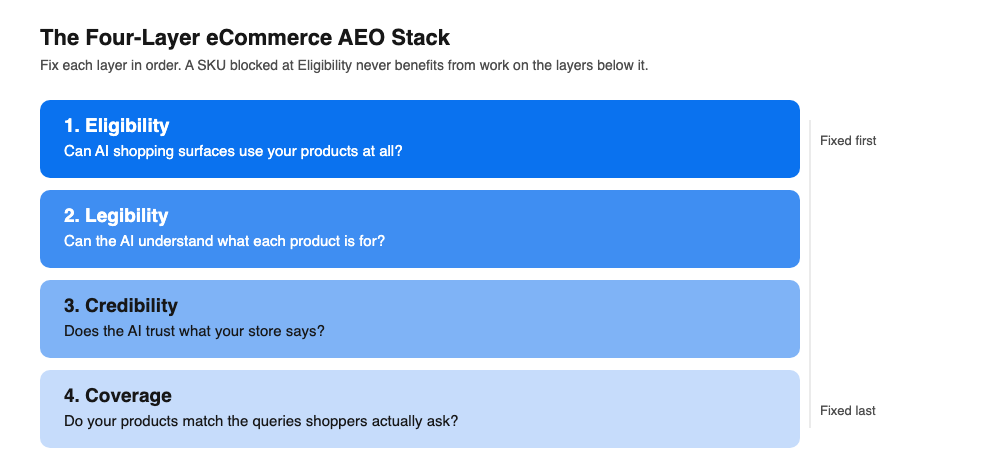
Eligibility: Can AI Shopping Surfaces Use Your Products at All?
This is the floor, and it has a cliff, not a slope. A compliant product feed (identity, price and availability, variants, policy fields), a server-rendered Product/Offer schema with GTINs, and open AI crawler access all sit here. A malformed gtin in 3% of catalog rows means 3% of the catalog is invisible, not "97% fine."
Fixing eligibility usually means keeping variant IDs, prices, and identifiers matched between your store and every feed you push. See the Product Feed Compliance for AI Shopping: The Eligibility Checklist, Product Schema and Structured Data for AI Recommendations, and Should You Block or Allow AI Crawlers on Your Store?.
Legibility: Can the AI Understand What Each Product Is For?
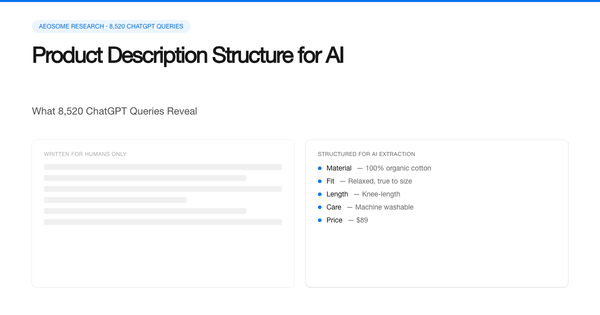
Once a product is eligible, the AI needs to understand it. That means attribute-forward titles and descriptions, and a per-variant attribute set (color, size, material, use case) that matches the constraints shoppers actually type into a prompt.
A generic "premium cotton tee" tells the AI little. "Men's crew-neck cotton tee, navy, size L, machine washable" gives it constraints to match against a query. Our companion post on structuring product descriptions for AI, built from 8,520 ChatGPT queries, covers this in depth.
Credibility: Does the AI Trust What Your Store Says?
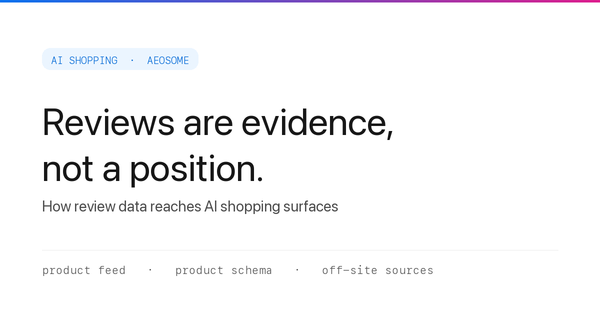
An AI engine corroborates a claim against outside evidence before it recommends. Reviews function as that corroboration. Entity consistency means the same brand and product facts (name, price range, category) appear everywhere the AI looks: your site, your feed, and any third-party listing.
Inconsistent facts read as a weaker signal, even when every individual source is accurate on its own. Our companion posts cover whether reviews function as an AI shopping ranking signal and fixing entity consistency when AI describes your brand wrong.
Coverage: Do Your Products Match the Queries Shoppers Actually Ask?
Coverage means your catalog and content answer the queries that actually get asked. Map your content against the 9 stages of AI shopping intent; budget and attribute-constrained queries are where the shelf is busiest. A product can clear the first three layers and still miss the shelf if nothing in its content matches how shoppers actually phrase the question.
Citation Capsule: AI shopping visibility is decided per SKU: a product needs a compliant feed row and a server-rendered Product/Offer record with a GTIN. Price and availability must stay consistent across feed and page before any content work can move it (AEOsome analysis, 2026).
If your products are already missing and you're not sure which layer is holding them back, our diagnostic guide walks through how to find out.
Which Platforms and Queries Should You Prioritize First?
Start where the shelf is busiest. That's Google AI Mode by platform, and budget-framed, attribute-constrained, and purchase-ready queries by intent. Don't build a strategy around Perplexity for product placement.
Intent is the stronger predictor here: a 40-point spread between the top and bottom intent stages, against a smaller platform-to-platform spread once you exclude Perplexity's outlier low. Ads stayed rare, at 1.0% of AI shopping answers overall, but they're already at 3.9% on Google AI Mode. Organic slots are still mostly unpaid, and that's changing first on the platform with the biggest shelf.
Citation Capsule: Budget-framed queries such as "best X under $Y" returned a product card 54.8% of the time, versus 14.7% for post-purchase questions, a 40-point spread driven by intent alone (AEOsome Research, 2026).
For the full four-platform breakdown behind these numbers, see our companion post analyzing all 22,335 deduplicated AI shopping responses.
Where Do Agentic Commerce, ACP, and UCP Fit In?
Agentic commerce is when an AI assistant completes the purchase itself, not just the recommendation. Today it runs on two protocols:
- ACP (Agentic Commerce Protocol, from OpenAI and Stripe)
- UCP (Universal Commerce Protocol, from Google and Shopify)
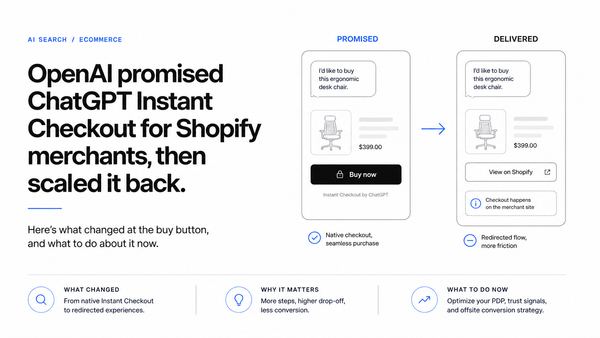
Right now, almost all AI-driven sales are still AI-referred: a human clicks through and buys on the merchant's own site. Feed and data readiness pays off now, and it pays off again when checkout moves inside the assistant itself.
Checkout eligibility needs an explicit flag plus an integration; is_eligible_checkout defaults to false until a merchant turns it on. The practical stance is to serve both protocols from one clean product record rather than betting on a single one. Our AEO glossary for eCommerce teams defines these and related terms (SKU visibility, llms.txt) in one place, if any of this vocabulary is new to your team.
How Do You Measure AEO, and Who Should Own It?
Measure the shelf, not just the clicks. Track SKU visibility rate (the share of target queries where your product appears), compliance pass rate, and AI-referred traffic and conversion.
Run it as a loop: Monitor your visibility rate and feed compliance, Audit the layer that's blocking it, Optimize the fix, and Verify by re-running the same query set 48–72 hours later.
Clicks alone under-report AEO, because many AI answers influence a purchase without producing one. When they do produce a click, it tends to convert well: AI-referred visits to US retail sites converted 42% better than non-AI traffic in March 2026 (Adobe Digital Insights, via TechCrunch, 2026).
Because AEO spans SEO, content, and feed operations, it needs one named owner or it falls through the cracks between teams. A companion post on who should own AEO walks through how to structure that ownership. On the revenue side, a companion post on zero-click search covers why clicks were always an incomplete metric for measuring AI's effect on store revenue.
Frequently Asked Questions
How do I get my products recommended by ChatGPT?
Start with eligibility: a compliant product feed, a server-rendered Product/Offer schema with GTINs, and prices that match between feed and page. Then target budget and attribute-constrained queries. ChatGPT showed products in 28.5% of shopping queries in our study (AEOsome Research, 2026).
Is AEO just SEO with a new name?
No. The unit is the SKU, not the page, and the failure mode is silent exclusion rather than a lower rank. See AEO vs SEO for Online Stores: What Actually Changes for the full breakdown.
Which AI platform shows the most products?
Google AI Mode, at 64.4% of shopping queries in our study. Perplexity was lowest, at 5.0% (AEOsome Research, 2026).
Do I need a product feed for AI shopping, or is schema enough?
Both. A feed and on-page schema are two delivery channels for the same product record, and AI systems cross-check them against each other. A mismatch between the two can cost you the recommendation.
How long does AEO take to work for an eCommerce store?
Feed and schema fixes can be re-checked within days, since the Verify step re-runs queries 48–72 hours after a change. Entity and review corrections tend to propagate over weeks. We don't promise a fixed timeline to revenue, because our data measures visibility, not causation.
Methodology
These figures come from two AEOsome studies. The first collected 27,255 query-response attempts; after removing 4,920 duplicate retries it covers 22,335 query-platform responses (5,584 distinct queries × 4 platforms), across the US market, 7 product categories, and 9 shopping-intent types, collected in 2026. A "product citation" means a structured card with a name, price, and merchant link; text mentions were excluded.
The second study covers 8,520 ChatGPT queries (gpt-5-mini) in the US, Women's Fashion > Dresses, also collected in 2026.
The AI Shelf Is Already Stocked. Make Sure Your SKUs Are On It.
AI platforms returned a buyable product card in 35.6% of 22,335 shopping responses. The platform spread ran from 64.4% down to 5.0%; the intent spread ran from 54.8% down to 14.7%. Neither gap closes on its own.
The order matters more than the tactic list: fix eligibility first, then legibility, then credibility, then coverage. A product stuck at the first layer never benefits from work on the other three.
Want to know where your own catalog stands? Run a free AEOsome AI shopping visibility check to see which of your SKUs are eligible today.
About the author. Vijaya Kumar Channalli is a serial SaaS founder and the founder of AEOsome (Tartu, Estonia), which helps eCommerce brands get their products recommended when shoppers ask AI what to buy. Read how we write, source and correct posts in our editorial policy.
Sources: AEOsome Research (2026) · Sundar Pichai, Google, remarks at NRF 2026 · Adobe Digital Insights, via TechCrunch (2026)