ChatGPT Business Hub is OpenAI's free beta tool for claiming your business inside ChatGPT, launched November 10, 2026. Open chatgpt.com/business-hub, find your listing, verify it by phone, email, DNS record or Shopify, pass an identity check, then add a product feed. It shows insights. It does not buy you higher placement.
Key TakeawaysOpenAI launched Businesses in ChatGPT in beta on November 10, 2026, for a product used by 1.2 billion people each week (OpenAI, 2026).You verify by business phone, business email, DNS TXT record or Shopify, then pass a Persona ID check (OpenAI Help Center, 2026).Shopify stores' products already reach ChatGPT through Shopify Catalog, with no extra work (OpenAI Help Center, 2026).Claiming "does not guarantee higher placement or sales," in OpenAI's own words (OpenAI, Businesses in ChatGPT page, 2026).In 8,520 women's-dress questions, ChatGPT showed a product card on 93.0% of purchase questions but 2.8% of post-purchase ones (AEOsome Research, 2026, Study 1).
Last checked: November 17, 2026. Business Hub is a beta, so every OpenAI fact below carries its date and may change.
Your feed is full of "claim your ChatGPT listing now" posts. You run a store, so you want to know two things. What do you actually click? And does any of it put your products in front of shoppers? This guide answers both, with OpenAI's official steps and our own data on how ChatGPT picks products.
In this article:
- What is ChatGPT Business Hub?
- How to claim your business on ChatGPT
- What does a claimed listing show you?
- How to add products directly to ChatGPT
- How ChatGPT picks products to show
- What the ChatGPT Business Hub launch means for stores
- A Business Hub checklist for store owners
- Frequently Asked Questions
- Claimed. Now feed the shelf.
What is ChatGPT Business Hub?
Businesses in ChatGPT is OpenAI's beta program for business listings, and Business Hub is where you manage yours. It launched on November 10, 2026, and it is free for now.
OpenAI pitches it as a way to "connect with the 1.2 billion people who use ChatGPT each week" (OpenAI, November 2026). You reach it at chatgpt.com/business-hub or from the ChatGPT sidebar (OpenAI Help Center).
| Feature | What it does | Who gets it at launch |
|---|---|---|
| Claim and verify | Proves you own the listing | Eligible businesses wherever ChatGPT is available |
| Business details | Edit website, description, category, logo, delivery and return policy | Verified owners |
| Product feed | Sends products, prices and stock to ChatGPT | Verified owners who sell products |
| Insights | Mentions, profile views, website clicks, discovery topics | Verified owners above a data threshold |
| Business agent | A labeled chat about your products and policies | US eCommerce and online service businesses |
Business Hub and agents "are free for now," and OpenAI has not ruled out paid options (Digiday, November 2026). TechCrunch reads the launch as ChatGPT becoming "a little bit more like Google" for local and business discovery (TechCrunch, November 2026).
How to claim your business on ChatGPT
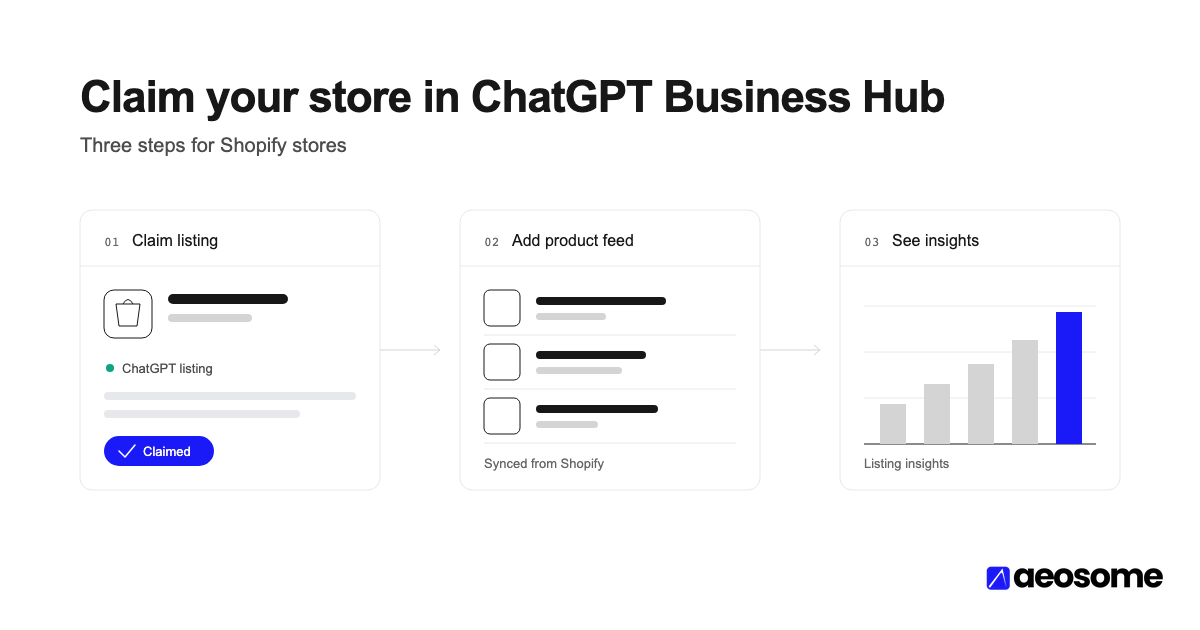
To claim your business on ChatGPT, open Business Hub, search for your business, verify that you own it, then pass a Persona identity check.
- Open Business Hub. Go to chatgpt.com/business-hub while logged in, or use the sidebar link.
- Find your listing. Search for your business name. If ChatGPT already knows you, pick that listing.
- Verify ownership. Choose one method. Get a code by SMS or call to your business phone, or by business email. Or add a DNS TXT record to your domain, or connect your Shopify store.
- Pass identity verification. Persona checks the person claiming, with a government ID and a video selfie. This step unlocks publishing changes, connecting a product feed, viewing Insights and creating a business agent (OpenAI Help Center).
- Review your details. Correct the website, description, category, logo and policies so they match your store.
Which method should a store pick? Shopify stores: connect Shopify, the simplest path. Other stores: the DNS TXT record, because it proves you own the domain your products link to.
What does a claimed listing show you?
Once verified, you control the business details ChatGPT uses about you. You also get Insights on how ChatGPT surfaced you over the past 28 days.
Insights has four metrics. Mentions count answers where ChatGPT references your website. Profile views and website clicks count people who opened your listing or clicked through. Discovery topics group conversations into the themes where you appeared (OpenAI Help Center).
Two limits matter. Insights are aggregated, and they show only "when there are enough conversations or interactions to meet certain thresholds" (OpenAI Help Center, 2026). A small store may see blanks at first. You also never see the real prompts, only topics.
Read a mention carefully. A mention means ChatGPT referenced your site. It does not mean a shopper saw your product in a product card. Those are two separate events, and only the second puts a price and a buy link in front of someone.
Insights shows ChatGPT's side of the visit. To see what those clicks did on your store, track ChatGPT traffic in GA4.
How to add products directly to ChatGPT
To add products directly to ChatGPT, open the products area of Business Hub and upload a feed. Use a CSV or TXT file, a hosted file URL, or Shopify. The feed carries your prices and stock.
You must pass the Persona identity check first. OpenAI calls it "a requirement to be able to upload your products" (OpenAI developer docs).
OpenAI's product feed spec lists the required fields. They are item_id, title, description, url, brand, seller_name, image_url, availability, price, target_countries and store_country (OpenAI product feed spec). Check the spec before you build, because a beta spec can change.
| Upload method | Best for | Keeps itself current? |
|---|---|---|
| CSV or TXT file | Small catalogs, a first test | No, you re-upload |
| Hosted file URL | Stores that already export a feed | Yes, if your export refreshes |
| Shopify connection | Shopify stores | Yes |
Keep price and stock in sync. A stale file that shows the wrong price is worse than no file. Larger merchants can also send feeds by SFTP through OpenAI's developer program. That route is tied to the Agentic Commerce Protocol (ACP, OpenAI and Stripe's standard for AI checkout).
Uploading is not the same as being chosen. OpenAI says connecting a feed doesn't guarantee that ChatGPT recommends your products (OpenAI Help Center, 2026). Field quality still decides a lot, so work through the Shopify product feed checklist for ChatGPT and the product feed eligibility checklist.
How ChatGPT picks products to show
ChatGPT shopping product discovery for merchants does not run on claims. ChatGPT picks products from merchant and product data, and only when the question calls for products.
Shopify merchants are already in. Their "product data is already integrated into ChatGPT through Shopify Catalog," with "no additional work required from individual merchants" (OpenAI Help Center). So no one needs to pay someone to "submit" a Shopify store.
OpenAI is just as plain about ranking. Claiming "does not guarantee higher placement or sales" (OpenAI). The terms promise no "particular placement, ranking, visibility" (OpenAI terms).
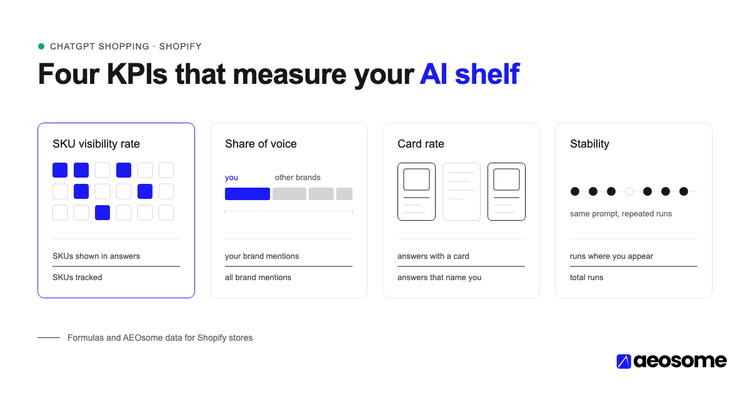
What does decide? First, the question. We asked ChatGPT 8,520 women's-dress questions across nine intent stages. A product card appeared on 93.0% of Purchase Execution questions and 2.8% of Post Purchase questions (AEOsome Research, 2026, Study 1).
Second, the model. In May 2026, across seven categories, ChatGPT showed a product card on 28.5% of shopping questions. That rate mixes ChatGPT's served models (AEOsome Research, 2026, Study 2). Its small model, gpt-5-3-mini, showed cards 3.7% of the time and gpt-5-5 65.3% (AEOsome Research, 2026).
What claiming can't change: in 8,520 women's-dress questions, ChatGPT showed products on 93.0% of purchase questions and 2.8% of post-purchase ones (AEOsome Research, 2026, Study 1). No listing setting moves that.
For the full mechanics, read how AI product discovery works.
What the ChatGPT Business Hub launch means for stores
The ChatGPT Business Hub launch gives stores control of their identity in ChatGPT and a first look at ChatGPT-side data. It does not replace product data work.
Three things improve:
- Correct details. You fix a wrong website, category or return policy at the source.
- First-party data. Mentions, views, clicks and topics come from OpenAI itself.
- A direct feed path. Stores outside Shopify can now upload products without a developer integration.
Three things stay the same:
- No placement boost. OpenAI says so in its terms.
- No ratings. Ratings appear on 73% of ChatGPT's product cards (AEOsome Research, 2026, Study 2). Claiming creates none: ratings come from real reviews of your products.
- Volatility. Asking the same question twice changed whether ChatGPT showed a product card in 42% of pairs. The served model was the cause (AEOsome Research, 2026). Judge Insights over 28 days, not one prompt. Here is why products appear one day and vanish the next.
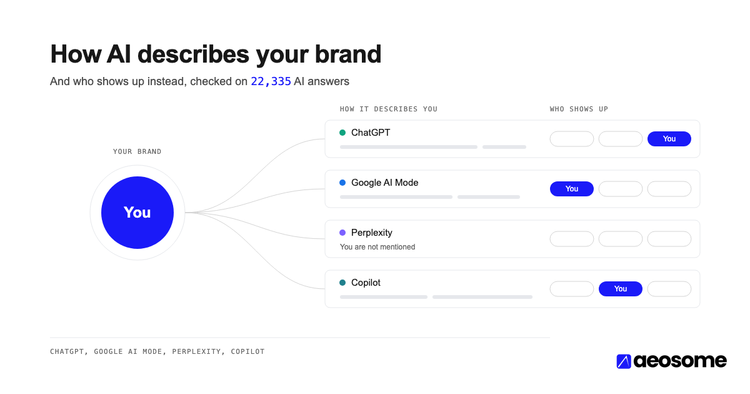
ChatGPT is also one shelf of several. In the same study, Google AI Mode showed product cards on 64.4% of shopping questions, more than double ChatGPT's blended 28.5% (AEOsome Research, 2026).
Business Hub fixes ChatGPT's copy of your details. Your other profiles still need to match, so read about fixing how AI describes your brand.
A Business Hub checklist for store owners
Claim, verify, correct, feed, check, then measure. If your feed already exists, most of this is quick.
- Claim your listing and verify it by Shopify or DNS TXT where you can.
- Pass the Persona identity check.
- Correct your website, description, category, logo, delivery and return policy so they match your site.
- Connect Shopify or upload your feed, with every required field filled.
- Spot-check five top products for the right price and stock.
- Write down the date, so you have an Insights baseline.
- Each month, compare discovery topics with your product pages, and add content where topics have no matching page.
A note on business agents. If you are a US eCommerce or online service business, you can create one. It answers questions about your products and policies in a labeled chat. It "cannot complete purchases, make bookings, or check a customer's order" and links shoppers to your site instead (OpenAI Help Center, 2026).
Frequently Asked Questions
Is ChatGPT Business Hub free?
Yes, for now. Business Hub and business agents are free during the beta, and OpenAI has not ruled out paid options later (Digiday, November 2026).
How much does a ChatGPT Business account cost, and do I need one?
You don't need one. ChatGPT Business is the paid team plan, renamed from Team in August 2025 (OpenAI Help Center). Business Hub is a separate listing tool, and claiming needs no paid plan.
Do Shopify stores need Business Hub to appear in ChatGPT?
No. Shopify products already reach ChatGPT through Shopify Catalog (OpenAI Help Center, 2026). Claim anyway to verify ownership, correct your details and see Insights.
Does claiming my business help my products rank in ChatGPT?
No. OpenAI says claiming "does not guarantee higher placement or sales" (OpenAI). Product cards depend on the question, the model and your product data.
What is a ChatGPT business agent?
It is a labeled chat that answers shopper questions about your products and policies. At launch it is limited to US eCommerce and online service businesses, and it cannot take orders or look them up (OpenAI Help Center, 2026).
Claimed. Now feed the shelf.
- Claiming is free. Shopify stores are already in through Shopify Catalog.
- The claim fixes who you are. Your product data decides what gets recommended.
- ChatGPT's 28.5% product card rate mixes models: 3.7% on gpt-5-3-mini, 65.3% on gpt-5-5 (AEOsome Research, 2026, Study 2).
- Re-asked questions flipped product cards in 42% of pairs, so read Insights over 28 days.
Insights counts mentions, not products. To see which of your SKUs actually appear across ChatGPT, Google AI Mode, Copilot and Perplexity, request a free AI citation check from AEOsome. Start with how to see how your brand appears in ChatGPT.
Methodology: Study 1 covers 8,520 ChatGPT answers to women's-dress questions from two served models, collected February 28 and March 1, 2026. Study 2 covers 22,335 de-duplicated answers (27,255 collected, 4,920 duplicate retries removed). They come from ChatGPT, Google AI Mode, Microsoft Copilot and Perplexity, collected May 5 to 14, 2026. Both are US, English, logged out. Full details are in Chapter 7: Methodology.
Retrieval note: OpenAI's Business Hub pages and help center change often during the beta. All OpenAI facts were checked on November 17, 2026.
Vijaya Kumar Channalli is a serial SaaS founder and the founder of AEOsome (Tartu, Estonia), which helps eCommerce brands get their products recommended when shoppers ask AI what to buy. Read how we write, source and correct posts in our editorial policy.