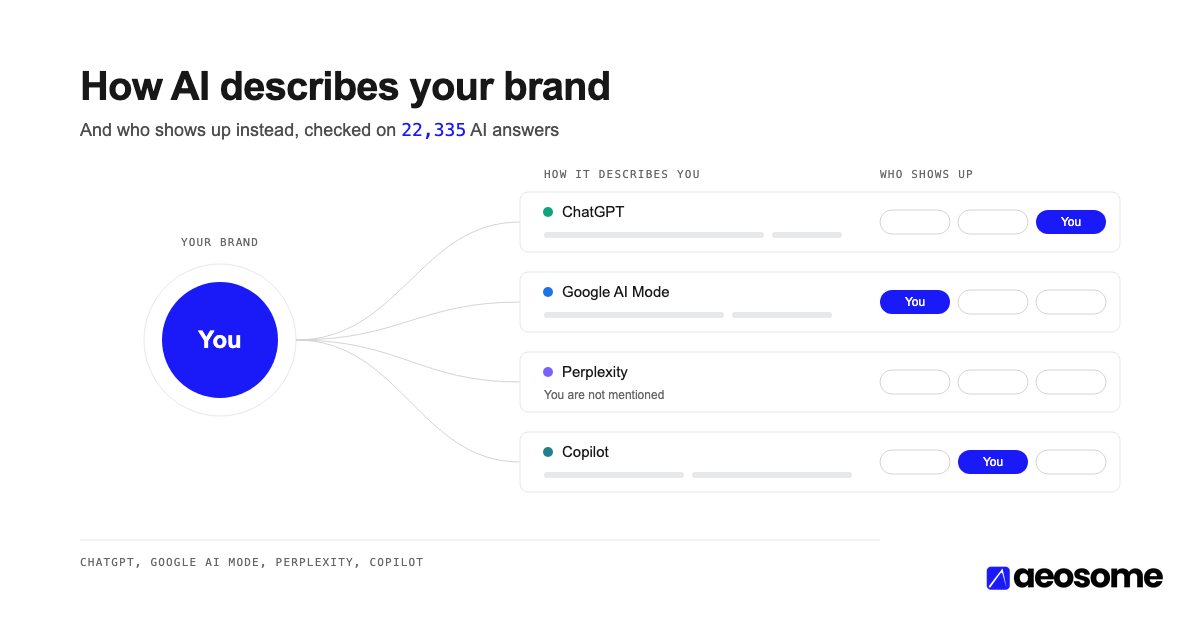
To see how your brand appears in AI answers, ask ChatGPT, Google AI Mode, Perplexity and Copilot the same shopping questions, several times each. Log whether you are mentioned, cited or shown in product cards, and which brands appear instead. One screenshot from one engine is not a measurement.
Key TakeawaysEngines disagree about brands: overlap is 0.42 for ChatGPT and Google AI Mode, and 0.29 for ChatGPT and Copilot (AEOsome Research, 2026).Between 18% and 41% of question pairs share no brand at all across two engines (AEOsome Research, 2026).Even when the shopper names your brand, other brands held 46% to 52% of the product slots on every engine (AEOsome Research, 2026).Re-asking the same question changes whether ChatGPT shows a product card in 42% of pairs (AEOsome Research, 2026).Google AI Mode's shopping sources are 35.1% community content, and Reddit appears in 51.8% of its answers (AEOsome Research, 2026).
Many store teams have never seen how AI answers describe their brand. They have seen one screenshot, from one engine, on one day. Our own Search Console shows merchants typing the worry as a full question: "why isn't my e-commerce brand showing up in chatgpt?"
AI brand visibility is how often, and in what form, AI engines mention, cite and recommend your brand. The answer changes by engine, by re-ask and by the model that served it. This guide gives you a repeatable check: what to ask, what to log, how often to run it, and who shows up instead.
It is part of AEO (Answer Engine Optimization), the work of getting your products into AI answers. The numbers come from our AI Shopping Visibility Study 2026: 22,335 answers from four engines.
In this article:
- Why don't most teams know how AI tools describe their brand?
- What does a gap in AI visibility actually cost?
- How to check how your brand appears in AI answers (step by step)
- What to track: mentions, citations and recommendations
- Which competitors show up instead, and why?
- What are communities saying about your brand that AI picks up?
- How often should you check, and what patterns show up over weeks?
- Frequently Asked Questions
- Check Four Engines, Not One Screenshot
Why don't most teams know how AI tools describe their brand?
Because there is no single answer to look at. Four engines put four different shelves in front of the shopper, and the same engine can change its answer when you ask again.
We asked the same shopping questions on ChatGPT, Google AI Mode, Copilot and Perplexity. Where two engines both showed product cards, we compared the brands they named. The overlap is modest (AEOsome Research, 2026). Chapter 2 of the study shows how the four engines disagree.
A Jaccard index of 0.42 means the shared brands make up 42% of all the brands the two engines named together. Between 18% and 41% of question pairs share no brand at all. Cited domains overlap even less, at 0.06 to 0.12 (AEOsome Research, 2026).
Our interpretation: a brand that checks one engine measures that engine, not AI. Presence on ChatGPT is evidence of presence on ChatGPT only.
Your analytics can't fill the gap. It records the clicks that arrived, not the answers where you were absent. Clicks also drop: Google users clicked a result in 8% of visits with an AI summary, against 15% without (Pew Research Center, 2025). Still track ChatGPT referral traffic in GA4. Just don't read it as visibility.
Citation Capsule: Where two AI engines both show product cards, their brand sets overlap by a Jaccard index of only 0.25 to 0.42. Between 18% and 41% of question pairs share no brand at all (AEOsome Research, 2026).
What does a gap in AI visibility actually cost?
The cost is the slot a competitor takes. An AI shopping answer holds a short list of products, and every slot you miss goes to another brand.
The list is short. On ChatGPT, the shelf fell from 8.0 products per carousel in our first study to 4.0 in the second (AEOsome Research, 2026). Four slots leave little room.
Branded questions leak too. When a shopper named a brand, that brand was present in 68.8% of card-bearing answers on Google AI Mode and 65.2% on ChatGPT. Other brands held 46% to 52% of the slots on every engine (AEOsome Research, 2026). It is one of the ten surprises in our AI shopping data.
What this means: your own brand name is not a safe question. A shopper who types it still sees competitors in about half of the slots. That is the first number your check should measure. For the reasons behind it, see why ChatGPT recommends your competitor's products.
Citation Capsule: A brand named in a shopping question was present in 68.8% of card-bearing answers on Google AI Mode and 65.2% on ChatGPT. Other brands held 46% to 52% of the slots on every engine (AEOsome Research, 2026, Study 2).
How to check how your brand appears in AI answers (step by step)
Build a fixed question set, ask every engine, ask each question more than once, and log the same fields every time. Then score rates, not screenshots.
- Write 20 to 40 questions the way shoppers ask them. Spread them across the nine shopping intent stages: exploration, comparison, budget, validation and the rest. Include 3 to 5 that name your brand and 3 to 5 that name a competitor.
- Ask on four engines. Use ChatGPT, Google AI Mode, Perplexity and Microsoft Copilot. Use a fresh, logged-out session where you can, and note the country. Our studies ran in the US only, so treat other markets as separate checks.
- Ask each question at least three times. Re-asks disagree. The card-or-no-card outcome matched 89.8% of the time on Google AI Mode, but only 57.6% on ChatGPT, across 3,519 retry pairs (AEOsome Research, 2026). ChatGPT agreed with itself 90.2% of the time on the same model, and 25.5% when the model switched. Note the model if the engine shows it.
- Log one row per answer. Use the same columns every time (see the log below).
- Score as rates. Count the share of asks where you hold a card and your share of all card slots. Add the share of asks where a competitor appears and you don't. Track these for each engine separately.
Here is the log we recommend. Copy it into a spreadsheet:
| Column | What to record |
|---|---|
| Engine and model | ChatGPT (model if shown), Google AI Mode, Perplexity, Copilot |
| Date and country | When and where you asked |
| Question and stage | The exact wording, plus its intent stage |
| Mentioned | Yes or no: is your brand named in the text? |
| Cited | Yes or no, plus the URL if one of your pages is a source |
| In product cards | Yes or no, plus your position in the strip |
| How you are described | One line, copied from the answer |
| Other brands | Every brand in the text and the cards |
| Cited domains | Every source domain the answer lists |
Three asks on four engines for 30 questions is 360 rows a month. In our experience running the studies, a fixed log beats any single screenshot.
What to track: mentions, citations and recommendations
Track all three, and keep them separate. A mention, a citation and a product-card recommendation are different outcomes with different inputs.
| Outcome | What it tells you | What moves it |
|---|---|---|
| Mention | The engine knows your brand and names it in text | Third-party coverage, reviews, community talk |
| Citation | One of your pages is a source for the answer | Indexable, quotable pages the engine retrieves |
| Recommendation | Your product sits in the cards, with a price and a link | Product data: feed, schema, availability |
Our interpretation from the study: being cited and being carded are different outcomes. ChatGPT shows cards in answers that cite no page at all (AEOsome Research, 2026). In our first ChatGPT study, the store hosting a carded product was among the cited sources for only 19.1% of slots.
Mentions overstate visibility. On ChatGPT in Study 2, 95.9% of card-bearing answers name at least one brand that is not on the shelf (AEOsome Research, 2026). A brand can be named and still sell nothing. A check that counts mentions only will look healthier than your sales. That's why a brand mention is not a product recommendation.
Citation Capsule: On ChatGPT, 95.9% of card-bearing shopping answers name at least one brand that is not among the product cards (AEOsome Research, 2026). Counting mentions alone overstates how often an engine actually recommends your products.
Which competitors show up instead, and why?
The competitor list is engine-specific. Read it per engine, then open the sources that engine cited for each answer you lost.
Each engine reads a different part of the web. Our interpretation: Google AI Mode reads the community web, Copilot the retail web, and ChatGPT and Perplexity the editorial web (AEOsome Research, 2026). The measured source mixes back that up:
- Google AI Mode: 35.1% of sources are community content (YouTube 13.0%, Reddit 12.1%).
- Copilot: 36.5% retail and 15.0% marketplace, with amazon.com alone at 12.4%.
- ChatGPT: 49.9% editorial, and 14.5% of its answers cite no source at all.
All three figures come from our study (AEOsome Research, 2026).
So "why is my competitor here and not me?" has a different answer on each engine. On Google AI Mode, look at the Reddit and YouTube pages it cited. On Copilot, look at which retailer listings carry your competitor. On ChatGPT, look at the review and editorial pages.
Compare descriptions too. Copy each engine's one-line description of you and of your top competitor into the log. Flag any wrong facts, such as an old price, a discontinued product or a wrong material. Then fix an AI answer that describes your brand wrong.
What are communities saying about your brand that AI picks up?
On some engines, a lot. Reddit appears in 51.8% of Google AI Mode's shopping answers, and far more often at certain intent stages.
Google AI Mode cites Reddit in 71% to 79% of its problem, comparison, validation and post-purchase answers. Copilot cites it in under 11% at every stage (AEOsome Research, 2026).
Our interpretation from that chapter, for comparison questions: the lever for a brand is third-party comparison content and community presence rather than product data. Your feed still decides whether you can be carded. Community threads shape what the answer says about you.
For each lost answer on Google AI Mode, open the cited threads and videos. Note what they say about you and about the competitor that won. Then join those conversations honestly, as the brand, with real answers. Don't plant reviews or fake posts: communities spot them, and the engines read the replies.
How often should you check, and what patterns show up over weeks?
Our advice, not a measured finding: run a small fixed sample weekly and the full question set monthly. Add a run after any visible model or feature change.
The evidence for repeating is strong. ChatGPT's card decision changed in 42% of re-ask pairs, and the cause was the served model, not the question (AEOsome Research, 2026). The shelf moved too. Between our two studies (February and May 2026), ChatGPT's brand-owned slots fell from 42.3% to 15.5%. Reddit went from 1.1% of Study 1's sources to 17.5% of gpt-5-5's (AEOsome Research, 2026).
Patterns worth watching in your log:
- Your card share holds on one engine but swings on another.
- A competitor enters at one intent stage, such as budget questions, and nowhere else.
- The cited domains shift, for example from editorial sites to forums.
- Your description changes wording after a product launch or price change.
For the mechanics behind day-to-day swings, read why products appear one day and vanish the next.
Frequently Asked Questions
What is AI brand visibility, and what should a check for it measure?
AI brand visibility is how often AI engines mention, cite and recommend your brand. A useful check measures each engine separately, repeats every question, keeps mentions, citations and product cards apart, and logs the competitors that appear. A single combined score hides all four.
Can I track my rank in ChatGPT like a Google rank tracker?
Not in the same way. ChatGPT's card decision changed in 42% of re-ask pairs (AEOsome Research, 2026). Track a rate over repeated asks, plus your position within the cards when you appear. One rank from one ask is a sample, not a position.
How do I know if my store appears in Google AI Overviews?
Use Search Console. Its generative AI performance reports show how often your URLs appeared in AI features, including AI Overviews and AI Mode (Google Search Central, 2026). Google rolled them out to all websites by August 31, 2026. Pair them with manual checks to see the wording and the competitors.
What will Search Console's AI reports show, and what won't they show?
They show impressions by page, country, device and date, from hourly to monthly. Google's announcement does not list queries, clicks or position for them. They cover Google only: nothing about ChatGPT, Perplexity, Copilot or your competitors. Google adds that pages in AI features are also counted in the regular Performance report (Google Search Central).
Do ads and community mentions affect AI recommendations?
Community content matters on some engines: Reddit appears in 51.8% of Google AI Mode's shopping answers (AEOsome Research, 2026). Ads are a separate layer. Google AI Mode showed ads in 3.9% of shopping answers in our study. We have not measured whether ads change which organic products get carded.
Why isn't my brand showing up when AI chatbots recommend products in my category?
Three common reasons. Your products aren't eligible for cards because of feed or schema gaps. Your brand is missing from the sources that engine reads. Or you appeared once and lost the slot on a re-ask. Work through how to diagnose why your products don't show up.
Check Four Engines, Not One Screenshot
AI engines don't agree on which brands to show. Where both show product cards, their brand lists overlap by only 0.25 to 0.42. Even on questions that name you, other brands take 46% to 52% of the slots (AEOsome Research, 2026). Ask every engine, ask more than once, and log who shows up instead.
For the wider playbook, read the complete AEO for eCommerce guide. Want this check run on your category? Request a free AI visibility and product-card check from AEOsome. We run it as Monitor → Audit → Optimize → Verify.
Methodology: Study 2 covers 22,335 de-duplicated answers (27,255 collected, 4,920 duplicate retries removed) from Google AI Mode, Copilot, ChatGPT and Perplexity. It spans 7 product categories and 9 intent stages, collected in the US from May 5 to 14, 2026. Study 1 covers 8,520 ChatGPT answers to women's-dress questions, collected on February 28 and March 1, 2026. Full details are in our methodology.
Retrieval note: Google's Search Console announcement and its AI features page can change. Both were retrieved on November 10, 2026.
Vijaya Kumar Channalli is a serial SaaS founder and the founder of AEOsome (Tartu, Estonia), which helps eCommerce brands get their products recommended when shoppers ask AI what to buy. Read how we write, source and correct posts in our editorial policy.