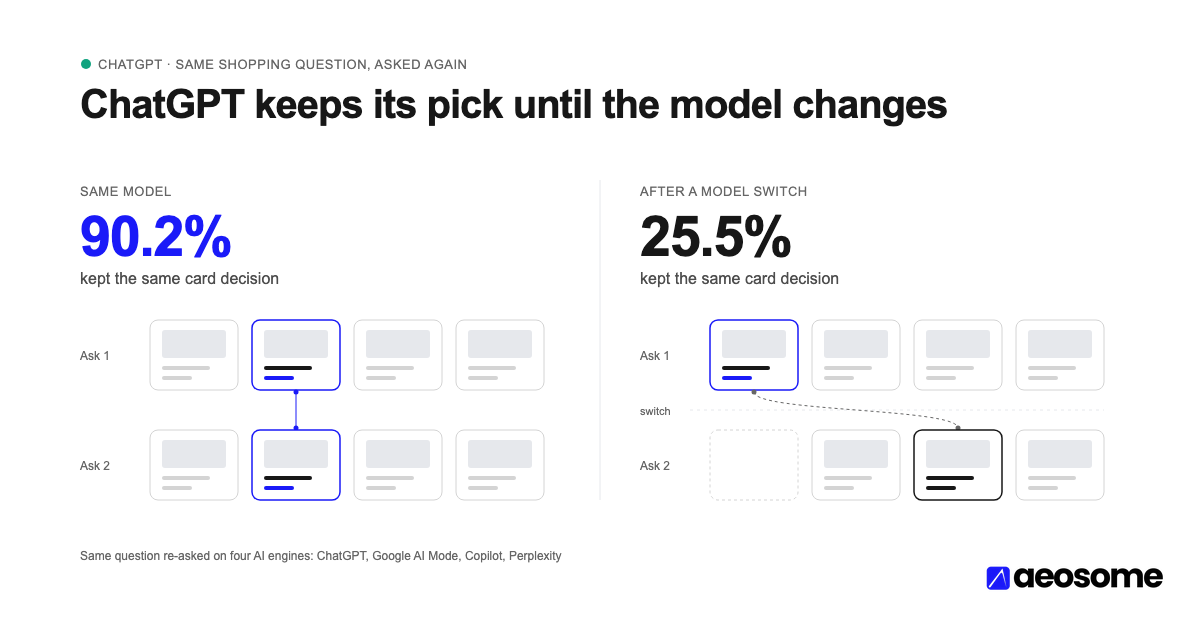
ChatGPT recommendations change mostly because ChatGPT routes each question to different models, and those models behave very differently on shopping. In AEOsome's re-ask test, ChatGPT kept its product-card decision 90.2% of the time on the same model. After a model switch, it kept it 25.5% (AEOsome Research, 2026, Study 2). One check is a sample, not a verdict.
You asked ChatGPT for the best option in your category on Monday. Your product sat in the carousel. On Tuesday you asked the same question and it was gone. Nothing in your store had changed.
That experience is common, and it is usually not your fault. We measured it. This post shows how often ChatGPT changes its shopping answer and the main reason why. It separates the two ways a product can "disappear," then covers what you control and how to measure.
TL;DR: If your product appears in ChatGPT one day and not the next, the most likely cause is not your store. The served model changes, and it decides whether a shelf appears at all. Even when products show both times, the products inside churn: overlap was just 0.06 (AEOsome Research, 2026, Study 2). Measure visibility as a rate over repeated asks, never from one check.
Key TakeawaysOn a re-ask, ChatGPT kept its card decision 57.6% of the time. Google AI Mode kept it 89.8%, Perplexity 86.4%, Copilot 75.4% (AEOsome Research, 2026, Study 2).ChatGPT's figure splits in two: 90.2% when the same model answered both times, 25.5% when the model switched (AEOsome Research, 2026, Study 2).One ChatGPT retry pair in five (19.8%) shared no brand at all (AEOsome Research, 2026, Study 2).Even when the outcome agreed, ChatGPT's product sets overlapped by only 0.06 (AEOsome Research, 2026, Study 2).60.4% of ChatGPT's answers came from gpt-5-3-mini, which showed a card in 3.7% of them. The gpt-5-5 model showed one in 65.3% (AEOsome Research, 2026, Study 2).
In this article:
- ChatGPT changes its shopping answer more than the other engines we tested
- The served model, not your store, explains most of the swing
- Routing changed by day, so "this week" can look like a drop
- Even when products show, the shelf reshuffles
- Brand mentions, citations and cards come from different sources
- What you can control when you drop out
- Measure visibility as a rate, not a screenshot
- Frequently Asked Questions
- One Answer Is a Sample
ChatGPT changes its shopping answer more than the other engines we tested
Ask the same shopping question twice and ChatGPT keeps its decision to show products far less often than Google AI Mode, Perplexity or Copilot.
In Study 2, some questions were asked more than once on the same engine. Those repeats give 3,519 retry pairs. For each pair we checked the card decision: did both answers show a product card, or did both show none?
A "product card" has a strict meaning here. An answer shows one when the engine's structured response contains at least one product object. A product named only in the text does not count (AEOsome Research, 2026, methodology).
The outcome agreed 89.8% of the time on Google AI Mode and 86.4% on Perplexity. Copilot reached 75.4%, and ChatGPT 57.6% (AEOsome Research, 2026, Study 2). Put another way, asking twice changes whether ChatGPT shows a card in 42% of pairs.
In short: ChatGPT is the least consistent of the four major AI shopping engines on a repeated question. In 3,519 retry pairs, its card decision matched 57.6% of the time, against 89.8% on Google AI Mode (AEOsome Research, 2026, Study 2).
For the full four-engine comparison, see Chapter 2 of our study, Four engines, one question.
The served model, not your store, explains most of the swing
ChatGPT is stable when the same model answers twice. It becomes unstable when the model switches.
OpenAI's release notes say ChatGPT's Auto mode routes each request to a model. For lightweight tasks it may use a mini model behind the scenes (OpenAI Help Center, Model Release Notes, retrieved 2026-11-02; the page changes over time). Our data shows what that routing does to shopping answers.
When the same model answered both asks, ChatGPT kept its card decision 90.2% of the time (439 pairs; AEOsome Research, 2026, Study 2). When the model switched, it kept it 25.5% of the time (444 pairs). On the same model, ChatGPT matched Google AI Mode's overall consistency (90.2% against 89.8%).
The models differ sharply on shopping. In Study 2, 60.4% of ChatGPT's answers came from gpt-5-3-mini, 30.1% from gpt-5-5 and 9.1% from gpt-5-3. The mini model showed a product card in 3.7% of answers (95% CI 3.1 to 4.4). The gpt-5-5 model showed one in 65.3%, and gpt-5-3 in 72.2% (AEOsome Research, 2026, Study 2).
On ChatGPT, the served model was the single strongest feature in our study. Its importance was 0.398, four times that of intent (AEOsome Research, 2026, Study 2). Our reading is that ChatGPT behaves like two products: a text engine and a shopping engine. That is our interpretation, not a separate measurement.
One caveat: the gpt-5-3 model answered only on May 5, for Electronics questions, so it is tangled up with that category. The clean contrast is gpt-5-3-mini against gpt-5-5, which shared days and categories.
What this means for you: If your product vanished, assume a model switch first. Re-ask on another day before you change anything, because a mini-model answer may simply show no shelf.
Routing changed by day, so "this week" can look like a drop
In our data, the model mix depended on the collection day, not on the question. A check on a different day can hit a different model.
Every intent and phrasing style received the same model mix (AEOsome Research, 2026, Study 2). All gpt-5-3 answers were collected on May 5 with the Electronics batch. The later days mixed the mini model and gpt-5-5.
ChatGPT showed cards in 59.5% of answers in Study 1 and 28.5% in Study 2. That gap is a routing artifact: on its full models, Study 2's card rate across seven categories is 66.9% (AEOsome Research, 2026). We also expect the 28.5% figure not to replicate, because the next run depends on that day's share of mini-model answers.
What this means for you: Before you conclude you lost ground, rule out a routing shift. This is what we observed in May 2026. Routing is OpenAI's to change, and it may behave differently now. For the wider study, see the AI Shopping Visibility Study 2026.
Even when products show, the shelf reshuffles
A stable "yes, show products" does not mean the same products. On ChatGPT, brand and product overlap between two asks of the same question is low.
We measure overlap with the Jaccard index. It is the share of items two lists have in common, out of all items in either list. Zero means nothing shared, one means identical.
When the card decision agreed, brand sets overlapped by 0.44 on ChatGPT, 0.49 on Copilot, 0.67 on Google AI Mode and 0.77 on Perplexity. Product sets overlapped by 0.06, 0.13, 0.23 and 0.70 (AEOsome Research, 2026, Study 2). One ChatGPT retry pair in five (19.8%) shared no brand at all.
| Engine | Re-ask agreement | Brand overlap | Product overlap |
|---|---|---|---|
| Google AI Mode | 89.8% | 0.67 | 0.23 |
| Perplexity | 86.4% | 0.77 | 0.70 |
| Copilot | 75.4% | 0.49 | 0.13 |
| ChatGPT | 57.6% | 0.44 | 0.06 |
Source: AEOsome Research, 2026, Study 2. Overlap is measured on retry pairs where the card decision agreed.
Study 1 confirms the pattern with a separate test. Its February ChatGPT models answered 1,286 pairs of identical question texts. They agreed on card versus no card 96.0% of the time, yet brand overlap was 0.25 and product overlap 0.06. In 15.5% of pairs, no brand was in common (AEOsome Research, 2026, Study 1).
"ChatGPT showed products again" does not mean "ChatGPT showed your products again." So there are two kinds of disappearing.
In short: A stable shopping answer can still swap the products inside it. When ChatGPT showed cards on both asks, the two product sets overlapped by just 0.06 (AEOsome Research, 2026, Study 2).
More unexpected results like this are in Chapter 5, Ten things we did not expect.
Brand mentions, citations and cards come from different sources
The brands ChatGPT names in its text, the pages it cites and the products on its shelf come from different places. In our reading, losing one does not mean you lost the others.
In Study 1, the host of a surfaced product was among the cited sources for 19% of 40,544 card slots. The median position was twelfth (AEOsome Research, 2026, Study 1). In Study 2, 95.9% of ChatGPT's card-bearing answers named at least one brand that was not on the shelf (AEOsome Research, 2026, Study 2).
Our hypothesis is that a product index supplies the cards, while retrieved pages supply the citations. Citations then justify the text and do not select the shelf. The pattern is confirmed. The mechanism is our hypothesis, not a measured result.
OpenAI's own description points the same way. ChatGPT considers structured metadata from first-party and third-party providers, such as price and product description. It also uses other third-party content (OpenAI Help Center, Shopping with ChatGPT Search, retrieved 2026-11-02).
What this means for you: Losing a citation is not the same as losing a product slot. Read why a brand mention is not a product recommendation.
What you can control when you drop out
You can't control routing. You can control whether your SKUs are eligible and competitive when a shopping-capable model answers.
Start with eligibility. Complete feed attributes, accurate price and availability, and valid structured data are the preconditions for a SKU to appear. OpenAI says ChatGPT draws on structured metadata such as price and description. Google documents these fields in its product structured data guide, built on the Schema.org Product type. Our product feed eligibility checklist covers the fields, and our guide to Product schema and GTINs covers the markup.
Then look at what decides position. Inside ChatGPT's carousel, the most-reviewed product leads 33.1% of the time, and the cheapest 9.4% (AEOsome Research, 2026, Study 1). See how reviews affect AI shopping rank for the detail. Our reading is that brand presence on the shelf is close to unpredictable from the question, while position is predictable from reviews.
Question type matters too. Even the mini model showed cards on 12.8% of Budget Framing questions, its best stage (AEOsome Research, 2026, Study 2). See why budget-framed questions win product slots.
What not to do:
- Don't rewrite product pages after one bad check.
- Don't chase wording tweaks. In our reading, the levers run platform, then intent, then category, then, far behind, wording.
For the full checklist when products never show, use our diagnostic guide for products missing from AI shopping results.
Measure visibility as a rate, not a screenshot
A single answer is a sample. Measure AI visibility by asking each question several times, on more than one day, per engine and, for ChatGPT, per served model.
Our view is that a visibility measurement needs repeated asks and should report a rate. It has to be split per engine, per intent stage and, for ChatGPT, per served model. Otherwise it measures routing noise (AEOsome Research, 2026).
A practical setup looks like this:
- Fix a question set that covers each shopping-intent stage, from first research to purchase.
- Ask each question repeatedly, across several days.
- Record the date, the engine and, where visible, the model.
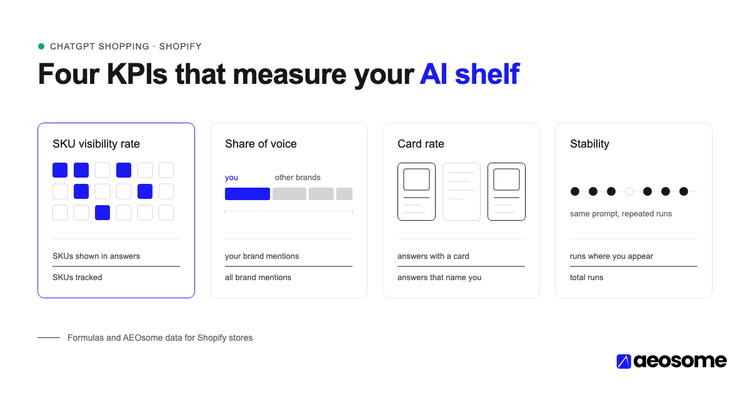
- Track two rates: the share of asks with any card, and the share with your SKU.
- Compare week over week on the same basis, never against a one-off check.
Pair this with on-site data and track ChatGPT traffic in GA4 to see visits next to visibility. Our own loop runs Monitor → Audit → Optimize → Verify on the same principle: verify with repeated asks, not one answer. If the terms are new, start with what AEO (Answer Engine Optimization) is.
Frequently Asked Questions
Why does ChatGPT recommend different products every time I ask?
Two reasons. ChatGPT routes questions to different models, and the products inside a shopping answer churn even when the model stays the same. One ChatGPT retry pair in five (19.8%) shared no brand at all (AEOsome Research, 2026, Study 2).
Did I do something wrong if my product disappeared from ChatGPT?
Not necessarily. ChatGPT kept its card decision 90.2% of the time on the same model and 25.5% after a model switch (AEOsome Research, 2026, Study 2). Re-ask on other days to rule out routing, then check your product data.
Does ChatGPT switch models without telling me?
OpenAI says ChatGPT's Auto mode routes each request to a model and may use a mini model for lightweight tasks. So two asks of the same question can reach different models. In Study 2, 60.4% of ChatGPT's shopping answers came from gpt-5-3-mini (AEOsome Research, 2026, Study 2).
Is Google AI Mode more consistent than ChatGPT for shopping?
Yes on the outcome: 89.8% re-ask agreement against 57.6% on ChatGPT. Its brand overlap between asks is also higher, 0.67 against 0.44 (AEOsome Research, 2026, Study 2).
How many times should I re-ask a question to measure visibility?
There is no magic number. Repeat each question across several days, so you can report a rate. Our own studies use thousands of answers (22,335 in Study 2) to keep platform-rate margins near 1.2 points (AEOsome Research, 2026, methodology).
One Answer Is a Sample
Methodology: Study 2 collected 27,255 answers from ChatGPT, Google AI Mode, Microsoft Copilot and Perplexity, May 5 to 14, 2026. They answered 5,584 questions across seven categories. We kept one answer per question and engine, which gives 22,335 answers (4,920 duplicate retries removed). The retries form the 3,519 re-ask pairs. ChatGPT's answers came from gpt-5-3-mini, gpt-5-5 and gpt-5-3.
Study 1 holds 8,520 ChatGPT answers to women's-dress questions, collected February 28 and March 1, 2026, with 1,286 pairs of identical question texts. All answers are US, English and logged out, captured from consumer web interfaces, with no developer API. Read the full methodology.
Three numbers carry the story. ChatGPT kept its card decision 57.6% of the time on a re-ask. That splits into 90.2% on the same model and 25.5% after a switch. And when products showed both times, the product sets overlapped by just 0.06.
Want to see your own rate instead of a screenshot? Get a free AEOsome AI citation check that re-asks your category's questions across engines and reports how often your products appear.
Vijaya Kumar Channalli is a serial SaaS founder and the founder of AEOsome (Tartu, Estonia), which helps eCommerce brands get their products recommended when shoppers ask AI what to buy. Read how we write, source and correct posts in our editorial policy.