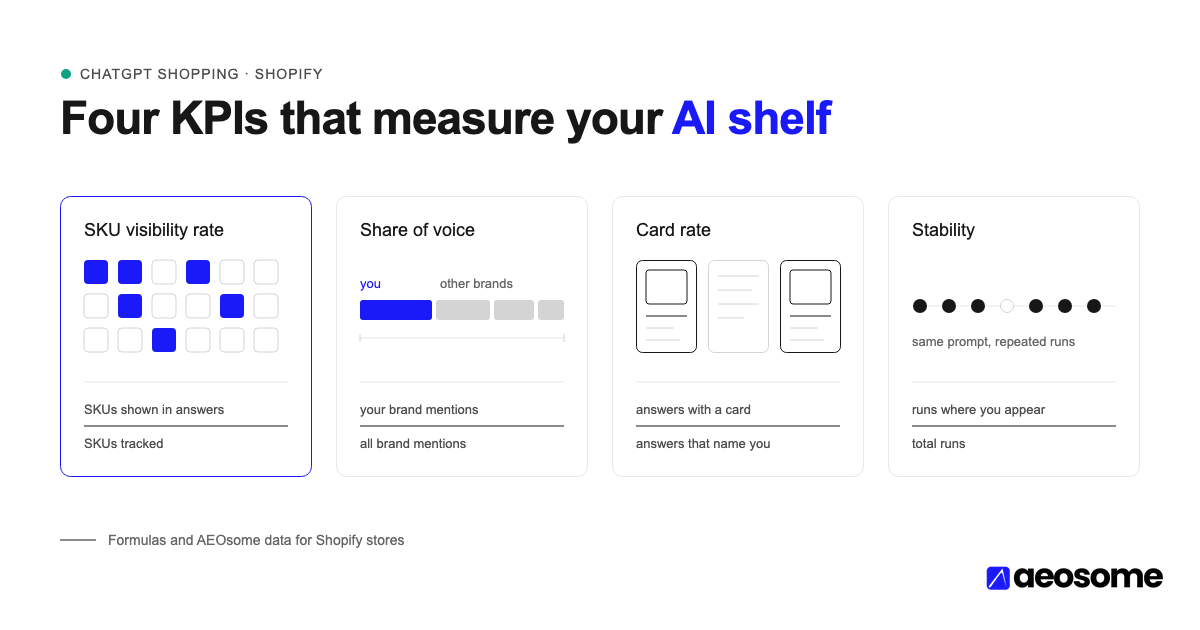
The core ChatGPT Shopping KPIs are five rates: card rate, SKU visibility rate, share of voice, position-one rate and stability. Card rate asks whether a shelf exists. The others ask whether your SKU is on it, how much you hold, whether you lead and whether the number holds. Report each by engine and intent stage.
Key TakeawaysIn May 2026, ChatGPT showed a product card on 28.5% of shopping questions, a blend of three served models. Google AI Mode showed one on 64.4% (AEOsome Research, 2026, Study 2).Asking the same question twice changed whether ChatGPT showed a product card in 42% of pairs. The cause was the served model, not the question (AEOsome Research, 2026, Study 2).One ChatGPT retry pair in five (19.8%) shared no brand at all (AEOsome Research, 2026, Study 2).On ChatGPT, 95.9% of card-bearing answers name at least one brand that is not on the shelf, so mention counts overstate visibility (AEOsome Research, 2026, Study 2).The most-reviewed product takes position one 33.1% of the time, 2.6 times the 12.5% base rate (AEOsome Research, 2026, Study 1).
On Monday you screenshot your product in a ChatGPT carousel. On Tuesday you ask the same question and it's gone. Both screenshots are true. Neither is a measurement.
GA4 shows ChatGPT referrals after someone clicks. Nothing in Shopify admin shows whether you were on the shelf before the click. That gap is what visibility KPIs fill.
This page defines the numbers, gives each one a formula, and shows from our own data why a single ask can't be trusted. It is part of AEO (Answer Engine Optimization): getting your products recommended inside AI answers. The unit that matters is SKU-level visibility, meaning whether a specific product or variant appears, not whether your brand is named (see SKU visibility, defined).
In this article:
- What KPIs should a Shopify store track for ChatGPT Shopping?
- What is SKU visibility rate and how do you calculate it?
- What is share of voice in AI shopping?
- Why is one ChatGPT answer not a measurement?
- Should you measure by intent stage and by engine?
- Is being mentioned the same as being recommended?
- What moves your position once you are on the shelf?
- Frequently asked questions
- Methodology
- Measure the shelf, not the screenshot
What KPIs should a Shopify store track for ChatGPT Shopping?
Track five rates, each with an explicit denominator. A product card is a structured product object inside the answer. A product named only in the text does not count (AEOsome Research, 2026).
| KPI | Formula | Question it answers |
|---|---|---|
| Card rate | Asks with at least one product card ÷ all asks in your question set | Does a shelf exist for these questions? |
| SKU visibility rate | Asks where your SKU appears in the cards ÷ all asks | Are you on the shelf? |
| Share of voice | Your card slots ÷ all card slots in the set | How much of the shelf do you hold? |
| Position-one rate | Your slots at rank one ÷ all your slots | Do you lead the shelf when you're on it? |
| Stability | Repeat-ask pairs with the same outcome for your SKU ÷ all repeat-ask pairs | Can you trust this week's number? |
These five sit before the click. After it, the business link is referral sessions and revenue. You can track ChatGPT referral traffic in GA4. Google announced an "AI Assistant" channel on May 13, 2026, for traffic from ChatGPT, Gemini and Claude (Google Analytics Help, retrieved 2026-11-07).
What is SKU visibility rate and how do you calculate it?
SKU visibility rate is the share of asks in which a specific SKU or variant appears in the product cards. Count it over a fixed question set, repeated several times. Fix the questions first. Changing them between weeks changes the denominator, not your visibility.
Here is an illustrative example, not data. You write 40 shopping questions for your category and ask each one 3 times. That gives 120 asks. Your SKU appears in the cards on 18 of them. Your SKU visibility rate is 18 ÷ 120 = 15%.
Report a second version over card-bearing asks only. If 48 of the 120 asks showed any cards, your rate there is 18 ÷ 48 = 37.5%. The first number blends two problems. The second separates "no shelf" from "not on the shelf".
That split matters because engines differ so much. In Study 2, Google AI Mode showed a card on 64.4% of shopping questions, Copilot 44.5%, ChatGPT 28.5% and Perplexity 5.0% (AEOsome Research, 2026, Study 2).
Within ChatGPT, the served model sets the shelf. 60% of ChatGPT's answers came from gpt-5-3-mini, which showed a card 3.7% of the time (95% CI 3.1 to 4.4). The full models showed one 65.3% (gpt-5-5) and 72.2% (gpt-5-3) of the time (AEOsome Research, 2026, Study 2). A falling SKU visibility rate can be routing, not your catalog.
Measure the SKU, not the brand. A brand can appear while the variant a shopper wants does not. Start with variant-level product schema and GTINs and checkout-ready SKUs.
What is share of voice in AI shopping?
Share of voice is your card slots divided by all card slots across the question set. It measures how much of the shelf you hold. It does not measure whether you were mentioned.
Illustrative again: those 48 card-bearing answers hold 192 slots. You hold 20 of them, because two of your variants sometimes share one answer. Your share of voice is 20 ÷ 192, about 10.4%.
Shelf size changes the math. ChatGPT's shelf held 8.0 products per carousel in Study 1 and 4.0 in Study 2 (AEOsome Research, 2026). The same number of slots for you means twice the share on the shorter shelf.
Category structure sets what a realistic share looks like. Electronics is the only concentrated category: Samsung, Apple, Sony, LG and Google take 29% of its slots. Its brand HHI (a standard concentration index) is 0.044, twice the next category. Inside it, Smartphones reaches 0.185. Beauty and Health are the flattest, with no brand above 20% of any subcategory (AEOsome Research, 2026, Study 2).
Our interpretation: flat shelves reward presence at the right stage. Concentrated shelves reward displacing a named incumbent at a specific stage (AEOsome Research, 2026). You also share the shelf with retailers. ChatGPT and Google AI Mode both lead with Walmart, at about 11% of slots (AEOsome Research, 2026, Study 2).
Why is one ChatGPT answer not a measurement?
Answers change between asks, so a KPI needs repeated asks and must be reported as a rate. That is our interpretation of the stability data below (AEOsome Research, 2026). It is why every KPI above is a rate over a fixed, repeated question set.
We re-asked questions and compared 3,519 retry pairs. The card-or-no-card outcome agreed 89.8% of the time on Google AI Mode, 86.4% on Perplexity, 75.4% on Copilot and 57.6% on ChatGPT (AEOsome Research, 2026, Study 2).
ChatGPT's figure is really two figures. Agreement was 90.2% when the same model answered both times (439 pairs). It fell to 25.5% when the model switched (444 pairs; AEOsome Research, 2026, Study 2).
The contents move even when the outcome holds. When ChatGPT's outcome agreed, brand sets overlapped by 0.44 and product sets by just 0.06. One ChatGPT retry pair in five (19.8%) shared no brand at all (AEOsome Research, 2026, Study 2).
Citation Capsule: Asking ChatGPT the same shopping question twice changes whether it shows a product card in 42% of pairs. The cause is the served model, not the question (AEOsome Research, 2026, Study 2).
What this means for you: ask each question more than once, on different days. Log the served model where it's visible. Never compare a Monday screenshot with a Tuesday one and call it a trend.
Should you measure by intent stage and by engine?
Yes. A blended number hides where you are absent. Our reading of the data is that the levers are ordered: platform, then intent, then category, then, far behind, wording (AEOsome Research, 2026).
Intent stage swings the card rate more than most merchants expect. We group shopping questions into nine intent stages, from Problem Recognition to Post Purchase (AEOsome Research, 2026). Budget Framing leads on every engine: 54.8% pooled across four engines and 47.0% on ChatGPT. Post Purchase trails everywhere, at 14.7% pooled (AEOsome Research, 2026, Study 2).
So segment SKU visibility rate by stage. Budget-framing questions get the most product cards, so a store that only tests "best X under $Y" questions will overstate its visibility.
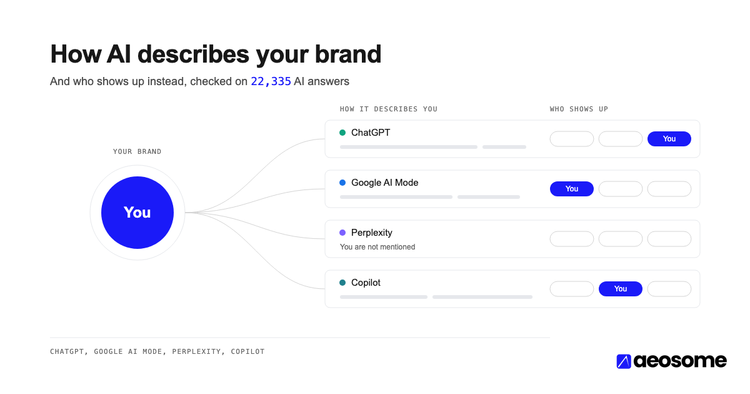
Engines disagree too. Of 5,583 questions asked on all four engines, 1.6% got a product card on all four and 21.9% on none (AEOsome Research, 2026, Study 2). Our interpretation: a brand that measures its AI visibility on one engine measures that engine, not AI.
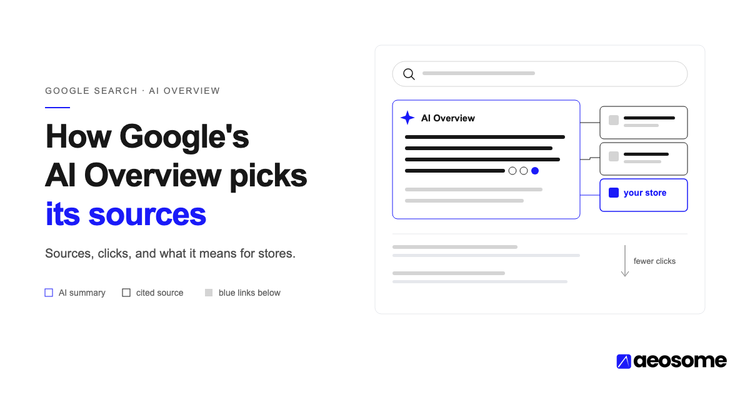
Google's own documentation says something similar about its two AI surfaces. "AI Mode and AI Overviews may use different models and techniques, so the set of responses and links they show will vary" (Google Search Central, retrieved 2026-11-07).
Is being mentioned the same as being recommended?
No. Track card presence, not text mentions. A brand named in the answer text is often not on the shelf the shopper can buy from.
On ChatGPT in Study 2, 95.9% of card-bearing answers name at least one brand that is not on the shelf. Only 21.8% of the brands Perplexity names in its text reach its cards (AEOsome Research, 2026, Study 2).
Cards don't come from the cited pages either. The host of a surfaced product is among the cited sources for 19% of Study 1's 40,544 card slots. That pattern is confirmed; why it happens is still a hypothesis (AEOsome Research, 2026, Study 1).
Citation Capsule: On ChatGPT, 95.9% of card-bearing shopping answers name at least one brand that is not in the product cards. Mention share is not shelf share (AEOsome Research, 2026, Study 2).
Our interpretation: being cited and being carded are different outcomes with different inputs (AEOsome Research, 2026). Citation counts are a valid KPI for content. They are the wrong KPI for a purchasable SKU.
What moves your position once you are on the shelf?
Reviews and rating predict rank inside the carousel. Rating does not predict presence across carousels (AEOsome Research, 2026, Study 1, ChatGPT).
In Study 1, the most-reviewed product in a carousel took position one 33.1% of the time, 2.6 times the 12.5% base rate. The cheapest product took it 9.4% of the time, below base (AEOsome Research, 2026, Study 1).
Per within-carousel standard deviation, rating multiplied the odds of rank one by 2.12, review count by 1.69 and price by 1.38. Price pointed toward the pricier product (AEOsome Research, 2026, Study 1).
Presence is a different story. Across the 110 Study 1 brands with at least 50 slots, average rating and carousel count correlate negatively (Spearman −0.24; AEOsome Research, 2026, Study 1). So position-one rate and share of voice need different fixes. For more on ratings, see whether reviews move ChatGPT rank.
Frequently asked questions
How many times should I ask ChatGPT the same question to measure visibility?
More than once, and on different days. ChatGPT kept its card decision in only 57.6% of retry pairs (AEOsome Research, 2026, Study 2). We don't publish a magic number of asks. Report the rate together with the number of asks behind it.
Can I see ChatGPT Shopping impressions in Shopify or GA4?
Not shelf impressions. GA4 reports sessions once a shopper clicks through, and Shopify describes its ChatGPT channel as "a discovery-focused referrer platform" (Shopify Help Center, retrieved 2026-11-07). That page describes no shelf-impression reporting, and GA4 sees only the click. That's why visibility KPIs are measured by asking.
What is a good SKU visibility rate for a Shopify store?
There is no universal benchmark. It depends on your category's concentration and on the intent stage. Electronics brands compete on a concentrated shelf, while in Beauty no brand holds more than 20% of any subcategory (AEOsome Research, 2026, Study 2). Benchmark against your own baseline.
Do I need to track Google AI Mode and Copilot too, or just ChatGPT?
Track all four if you want "AI" numbers rather than "ChatGPT" numbers. Only 1.6% of questions got a product card on all four engines (AEOsome Research, 2026, Study 2). To set up the question set, run a visibility audit of your catalog.
Methodology
Study 1 holds 8,520 ChatGPT answers to women's-dress questions, collected on February 28 and March 1, 2026. Study 2 collected 27,255 answers from ChatGPT, Google AI Mode, Microsoft Copilot and Perplexity, May 5 to 14, 2026. We kept one answer per question and engine, removing 4,920 duplicate retries and leaving 22,335 answers across seven categories.
The stability figures compare 3,519 retry pairs: the same question asked again on the same engine. All answers are US English, logged out, and captured from consumer web interfaces. No developer API was used. Full detail is in the methodology chapter.
Measure the shelf, not the screenshot
In May 2026, ChatGPT showed a product card on 28.5% of shopping questions, a blend of three served models. Re-asking flipped that outcome in 42% of pairs. And 95.9% of its card answers named a brand that wasn't on the shelf (AEOsome Research, 2026, Study 2). A screenshot can't carry numbers like these. A fixed question set, asked repeatedly and reported as rates, can.
Want to know your SKU visibility rate and share of voice across ChatGPT, Google AI Mode, Copilot and Perplexity? Request a free AI shopping visibility check from AEOsome, the first step of a Monitor → Audit → Optimize → Verify loop.
Vijaya Kumar Channalli is a serial SaaS founder and the founder of AEOsome (Tartu, Estonia), which helps eCommerce brands get their products recommended when shoppers ask AI what to buy. Read how we write, source and correct posts in our editorial policy.