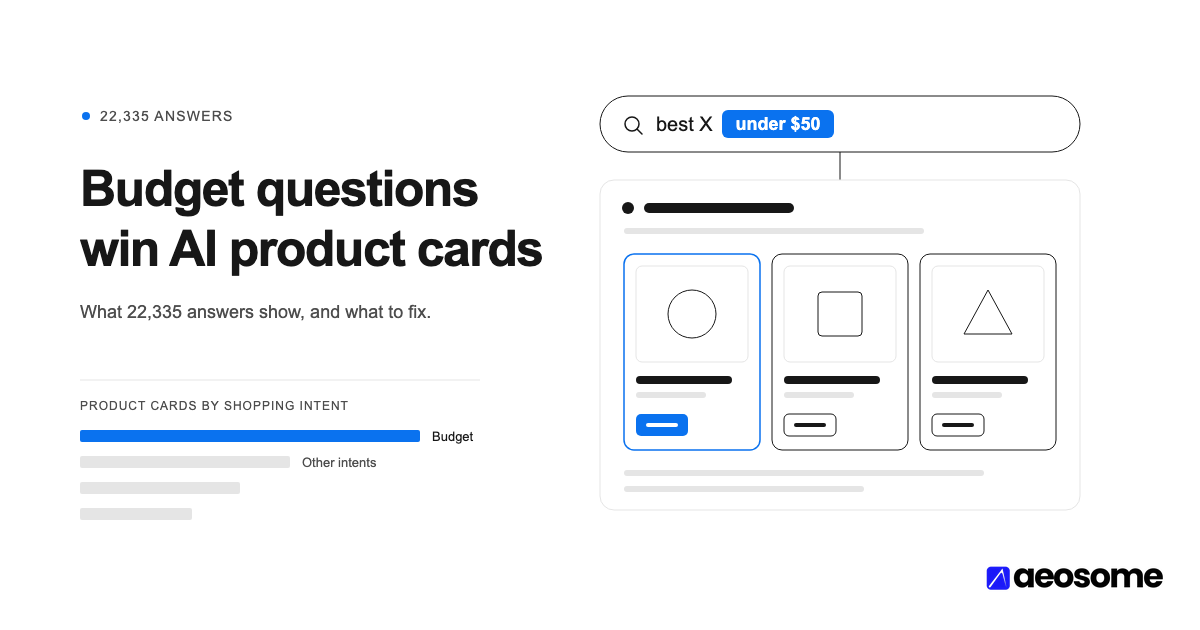
"Best X under $Y" questions are the shopping intent most likely to get a product card. ChatGPT showed one on 47.0% of them, and four engines pooled reached 54.8% (AEOsome Research, 2026, Study 2). But the cap isn't a filter: 27.0% of ChatGPT's surfaced products exceeded it. Readable prices get you on the shelf. Ratings beat price for the top slot.
Key findings from 22,335 AI shopping answersBudget Framing is the top intent stage on every engine: 54.8% pooled, against 14.7% for Post Purchase (AEOsome Research, 2026, Study 2).Only 2.6% of budget questions got no product card on any of the four engines (AEOsome Research, 2026, Study 2).27.0% of the products ChatGPT surfaced were priced above the shopper's stated cap (AEOsome Research, 2026, Study 2).ChatGPT names a single pick in 63.0% of budget answers, its highest share at any stage (AEOsome Research, 2026, Study 2).The cheapest product leads ChatGPT's carousel only 9.4% of the time; the most-reviewed leads 33.1% (AEOsome Research, 2026, Study 1).
A shopper types "best running shoes under $100" into ChatGPT. Few shopping questions are more likely to get a product shelf. Your product either has a price ChatGPT can read, or it isn't on that shelf.
Budget is a first-class input in ChatGPT shopping research. OpenAI's own launch post says the feature asks clarifying questions "about things like your budget" before it builds a buyer's guide (OpenAI, November 24, 2025).
This post covers one shopping intent: the price-capped question. We measured it across two studies and four engines. It is one part of AEO (Answer Engine Optimization): getting your products recommended inside AI answers. For the wider picture, see the complete guide to AEO for eCommerce.
In this article:
- Budget questions earn more product cards than any other shopping intent
- On ChatGPT, the full models show a budget shelf almost every time
- ChatGPT doesn't treat "under $X" as a hard filter
- Budget shelves are cheap, decisive and retailer-heavy
- Being cheapest doesn't win the top slot
- How Shopify merchants can compete for budget-framed questions
- Frequently asked questions
- Methodology
- The budget shelf is the busiest shelf
Budget questions earn more product cards than any other shopping intent
Across 22,335 de-duplicated answers, Budget Framing is the top intent stage, at 54.8% pooled across four engines. Post Purchase trails at 14.7% (AEOsome Research, 2026, Study 2).
Budget Framing is one of the nine intent stages of AI shopping we track. It covers any question that names a price limit. It leads on every engine: Google AI Mode 88.6%, Copilot 69.2%, ChatGPT 47.0% and Perplexity 14.2%. That 14.2% is Perplexity's best stage (AEOsome Research, 2026, Study 2).
Coverage is nearly universal. 97.4% of budget questions got a card on at least one engine, and 5.6% on all four. Only 2.6% got no card anywhere, against 57.1% at Post Purchase (AEOsome Research, 2026, Study 2).
Our regression model agrees. Relative to Attribute Constrained questions, Budget Framing has an odds ratio of 1.24 for a card. It is the only stage above 1 (AEOsome Research, 2026, Study 2).
Citation Capsule: Budget Framing is the intent stage most likely to earn a product card on all four engines AEOsome tested: 54.8% pooled across 2,000 Study 2 answers, against 14.7% at Post Purchase (AEOsome Research, 2026).
What this means for you: a stated price is the clearest buying signal a shopper sends an AI engine. If your catalog has no machine-readable prices, you are absent from the busiest shelf. For the general mechanism, see how AI product discovery works.
On ChatGPT, the full models show a budget shelf almost every time
ChatGPT's 47.0% average hides model routing. Its full models showed cards on budget questions 98% to 100% of the time. The small gpt-5-3-mini model reached 12.8%, its best stage (AEOsome Research, 2026, Study 2).
Routing matters because the small model is common. 60% of ChatGPT's Study 2 answers came from gpt-5-3-mini. Routing varied by collection day, not by query: every intent and style got the same mix (AEOsome Research, 2026, Study 2).
Study 1 points the same way. On 1,080 budget questions about women's dresses, ChatGPT showed a carousel 88.8% of the time (AEOsome Research, 2026, Study 1). Its two served models had the same overall carousel rate, so routing did not distort that study.
| Engine | Budget Framing card rate (Study 2) |
|---|---|
| Google AI Mode | 88.6% |
| Copilot | 69.2% |
| ChatGPT | 47.0% |
| Perplexity | 14.2% |
| Pooled, four engines | 54.8% |
What this means for you: you can't choose which model answers a shopper. You can make sure your product is eligible whenever the shelf appears. Start with the product feed eligibility checklist for AI shopping.
ChatGPT doesn't treat "under $X" as a hard filter
When the shopper names a maximum price, 14.3% of the products ChatGPT surfaced in Study 1 exceeded it. That covers 20,162 priced slots with a median cap of $150. 26.7% of carousels held at least one over-cap product (AEOsome Research, 2026, Study 1).
Study 2 shows a wider gap. In its six tagged categories, 27.0% of ChatGPT's surfaced products exceeded the stated cap. Copilot reached 23.3% and Google AI Mode 18.8% (AEOsome Research, 2026, Study 2).
These are not near misses. Of Study 1's 14.3 points, 10.0 are products priced at 1.5 times the cap or more (AEOsome Research, 2026, Study 1). Our interpretation, not a measured result: the engines treat a cap as a ranking preference, not a filter.
OpenAI says as much about its own feature. Shopping research "might make mistakes about product details like price and availability" (OpenAI, November 24, 2025).
Citation Capsule: When shoppers state a maximum price, ChatGPT does not filter by it. In AEOsome's Study 1, 14.3% of 20,162 priced product slots exceeded the cap, most by 1.5 times or more. In Study 2, 27.0% of ChatGPT's surfaced products did (AEOsome Research, 2026).
What this means for you: a correct, structured price matters more, not less. If ChatGPT reads a stale or missing price, your in-budget product competes with over-budget ones on a broken signal.
Budget shelves are cheap, decisive and retailer-heavy
Budget cards are the cheapest of any intent stage, with medians from $21 to $32 across engines. ChatGPT's median budget card is $32 (AEOsome Research, 2026, Study 2). Perplexity is excluded because some of its prices are not in dollars.
ChatGPT commits on these questions. It names a single pick in 63.0% of budget answers, its highest share at any stage (AEOsome Research, 2026, Study 2).
It also cites less. ChatGPT answers budget questions with no cited source 29.0% of the time, its highest share at any stage (AEOsome Research, 2026, Study 2). Your product data carries the answer on its own.
The shelf leans toward big retailers. Walmart hosts 17% of ChatGPT's budget slots, while only 10.5% sit on a brand-owned store (AEOsome Research, 2026, Study 2). In Health, three store brands lead budget questions: Great Value, Equate and up&up (AEOsome Research, 2026, Study 2). That cell is small, so treat it as suggestive.
Our reading is that on three of four engines, a "$X" question gets a Walmart, Target or Amazon private-label answer (AEOsome Research, 2026, Study 2).
Citation Capsule: On budget questions, ChatGPT names a single pick in 63.0% of answers, and only 10.5% of its budget product slots sit on a brand-owned store. Walmart hosts 17% (AEOsome Research, 2026, Study 2).
What this means for you: a DTC Shopify store competes with big-box private labels here. The 10.5% brand-owned share is the realistic opening. When ChatGPT names one pick, being first is worth far more than being fifth. Some shoppers can buy a single pick without leaving ChatGPT.
Being cheapest doesn't win the top slot
Inside ChatGPT's carousel, rating multiplies the odds of rank one by 2.12 per standard deviation. Review count multiplies them by 1.69. Price multiplies them by 1.38, in the direction of the pricier product (AEOsome Research, 2026, Study 1).
The simple counts match. The cheapest product leads the carousel 9.4% of the time. The most-reviewed product leads 33.1% (AEOsome Research, 2026, Study 1). These rank effects come from all Study 1 carousels, not budget questions alone.
What this means for you: don't race to the bottom of the price band. Aim for the best-rated product just under the cap. For the detail on ratings, read how reviews affect AI carousel rank.
How Shopify merchants can compete for budget-framed questions
Make your price unambiguous to machines, cover the price bands shoppers actually name, and earn the ratings that order the shelf. These are recommendations drawn from the findings above. We have not measured them as interventions.
1. Publish price as structured data. Every product page needs an Offer with price, priceCurrency and availability, as defined by schema.org. The values should match your feed and the visible page. Our guide covers price and availability in your product schema.
{
  "@context": "https://schema.org",
  "@type": "Product",
  "name": "Trail Runner 2",
  "offers": {
    "@type": "Offer",
    "price": "89.00",
    "priceCurrency": "USD",
    "availability": "https://schema.org/InStock"
  }
}
2. Expose every variant's real price. A $45 variant shouldn't hide behind a $70 default. Set up variant-level prices an AI agent can read.
3. Use compare-at prices honestly. Since October 9, 2026, Shopify's Catalog API returns a variant's compare-at price as list_price. Agents can use it to tell when a product is marked down, and by how much (Shopify developer changelog, 2026). An inflated compare-at price now reaches AI agents directly.
4. Test price-band collections. Pages like "Running shoes under $100" match the way shoppers phrase these questions. Treat them as a hypothesis worth testing. Our data measures shopper questions, not merchant pages.
5. Test both phrasing styles. A stated price or price word raises the odds of a carousel 1.74 times (95% CI 1.54 to 1.97; AEOsome Research, 2026, Study 1). But conversational phrasing cut Study 1's Budget Framing carousel rate from 93% to 100% down to 62.5% (AEOsome Research, 2026, Study 1). The shopper's wording helps decide whether a shelf appears at all. Run short and conversational versions of your budget prompts in every audit.
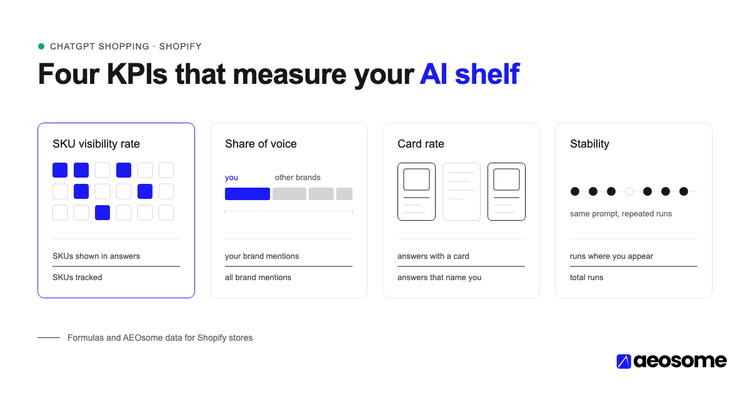
6. Measure by price band. Run budget-framed prompts in a visibility audit, and track SKU visibility rate by price band.
Frequently asked questions
Does ChatGPT actually respect a price limit like "under $50"?
Not as a hard limit. 27.0% of the products ChatGPT surfaced were priced above the stated cap (AEOsome Research, 2026, Study 2). Our reading is that it treats the number as a ranking preference.
Should I build "under $X" collection pages on my Shopify store?
It is a reasonable test. Budget questions are the highest-card intent stage on every engine (AEOsome Research, 2026, Study 2). We have not measured whether a page-level change lifts visibility, so track results before and after.
Why does ChatGPT show Walmart and store brands for cheap product questions?
Big retailers lead the budget shelf. Walmart hosts 17% of ChatGPT's budget slots in Study 2 (AEOsome Research, 2026). In Health, store brands such as Great Value lead budget questions, a suggestive finding from a small cell.
Does being the cheapest product help me rank first in ChatGPT's carousel?
Rarely. The cheapest product leads only 9.4% of the time in Study 1. Rating and review count predict rank one far more strongly than a low price (AEOsome Research, 2026, Study 1).
Do budget questions get product cards on Google AI Mode and Perplexity too?
Yes. Budget Framing reached 88.6% on Google AI Mode and 14.2% on Perplexity, which is Perplexity's best stage (AEOsome Research, 2026, Study 2).
Methodology
Study 1 holds 8,520 ChatGPT answers to women's-dress questions, collected on February 28 and March 1, 2026. It includes 1,080 budget questions, answered by two served models with the same overall carousel rate. Study 2 collected 27,255 answers from ChatGPT, Google AI Mode, Microsoft Copilot and Perplexity, May 5 to 14, 2026. We removed 4,920 duplicate retries, leaving 22,335 answers across seven categories.
Study 2 has 2,000 Budget Framing answers, 500 per engine. 60% of its ChatGPT answers came from gpt-5-3-mini. The gpt-5-3 model answered only on May 5, so its rates are confounded with Electronics. Home and Toys have no Budget Framing questions. All answers are US English, logged out, captured from consumer web interfaces. An answer "shows a product card" when it contains at least one structured product object. Full detail is in the methodology chapter.
The budget shelf is the busiest shelf
Budget questions earn a product card 54.8% of the time across four engines. ChatGPT still surfaces over-cap products 27.0% of the time (AEOsome Research, 2026, Study 2). And the cheapest product leads its carousel only 9.4% of the time (AEOsome Research, 2026, Study 1). Readable prices get you on the shelf. Ratings move you up it.
Want to know whether ChatGPT shows your products for "under $X" questions in your category? Request a free AI shopping citation check from AEOsome.
Retrieval note: OpenAI's shopping research announcement was retrieved on October 30, 2026, and may change.
Vijaya Kumar Channalli is a serial SaaS founder and the founder of AEOsome (Tartu, Estonia), which helps eCommerce brands get their products recommended when shoppers ask AI what to buy. Read how we write, source and correct posts in our editorial policy.